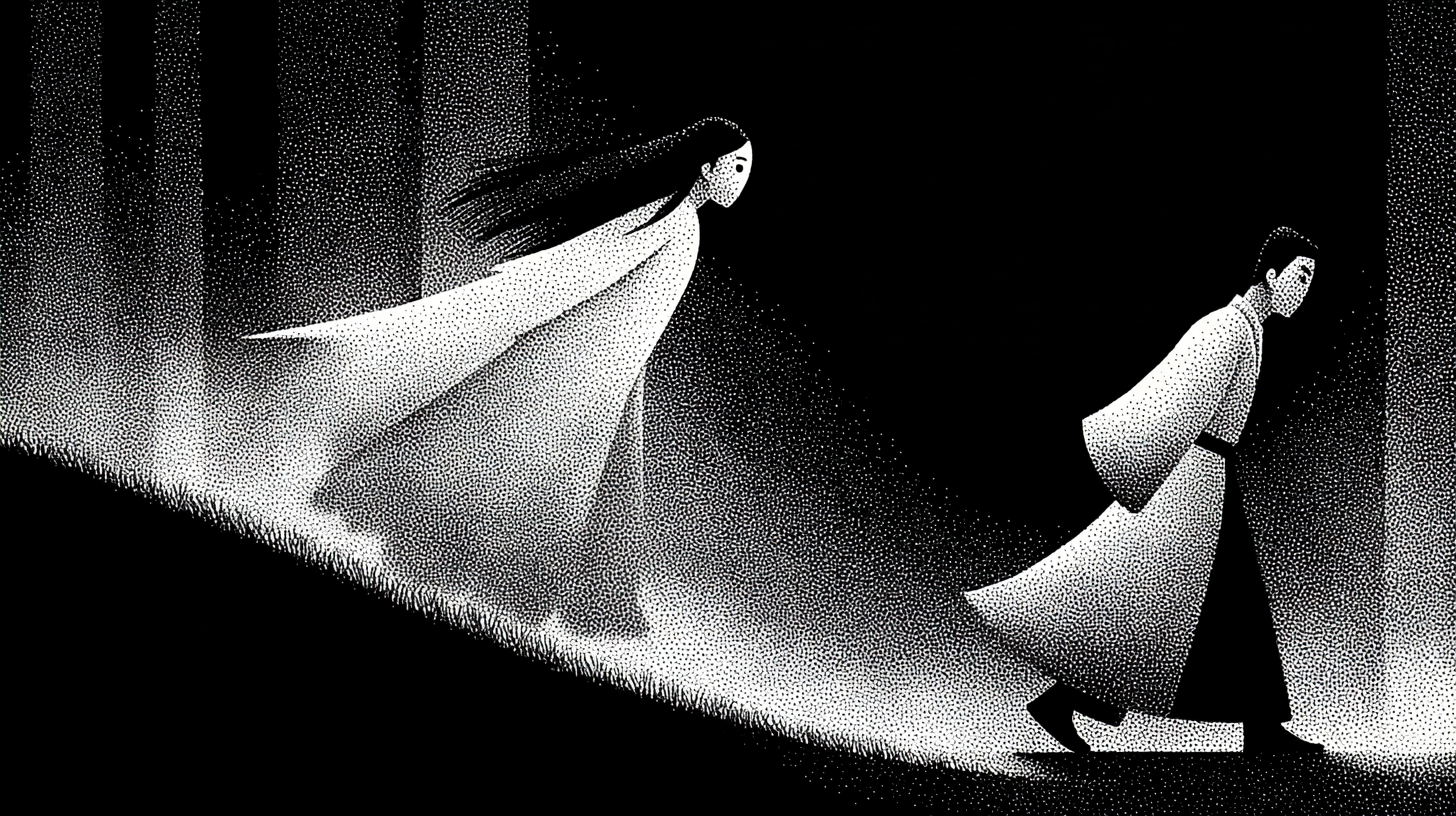
Impossible Love, Rewritten as Farce
In earlier Korean literature, 시애설화 (屍愛說話, siaeseolhwa), or corpse-love tales, posed a chilling question:
What if the person you love turns out to be dead?
By the late eighteenth and early nineteenth centuries, however, writers were no longer content with simply frightening readers. They began to manipulate the familiar ghost-lover motif — twisting it into parody, social criticism, even outright farce.
This is where 《종옥전》(鍾玉傳, Jongokjeon, The Tale of Jongok) enters the stage: a short classical novel that appropriates the emotional machinery of siaeseolhwa and deploys it to humiliate a self-righteous scholar and satirize elite male hypocrisy.
To appreciate what Jongokjeon accomplishes, we first require a brief frame for siaeseolhwa.
Siaeseolhwa in Brief: The Grammar of Ghostly Love
Siaeseolhwa are narratives in which:
- A living protagonist (typically a male scholar)
- Enters an intimate or romantic relationship
- With a partner who is already dead — a corpse, ghost, or spirit —
- And only later discovers the horrifying truth
The genre’s defining elements include:
- Transgression: love that violates the boundary between life and death
- Shock: a terrifying revelation when the beloved’s death is exposed
- Collapse: the living partner’s descent into madness, despair, or death
Emotionally, these tales explore the refusal to accept finality — the insistence that even death cannot sever a bond of love.
(For a comprehensive treatment of siaeseolhwa’s origins and evolution, see our previous Kwaidanote articles: “When the Dead Fall in Love” and “Corpse-Love Tales and The Nine Cloud Dream.“)
By the late Joseon period, these motifs had become so thoroughly codified that writers could quote them, parody them, and invert them — which is precisely what transpires in Jongokjeon.
What Is Jongokjeon?
3.1. The Work and Its Author
| Title | 《종옥전》(鍾玉傳, Jongokjeon) — The Tale of Jongok |
| Author | Mok Tae-rim (목태림, 睦台林) |
| Date | 1803, during King Sunjo’s reign |
| Language | Classical Chinese (hanmun, 漢文) |
| Structure | One volume, five chapters (jangho, 章回) in extant editions |
The work survives in at least two principal manuscript lineages:
- A Tōyō Bunko (東洋文庫, Japan) manuscript, containing Mok Tae-rim’s preface and explicit five-chapter divisions
- A Cho Chun-ho (趙春鎬) manuscript, lacking the preface and chapter headings
Critics classify Jongokjeon within several overlapping categories:
- 세태소설 (世態小說, setae soseol) — “novel of worldly manners,” depicting the customs and vices of its era
- 훼절소설 (毁節小說, hoejeol soseol) — literally “novel of ruined chastity,” typically satirizing moral pretensions
Thematically, it belongs alongside works such as Oyoranjeon (烏有蘭傳, The Tale of Oyoran) and Baebijangjeon (裵裨將傳, The Tale of Vice-Commander Bae), which similarly target elite male sexuality and hypocrisy.
Plot Overview: The Systematic Demolition of a Virtuous Facade
At the center of Jongokjeon stands Jongok (鍾玉), a young man almost theatrically averse to women.
4.1. A Scholar Who Refuses Marriage
During King Yeongjo’s reign, in Yangju (楊州, near present-day Seoul), a scholar named Kim Seong-jin (金成鎭), also known as Kim Gong (金公), raises his brother’s only son, Jongok, as if he were his own.
Jongok matures into a young man who is:
- Intellectually brilliant
- Intensely devoted to classical study
- Conspicuously uninterested in women
When his father writes to announce that an advantageous marriage has been arranged and summons him to the capital, Jongok declines:
Not until I have fully mastered my studies and passed the civil examinations will I consider marriage.
His stance appears admirably principled — a man of learning elevated above sensual desire.
4.2. The Test: Enter Hyangnan, the Courtesan
Kim Gong grows suspicious. Is this genuine virtue, or merely theatrical self-presentation?
To ascertain the truth, he devises an experiment:
- He summons Hyangnan (香蘭), a talented courtesan
- And instructs her to test Jongok’s resolve
Hyangnan approaches Jongok repeatedly, deploying all the refined skills of a professional entertainer. Initially, he proves impervious — unmoved, aloof, impeccably proper.
But gradually, his resistance shifts from moral certainty to anxious rationalization:
If I persist in rejecting her, she might perish from grief. Would that not constitute cruelty?
Under the guise of compassion, he yields and accepts her.
Hyangnan reports everything to Kim Gong. The ostensible “paragon of chastity” has failed his examination.
4.3. Death, Ghost, and Double Life
The uncle now escalates the experiment.
He summons Jongok and informs him gravely that his father has fallen critically ill; he must return to the capital immediately. Jongok departs, only to be intercepted en route by a servant bearing a new letter:
- His father has miraculously recovered
- He is to turn back and resume his studies
Jongok returns to Wonju (原州) — only to learn that Hyangnan has suddenly died of illness.
Overcome with grief, he mourns at her grave. That night, she appears in his chamber.
From that point forward:
- Hyangnan visits him night after night, exactly as when alive
- They converse, laugh, and share the bed as before
- For Jongok, she has become a ghost lover, and his existence transforms into a clandestine double life
One evening, Hyangnan calmly explains:
- She has become a spirit-woman (귀녀, gwinyeo)
- By sleeping with her, Jongok has likewise become a kind of “living ghost” (혼귀, hon’gwi)
- Ordinary mortals can no longer perceive him clearly
When he walks through the compound by day, household servants indeed pass by as though he were invisible. Convinced that he now inhabits a liminal state between life and death, Jongok surrenders himself to nights of pleasure, roaming and feasting with Hyangnan in what he believes is spectral freedom.
4.4. Public Humiliation at the Village Banquet
On the Double Ninth Festival (重陽節, Chungyangjol), Kim Gong hosts a grand banquet for the entire village.
Hyangnan urges Jongok:
Let us attend the banquet and sample the delicacies on your uncle’s table.
Believing himself invisible, Jongok strolls into the gathering and boldly consumes dishes set before Kim Gong — in full view of the assembled guests.
To everyone present, he is entirely visible.
Kim Gong erupts in fury at his nephew’s outrageous behavior. Startled, Jongok searches frantically for Hyangnan.
She has vanished.
In that instant, he realizes:
- He has been deceived by a demon (or so he believes)
- He has made himself a laughingstock before family and community
He confesses everything — his affair with Hyangnan, his belief that she had died, the nightly visitations, his conviction that he had become half-ghost.
At this point, Kim Gong summons someone from behind a folding screen.
It is Hyangnan, very much alive.
The entire ghost episode has been an elaborate staged lesson. The uncle orchestrated the “death,” the spectral visits, the invisibility ruse — all to expose Jongok’s inner contradictions.
Rather than punishing them, Kim Gong laughs, blesses their union, and wishes the couple a long and happy life together.
The “corpse-love” has evaporated into pure farce.