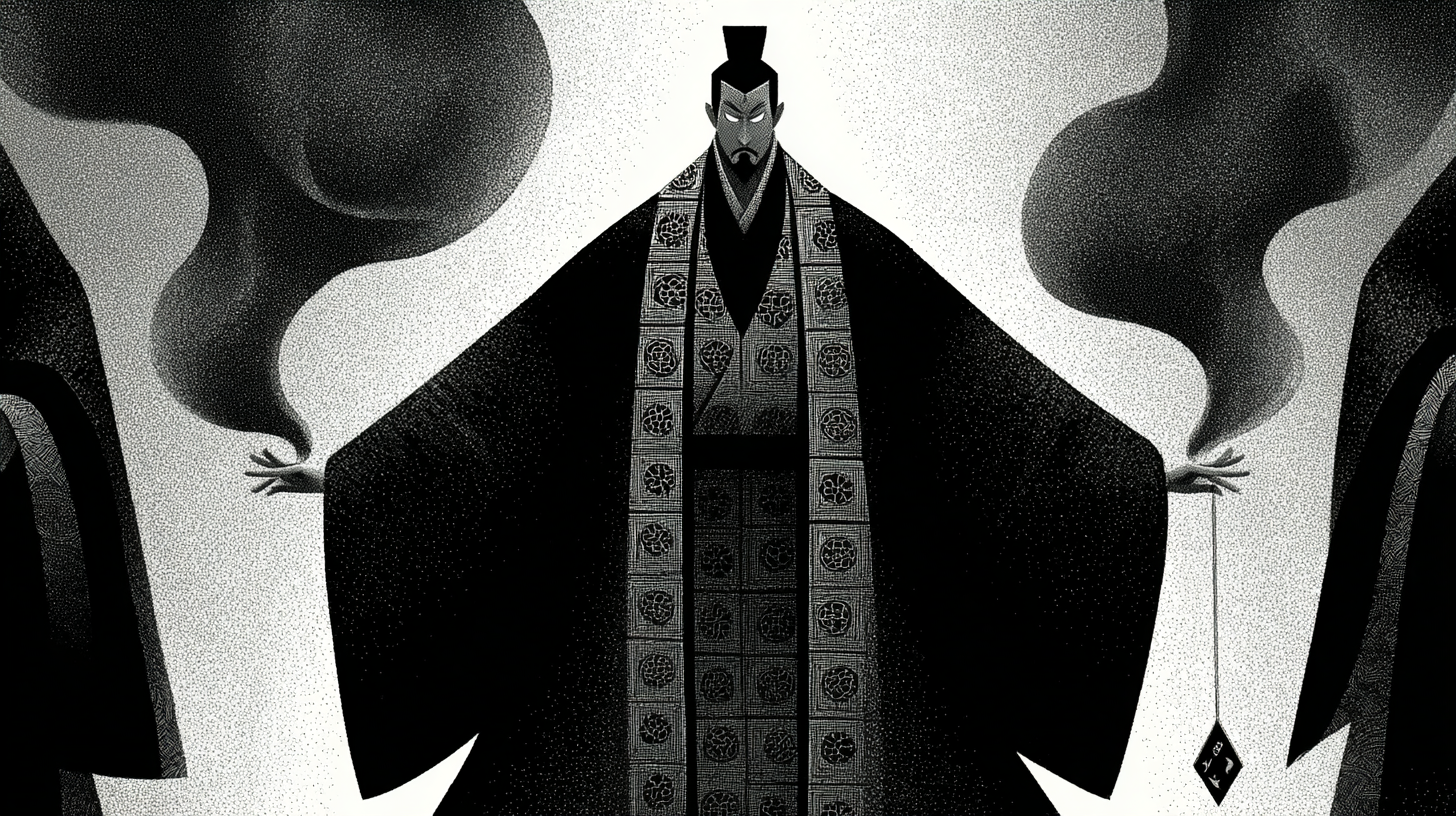
Long before anime and video games made onmyōji household names, these mysterious figures wielded actual influence over emperors and aristocrats in ancient Japan. They weren’t just fortune-tellers—they were the imperial court’s frontline defense against supernatural threats, cosmic imbalances, and the unpredictable whims of fate. But what exactly did they do? What were the spells, the rituals, the strange tools of their trade?
This guide walks you through the authentic techniques of onmyōdō (陰陽道, “The Way of Yin and Yang”)—the real practices that inspired centuries of legends.
Rituals: Ceremonies for Gods and the Underworld
Onmyōji weren’t simply casting spells in dark rooms. Their most powerful work happened through elaborate ceremonies addressed to cosmic deities. These rituals were classified into dai, chū, and shō (大・中・小法)—great, medium, and minor rites—depending on their scale and purpose.
Taizan Fukun Sai: The Ritual of Lord Taizan
The crown jewel of onmyōdō ceremonies. Taizan Fukun (泰山府君) is the lord of Mount Tai in China, a deity who governs human lifespans and judges the dead. In Japanese practice, he became identified with Enma, the Great King of Hell.
This ritual allowed practitioners to petition for extended life, protection from calamity, or—in legendary accounts—even resurrection. The famous onmyōji Abe no Seimei reportedly used this ceremony to bring his own murdered father back to life. Imperial families commissioned it regularly, believing it could add years to their reign.
The ritual involved addressing not just Taizan Fukun but twelve deities of the underworld collectively, presenting offerings, and reciting elaborate invocations. Its power was considered so significant that the Tsuchimikado family (descendants of Seimei) kept it as a closely guarded secret for generations.
Tensō Chifu Sai: The Rite of Heaven and Earth
Performed at each imperial enthronement, this ceremony ensured cosmic harmony between the new sovereign and the spiritual realm. It represented the onmyōji’s role as intermediaries between the earthly court and celestial powers.
Tsuina (Nuo Ritual): Banishing Demons at Year’s End
You know Setsubun, when Japanese people throw beans and shout “Oni wa soto!” (“Demons out!”)? That tradition descends directly from tsuina (儺祭), an ancient court ceremony where onmyōji would formally expel evil spirits before the new year. Historical records describe the onmyōji ascending a ritual platform to read the saimon (祭文)—a ceremonial text written half in classical Chinese and half in the native senmyō style, combining foreign mystical authority with Japanese spiritual tradition.
Other Major Ceremonies
The medieval text Bunkanshō catalogs dozens of onmyōdō rituals, each targeting specific cosmic forces:
- Gotei Shikai Jinsai (五帝四海神祭): Invoking the Five Emperors and gods of the four seas
- Hokkyoku Genkū Sai (北極玄宮祭): Petitioning the spirits of the North Star
- Sanman Rokusen Jinsai (三万六千神祭): Addressing the 36,000 spirits
- Shōkon Sai (招魂祭): Summoning and pacifying wandering souls
- Reiki Dōdan Sai (霊気道断祭): Severing paths of harmful spiritual energy
Incantations: The Power of Spoken Words
Kuji: The Nine Syllables
Perhaps no onmyōdō technique has captured popular imagination quite like kuji (九字). The standard formula runs: 臨・兵・闘・者・皆・陣・列・在・前 (Rin, Pyō, Tō, Sha, Kai, Jin, Retsu, Zai, Zen)—roughly meaning “Soldiers arrayed before me, all in formation.”
The earliest recorded version appears in the Chinese Taoist text Baopuzi by Ge Hong (4th century CE), where it was prescribed for protection when entering mountains. Japanese practice added two distinctive elements:
Kuji-kiri (九字切り): The practitioner draws a grid in the air—five horizontal strokes alternating with four vertical ones—while reciting each syllable. This creates a kind of protective lattice, cutting off demonic influences. In onmyōdō folk magic, practitioners would draw this grid over written words or images to gain power over what they represented. A sailor might trace it over the character for “sea” to prevent drowning.
Kuji-in (九字印): Hand gestures (mudra) accompanying each syllable. While these originated in esoteric Buddhism, onmyōdō developed its own variants. Interestingly, onmyōdō texts from the Kamakura period record a different nine-syllable formula for the henbai walking ritual: “Blue Dragon, White Tiger, Vermillion Bird, Black Tortoise, Void Formation, Southern Longevity, Northern Dipper, Three Bodies, Jade Maiden”—invoking the four directional guardian spirits and other cosmic powers.
The nine syllables follow yin-yang principles: five yang syllables (offensive, absolute) and four yin syllables (defensive, protective). This balance of cosmic forces was considered essential to the spell’s effectiveness.
Kyūkyū Nyoritsuryō: “Swiftly, as the Law Commands!”
This phrase (急急如律令) originated as bureaucratic shorthand on Han Dynasty Chinese documents—essentially “Execute immediately per regulations.” Somehow it migrated from paperwork to magic, becoming a standard closing formula for spells meaning “Begone at once!” Archaeologists have found it inscribed on wooden tablets from Japan’s Fujiwara-kyō capital, dating to the Nara period (8th century), proving that it was already being used for magical purposes over 1,200 years ago.
The phrase appears across onmyōdō, esoteric Buddhism, and Shugendō mountain asceticism—a rare formula shared by multiple Japanese mystical traditions.
Divination Instruments: Reading Heaven and Earth
Rikujin Shikiban: The Cosmic Divination Board
This was the onmyōji’s essential tool—a two-part device representing the universe in miniature.
The square base (yo, 輿) represents Earth, inscribed with the 28 lunar mansions, 10 celestial stems, 12 earthly branches, and the eight trigrams at its corners. The round upper disc (kan, 堪) represents Heaven, marked with the Twelve Monthly Generals and other celestial indicators.
By rotating the Heaven disc to align with the Earth base in specific configurations, the onmyōji could perform rapid calculations about auspicious timing and directions—essentially a portable computer for cosmic mathematics.
But here’s where it gets interesting: proper construction required specific materials. The Earth base had to be carved from jujube wood that had been struck by lightning. The Heaven disc required fūjin—a special burl that grows on Chinese sweetgum trees. Whether these requirements were purely symbolic or reflected some believed spiritual conductivity, they elevated the board from mere tool to sacred object.
Kontengi: The Armillary Sphere
For tracking celestial anomalies, onmyōji used armillary spheres—ringed instruments modeling the movements of stars and planets. Their primary concern? Comets. The appearance of a “broom star” (hōkiboshi) was considered a serious omen of disaster, and onmyōji were responsible for detecting and interpreting such phenomena for the court.
Talismans: Written Magic
The Seiman and Dōman: Twin Symbols of Power
Visit Kyoto’s Seimei Shrine today and you’ll find pentagrams everywhere—on the gates, lanterns, amulets, even the well. This five-pointed star is the Seiman (晴明紋), the personal seal of Abe no Seimei, Japan’s most legendary onmyōji.
The pentagram represents the five Chinese elements (Wood, Fire, Earth, Metal, Water) in their generative cycle. Called gobōsei in Japanese, it may have entered onmyōdō through Taoist or esoteric Buddhist channels. Regardless of origin, it became Seimei’s signature symbol.
Its counterpart is the Dōman (道満)—a grid of nine squares (like a tic-tac-toe board) associated with Seimei’s rival Ashiya Dōman. Together, the Seiman and Dōman represent the fundamental duality of onmyōdō practice.
Japanese ama (female divers) in some coastal regions still paint these symbols on their equipment, believing them to ward off sharks and evil spirits—a living trace of onmyōdō in folk practice.
Chintaku Reifushin: The 72 Talismans for Protecting the Home
This collection of 72 protective seals originated in Taoist China and entered Japan during the medieval period. The source text, Taijō Hihō Chintaku Reifu, was embraced not only by onmyōji but also by Buddhist temples and Shinto shrines.
The presiding deity of these talismans, Chintaku Reifushin (鎮宅霊符神), traces back to the Chinese Xuanwu/Zhenwu (the Black Warrior of the North). In Japan, he merged with Myōken Bosatsu, the bodhisattva of the North Star, creating a fascinating case of Sino-Japanese religious fusion.
During the Edo period, shrines would print all 72 talismans on a single sheet for household protection. Famous warriors like Kusunoki Masashige and Katō Kiyomasa were reportedly devoted to this cult. You can still find shrines dedicated to Chintaku Reifushin throughout the Kansai region, including at Osaka Tenmangu and Hoshida Myōken-gū.
Other Talisman Types
Onmyōji employed various other protective symbols:
- Kagome (籠目): The basket-weave hexagram pattern
- Uzumaki (渦巻): Spirals representing cosmic energy flow
- Batsu (×): Cross marks for sealing and binding
- Various talismans inscribed with “Kyūkyū Nyoritsuryō” in brushwork
The history of Japanese talismans remains partially mysterious—few early examples survived, though archaeological finds at Fujiwara-kyō confirm their use by at least the 8th century.
Ritual Techniques: The Body as Instrument
Hitogata: The Human-Shaped Proxy
Made from paper, wood, straw, or grass, hitogata (人形) are figures cut in human shape. In purification rituals, you rub one against your body to transfer spiritual pollution, then cast it into running water. This is the origin of nagashi-bina, the practice of floating dolls on rivers—which eventually evolved into the Hinamatsuri doll festival.
But hitogata had darker applications. Write someone’s name on one, then damage it, and you’ve created a curse. Bind two hitogata together with the right prayers, and you’ve cast a love spell. The infamous ushi no koku mairi (midnight shrine visits to curse enemies) uses straw effigies descended from this tradition.
Shikigami: Summoned Servants
The shikigami (式神) is perhaps onmyōdō’s most famous concept—spirits bound to serve a practitioner. The name itself is debated: some connect it to the shikiban divination board, others to esoteric Buddhist gohō dōji (protective child-spirits).
What’s clear is that shikigami required serious skill to control. Historical accounts typically describe them as invisible, though they could be bound to paper dolls or animal forms. A master onmyōji like Seimei supposedly commanded them effortlessly, using them as messengers, spies, or guardians.
But beware: shikigami that escaped control could turn on their masters. Their power was directly linked to the practitioner’s spiritual strength—summon beyond your ability, and the consequences could be fatal.
Uho: The Steps of Yu
This walking technique (uho, 禹歩) involves a distinctive shuffling gait while reciting incantations. The basic pattern traces the Big Dipper constellation, though variants follow the nine-star arrangement of kyūgū hakke cosmology or draw protective symbols on the ground.
The name references Yu the Great, the legendary Chinese emperor who tamed the floods. After traversing all of China to control the waters, Yu’s legs were said to have been damaged, leaving him with a distinctive shuffle. Onmyōji adopted this mythical gait for rituals intended to suppress earth spirits, dispel evil, and invite good fortune.
Ge Hong’s Baopuzi prescribes it for entering mountains to gather herbs—suggesting it originated as protection magic for travelers in dangerous terrain.
Henbai: The Departure Ritual
When someone important was about to travel—an emperor, a regent, a high noble—the onmyōji would perform henbai (反閇) at the gate. This ceremony began by summoning the Jade Maiden (gyokujō) through uho steps, then stating the journey’s purpose and requesting protection. The ritual concluded with six steps forward without looking back.
The traveler would then depart, spiritually armored against whatever lay ahead.
Migatame: Fortifying the Body
A category of protective techniques for strengthening one’s spiritual defenses. Historical records mention Tokugawa Ieyasu receiving migatame before battle, with the onmyōji reportedly inscribing the nine-syllable spell directly onto his skin.
A Living Legacy
Walk through a Setsubun festival, watch families float dolls on rivers, see the star-marked amulets at Seimei Shrine—these aren’t museum curiosities. They’re living fragments of onmyōdō practice, embedded in Japanese culture so deeply that most people don’t recognize their origins.
The onmyōji themselves vanished as an official profession in 1870, casualties of Meiji modernization. But their techniques, filtered through centuries of folk practice, Shinto absorption, and popular imagination, remain. Every anime sorcerer drawing pentagrams, every game character summoning shikigami, every horror movie featuring paper dolls—they’re all echoing practices that once commanded the attention of emperors.
The real onmyōji weren’t the dramatic figures of fiction. They were civil servants, calendar-makers, and interpreters of cosmic patterns. But within their bureaucratic roles, they preserved and practiced a remarkable synthesis of Chinese cosmology, Buddhist mysticism, and Japanese spirituality—a synthesis whose traces still mark the landscape of Japan today.
For more on who the onmyōji were and how they rose to prominence, see our companion article: “Onmyōji: Who Were Japan’s Imperial Sorcerers?”
References
- Masuo Shin’ichirō , “Chinese Religion and the Formation of Onmyōdō”: Japanese Journal of Religious Studies 40/1 (2013): 19–43
- Yanagihara, “Onmyōdō in the Muromachi Period” Japanese Journal of Religious Studies 40/1 (2013)
- “Onmyōdō” – Wikipedia
- “Onmyōji” – Wikipedia
- “Abe no Seimei” – Wikipedia
Latest Posts
- The Emperor Who Became Japan’s Most Feared DemonWhy This Story Among Japan’s countless supernatural tales, few carry the weight of actual historical documentation quite like the story of Emperor… Read more: The Emperor Who Became Japan’s Most Feared Demon
- Why Korea’s Greatest Geomancer Couldn’t Find a Burial Site—And What That Tells Us About KarmaWhy This Story While many pungsu (Korean geomancy) folktales focus on the mechanics of finding auspicious land, this one asks a more… Read more: Why Korea’s Greatest Geomancer Couldn’t Find a Burial Site—And What That Tells Us About Karma
- The Matsutooya Haunting: When Two Living Spirits Turned Deadly in Edo-Period KyotoWhy This Story I first encountered this account while researching documented cases of ikiryō—living spirits—in Edo-period records, and it immediately stood out… Read more: The Matsutooya Haunting: When Two Living Spirits Turned Deadly in Edo-Period Kyoto