Why This Story Caught My Attention
I’ve spent considerable time working with Korean folktales, and the Cheoyong narrative stands out for reasons that go beyond its surface strangeness. When adapting this tale for English-speaking audiences, I made several adjustments to help with narrative flow and cultural accessibility—things like restructuring certain sequences for dramatic effect and providing context that Korean readers would instinctively understand. But here’s what’s fascinating: despite these adaptations, the story’s essential DNA remains completely intact. The core message about restraint conquering rage, about dignity defeating darkness, translates with surprising power across cultures.
What drew me personally to this particular legend is its radical subversion of the hero’s journey. We’re so conditioned to expect confrontation—the brave warrior who slays the monster, the clever hero who outwits the villain. But Cheoyong simply… dances. And somehow, that’s enough. That choice—to respond to betrayal with art rather than violence—feels both ancient and strangely contemporary. It’s the kind of cultural wisdom that makes you reconsider what power actually looks like.
A Tale of Restraint and Its Supernatural Consequences
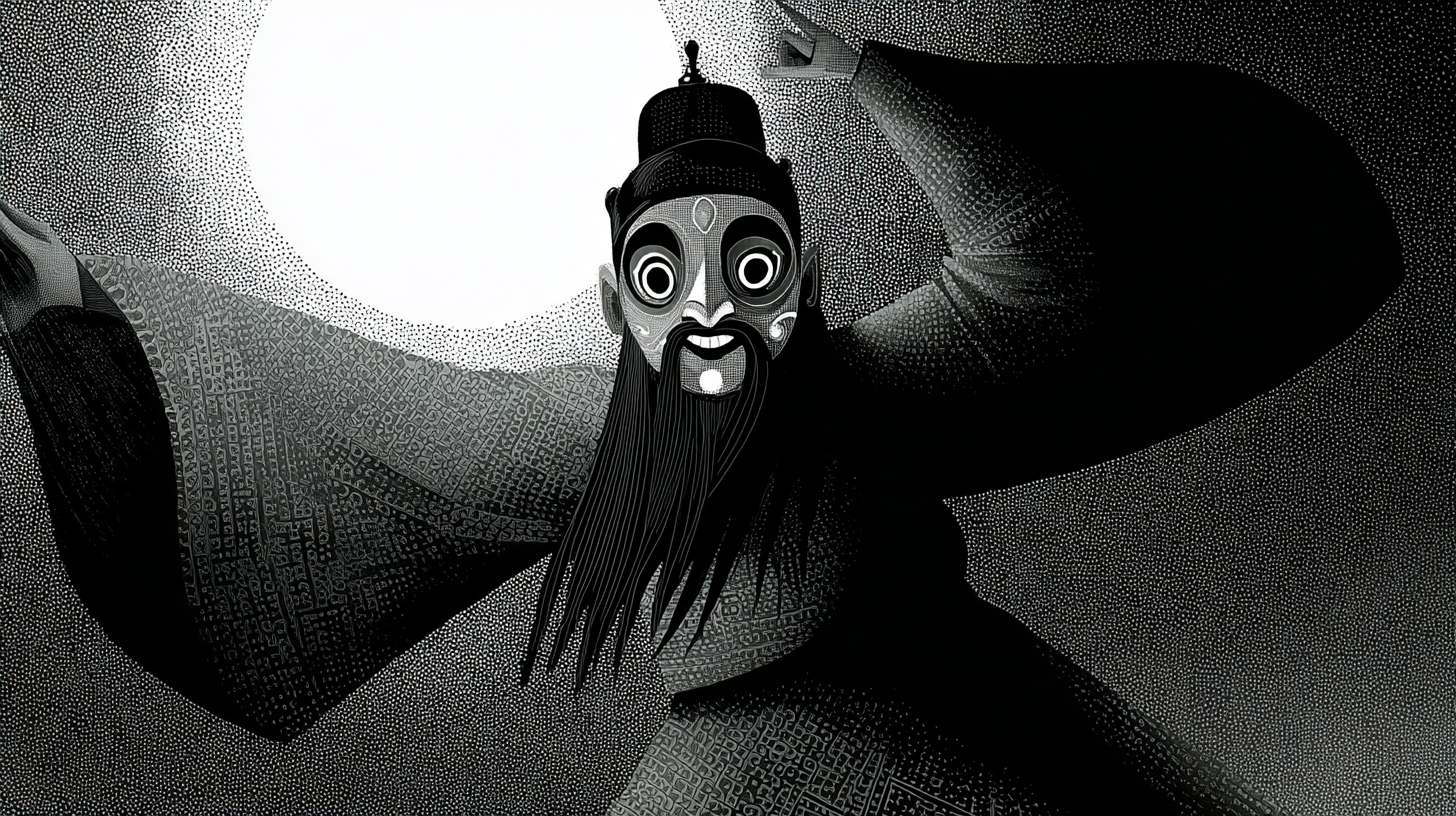
Picture this: A being born of the sea serves at a human king’s court, married to a woman so beautiful that even spirits cannot resist her. When a demon of pestilence violates his marriage bed, this dragon’s son does the unthinkable—he neither attacks nor accuses. Instead, he performs a dance so graceful, sings a song so accepting, that the demon itself is overwhelmed with shame and vows never to enter any home bearing his image.
This is the Cheoyong legend from Korea’s Unified Silla period (875-886 CE), and it became the foundation for one of Korea’s most enduring folk practices: the protective talisman.
The Historical Context
The Cheoyong narrative appears in the Samguk Yusa (Memorabilia of the Three Kingdoms), compiled by the Buddhist monk Ilyeon in the thirteenth century. The story is set during the reign of King Heongang, a period characterized by surface prosperity concealing deeper structural problems within the Silla kingdom. This wasn’t just any era—it was the calm before the storm, the last gasp of unified Korean rule before the peninsula fractured into the Later Three Kingdoms period.
The tale begins at Gaewunpo, a harbor along what is now Ulsan’s coast. King Heongang, traveling with his retinue, encounters supernatural darkness—fog so thick his party loses all sense of direction. A court astronomer identifies this as the Dragon King’s doing and suggests the king must perform a virtuous act. The king promises to build a temple, and the darkness lifts. In gratitude, the Dragon King appears with seven sons, performing a dance of thanksgiving. One son—Cheoyong—follows the king back to the capital.
At court, Cheoyong receives a position, a beautiful wife, and the king’s favor. But his wife’s extraordinary beauty attracts unwanted attention from a yeoksin—a pestilence spirit that spreads disease and misfortune. The spirit assumes human form and sleeps with Cheoyong’s wife.
When Cheoyong discovers them together, he doesn’t rage or attack. Instead, he performs what would become one of Korea’s most famous poems, the Cheoyong-ga: “Under the bright moon of the capital / I wandered and played until late. / Returning home, I looked at my bed— / Four legs I saw there… / Two are mine, / Two belong to another. / Once they were mine alone, / But what has been taken—how can I reclaim it?”
The demon, confronted not with violence but with this profound acceptance, reveals its true form and prostrates itself before Cheoyong, promising never to enter any dwelling that displays his image.
The Cultural Impact
What makes this story particularly significant is how it transformed Korean folk practice. From the Goryeo Dynasty (918-1392) onward, Korean households displayed images of Cheoyong on gates and doorways as protective talismans—a practice called byeoksa (벽사, “warding off evil”). The belief was simple but powerful: Cheoyong’s image alone could repel disease and misfortune.
The tale also spawned Cheoyong-mu (處容舞), an elaborate court dance that evolved over centuries. What began as a solo performance in Unified Silla became a pair dance in Goryeo, then transformed into the “Five-Direction Cheoyong Dance” during Korea’s Joseon Dynasty (1392-1897), incorporating principles from yin-yang and five-element philosophy. In 2009, UNESCO designated Cheoyong-mu as Intangible Cultural Heritage, recognizing its thousand-year continuous tradition.
The Mystery of Cheoyong’s Identity
Here’s where things get really interesting: nobody quite agrees on who—or what—Cheoyong actually was.
Theory One: The Apotropaic Mask Deity Some scholars argue that Cheoyong represents the personification of protective masks that ancient Koreans hung on their doors to ward off evil. In this interpretation, the legend emerged to explain an existing folk practice—a mythological backstory for why these masks worked.