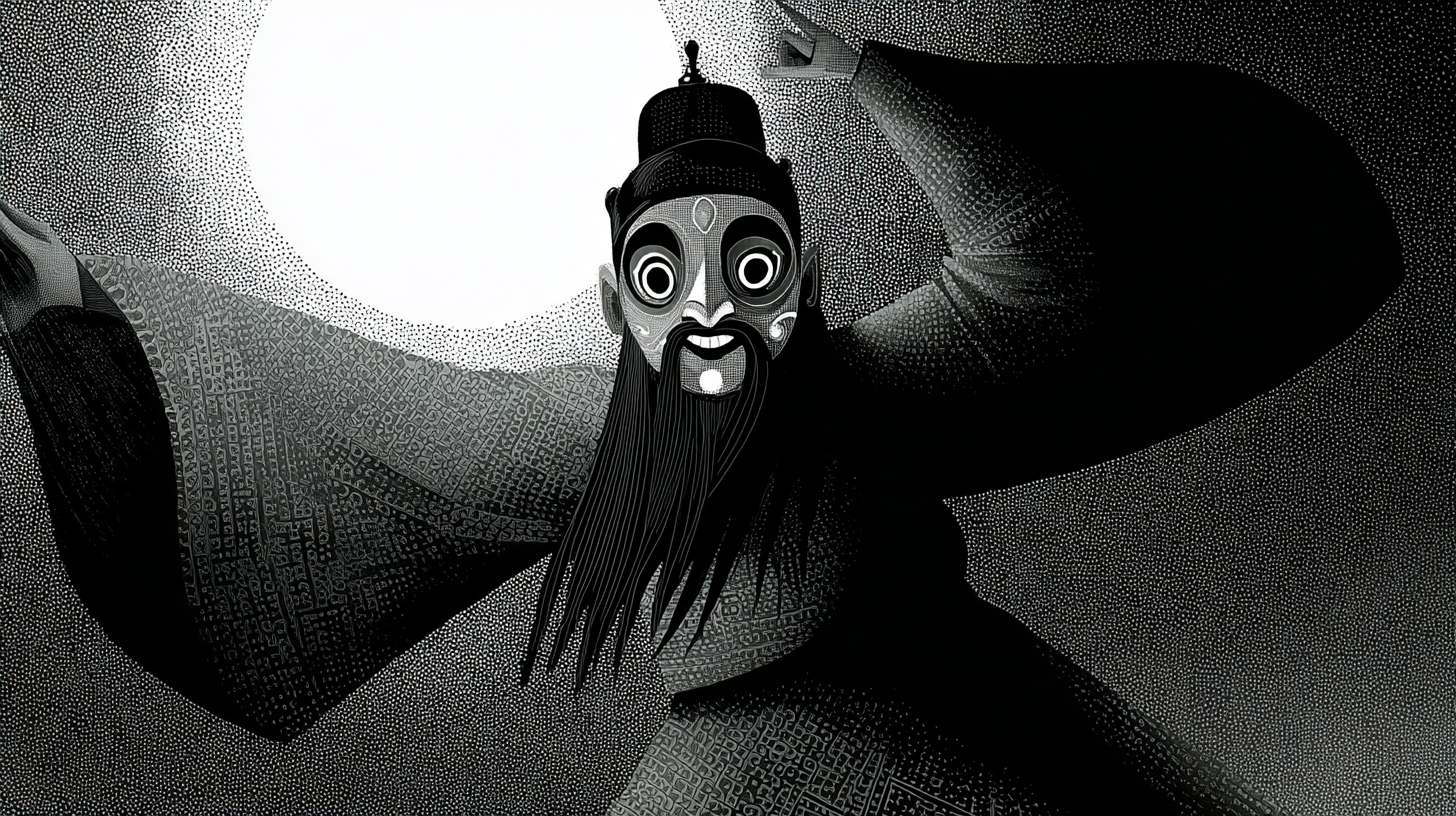
Theory Two: The Political Hostage Others suggest Cheoyong was the son of a local chieftain from Ulsan, sent to the capital as a jilcha (質子)—essentially a high-status hostage meant to ensure a region’s loyalty to the crown. The “Dragon King” would then be metaphorical language for a powerful regional leader.
Theory Three: The Foreign Merchant This is perhaps the most intriguing theory. Historical records show that Arab and Persian merchants regularly visited Silla ports during this period. Some scholars point to Cheoyong’s described appearance in historical texts—unusual features, exotic clothing—as evidence he may have been a Middle Eastern trader. The 2010 discovery of references in the Persian epic Kushnama to Sasanian refugees reaching “Silla” after the seventh-century Arab conquest has added fuel to this theory. The Kushnama describes Persian prince Abiteen arriving in Silla, being received by the king’s son at the harbor, and marrying a Silla princess—remarkably similar to Cheoyong’s story structure.
Theory Four: The Hwarang Warrior Some interpret Cheoyong as a member of the hwarang (花郞), Silla’s elite class of warrior-scholars. The title “Cheoyong-rang” (處容郞) in the original text uses the same honorific applied to hwarang members.
Theory Five: The Shaman Given the tale’s emphasis on supernatural intervention and ritual dance, some folklorists identify Cheoyong as a mudang (shaman) or the divine patron of shamans—someone whose role was to mediate between human and spirit realms.
The truth? We’ll probably never know definitively. But this multiplicity of interpretations reveals something important: Cheoyong existed at the intersection of multiple worlds—sea and land, foreign and domestic, divine and human, spiritual and political power.
The Buddhist Subtext
What often gets overlooked in Western retellings is the profound Buddhist philosophy embedded in Cheoyong’s response. The original hyangga poem he performs isn’t just about acceptance—it’s about recognizing the illusory nature of possession itself.
“Once they were mine alone, / But what has been taken—how can I reclaim it?”
This isn’t passive resignation; it’s active non-attachment. Cheoyong realizes that his anger stems from the concept of “mine”—a conceptual prison that Buddhist thought seeks to escape. By releasing his claim to ownership (of his wife, of his betrayed honor, of his right to vengeance), he achieves something the demon cannot comprehend: freedom from suffering through non-grasping.
The demon’s response isn’t just shame at Cheoyong’s restraint—it’s a recognition of spiritual superiority. In Buddhist cosmology, spirits and demons are trapped in cycles of desire and attachment. Cheoyong’s demonstration of non-attachment represents an evolutionary leap the demon cannot match, which is precisely why it bows.
From Ritual to Ridicule: The Cheoyong Controversy
In contemporary Korea, the Cheoyong legend has become unexpectedly controversial. Every autumn, the city of Ulsan hosts the Cheoyong Culture Festival, celebrating their city’s connection to the tale. However, some conservative Christian groups have repeatedly called for the festival’s cancellation or renaming, arguing that Cheoyong promotes inappropriate behavior and represents “pagan” religious practices.
This tension reveals an interesting cultural dynamic: a legend that once unified Korean protective practices has become a flashpoint in debates about religious plurality, traditional culture, and modernization.
The controversy also highlights how differently the story reads across cultural and temporal distances. What medieval Koreans saw as profound restraint and spiritual mastery, some modern critics interpret as problematic passivity. What was once understood as defeating evil through grace gets reframed as “not standing up for oneself.”
The Enduring Legacy
Despite (or perhaps because of) these controversies, Cheoyong remains deeply embedded in Korean cultural memory. His image still appears in folk art, his dance is performed at major cultural events, and the principle he represents—byeoksa-jingyeong (辟邪進慶, “expelling evil and inviting fortune”)—continues to shape Korean approaches to conflict and misfortune.
The tale’s survival over more than a millennium suggests it touches something fundamental about human experience. Perhaps it’s the fantasy that grace can triumph where force fails. Perhaps it’s the hope that our restraint might shame evil into retreat. Or perhaps it’s simply the beautiful image of someone dancing in moonlight, transforming betrayal into art, and in that transformation, discovering a power that violence could never provide.
In an age increasingly defined by confrontation and retaliation, there’s something both ancient and radical about a hero whose greatest weapon is a dance, whose victory comes not from what he does to his enemy, but from what he refuses to become.
Latest Posts
- The Emperor Who Became Japan’s Most Feared DemonThe Abdication Trap In 1141, Toba forced Sutoku to abdicate in favor of a younger prince, Emperor Konoe. The abdication decree contained… Read more: The Emperor Who Became Japan’s Most Feared Demon
- Why Korea’s Greatest Geomancer Couldn’t Find a Burial Site—And What That Tells Us About KarmaThe Interesting Bits They Don’t Tell You Beyond the central narrative, this tale carries several layers worth noting: The Geomancer’s Dilemma Yi… Read more: Why Korea’s Greatest Geomancer Couldn’t Find a Burial Site—And What That Tells Us About Karma
- The Matsutooya Haunting: When Two Living Spirits Turned Deadly in Edo-Period KyotoThe second spirit also eventually regained consciousness and revealed she was still alive. Ashamed and unable to face the boy, she refused… Read more: The Matsutooya Haunting: When Two Living Spirits Turned Deadly in Edo-Period Kyoto