Why This Story
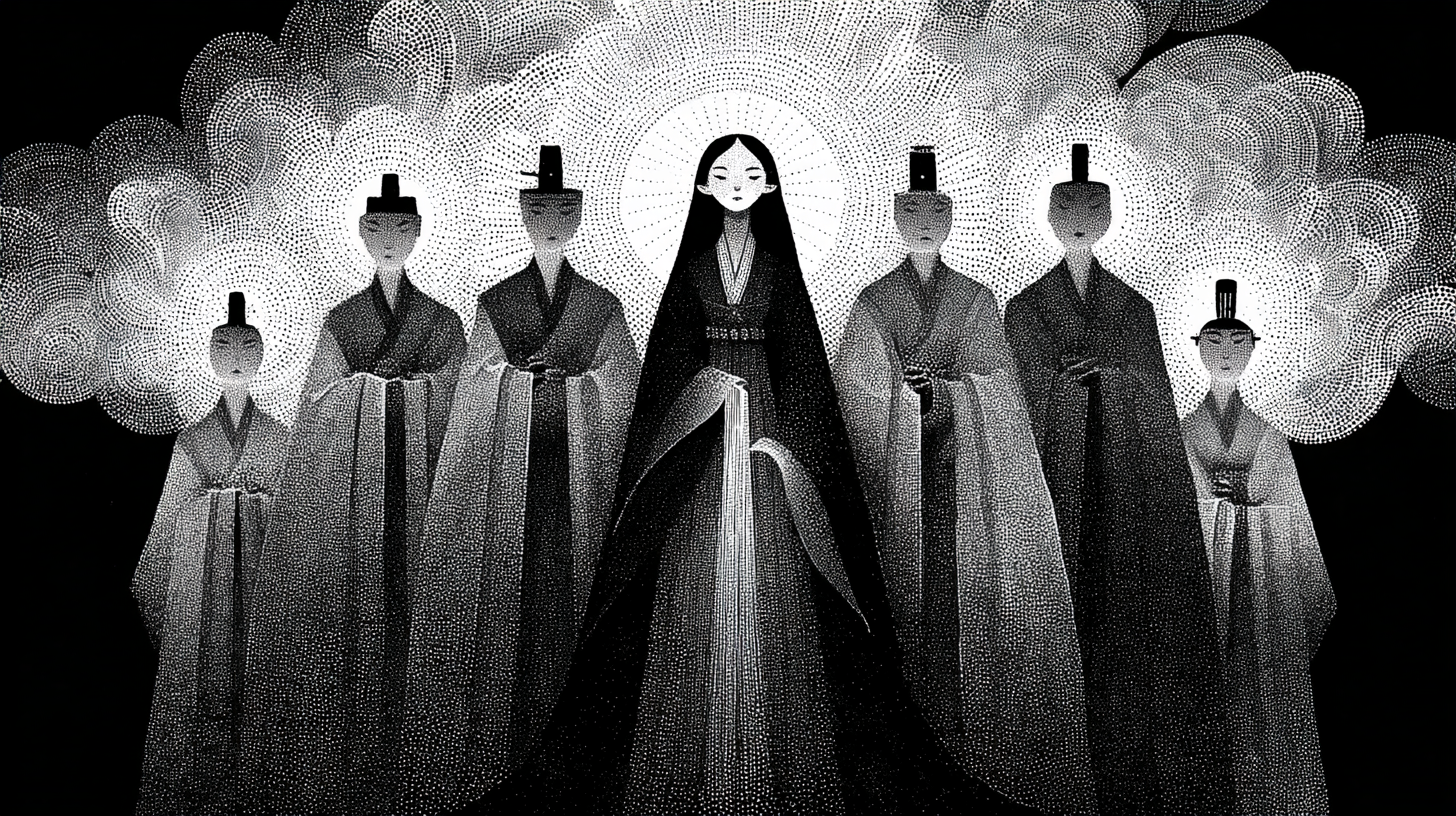
Among the vast archive of Korean supernatural tales, the legend of Princess Bari (바리공주) stands apart—not merely as a ghost story, but as the foundational myth of Korean shamanism itself. She is the Mujo-shin (巫祖神), the ancestral deity of all Korean shamans, and her narrative has been sung during funeral rites for centuries.
This retelling has been adapted for English-speaking readers. Certain narrative elements have been streamlined for clarity and cultural accessibility, while the essential arc—abandonment, journey, sacrifice, and transcendence—remains unchanged. The core themes that have resonated with Korean audiences for millennia are preserved here: that the discarded can become divine, and that the path to the afterlife requires a guide who has walked it herself.
Overview
What happens when a king throws away his seventh daughter simply because she wasn’t a son—and that daughter grows up to be the only person capable of saving him?
The myth of Princess Bari is a story that defies its era. Born into a world that valued sons above all else, Bari was cast out at birth, raised in poverty, and forgotten by the royal court. Yet when an incurable disease struck the king, it was this abandoned princess—not her six favored sisters—who volunteered to travel to the realm of the dead to retrieve the only cure.
Her journey took her through the underworld itself. The price she paid along the way was extraordinary. And what she chose at the end of her quest has made her Korea’s most enduring supernatural figure: the goddess who guides souls safely into the afterlife.
The Myth of Princess Bari
The Prophecy and the King’s Impatience
In the ancient kingdom of Bulla, King Ogu sought to marry Lady Gildae. Before the wedding, he consulted a diviner named Gali Baksa, who delivered a prophecy: if the king married that year, he would father seven daughters; if he waited one more year, he would have three sons.
The king, unwilling to delay, married immediately.
As foretold, the queen gave birth to six daughters in succession. When she became pregnant a seventh time, both parents took hope from an auspicious dream—visions of dragons and sacred turtles suggested a male heir at last. When the seventh child arrived and was revealed to be another daughter, the king ordered the infant to be disposed of.
The queen, devastated but powerless to defy her husband, asked only that the child be given a name before abandonment. She called her “Bari-degi”—meaning “the one thrown away.”
The Jade Box and the Elderly Couple
The infant was placed in a jade box and set adrift on the water. Rather than sinking, the box floated until it was discovered by Birigongdeok, an elderly fisherman, and his wife—a childless couple living in poverty. They took the baby in and raised her as their own.
The old woman gathered milk from village mothers. The old man caught fish to keep the family fed. Despite their circumstances, they raised Bari with devotion.
The child proved unusually perceptive. As she grew, she began asking about her origins, questioning inconsistencies in the explanations her adoptive parents offered. Eventually, they revealed the truth: the jade box, the silk garments inside it, and the embroidered name and birthdate that identified her as a discarded royal daughter.
The King’s Illness and the Impossible Cure
When Bari reached approximately fifteen years of age, King Ogu fell gravely ill. No physician could identify the cause; no medicine provided relief. A wandering sage—some versions describe a Buddhist monk, others a spirit messenger—appeared at court with an explanation: the king was suffering divine punishment for abandoning his child.
The only cure lay in the Western Heaven, the realm of the dead. There, sacred water guarded by a supernatural being could restore the king to health. Someone from his own bloodline would need to retrieve it.
The king summoned his six daughters, each raised in comfort and luxury. One by one, they refused. The excuses varied—fear of the journey, reluctance to leave their husbands, unwillingness to risk their lives for a father they claimed to love.
In desperation, the court dispatched messengers to find the seventh daughter.