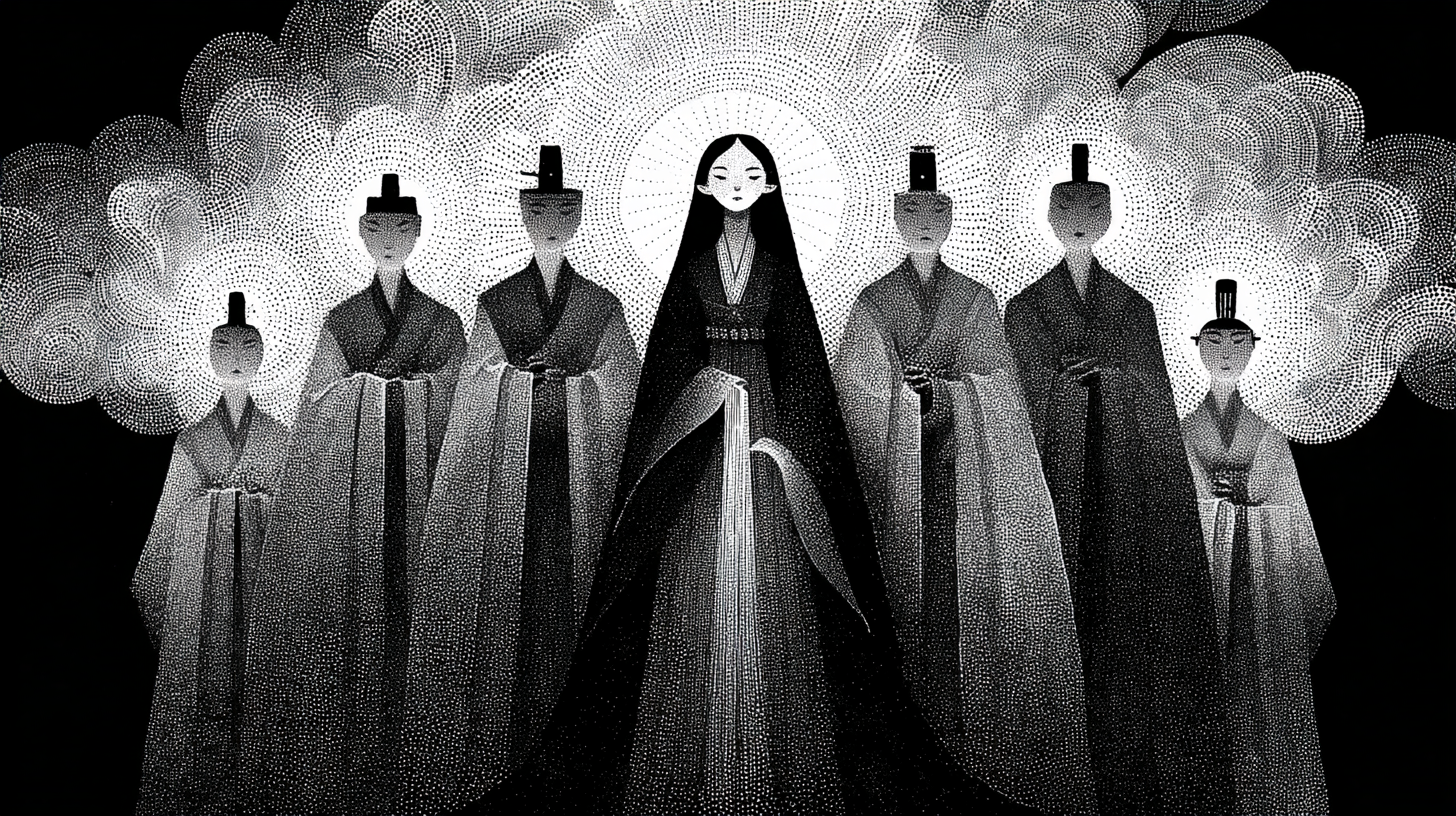
The Journey to the Underworld
When the messenger located Bari and explained the situation, she agreed to go. Her reasoning, as recorded across numerous regional versions of the myth, was straightforward: regardless of how he had treated her, a parent remained a parent. Filial duty did not require reciprocal affection.
Bari traveled to the palace, met her birth family for the first time, and departed for the Western Heaven—a journey that took her through the realm of the dead.
The path required crossing rivers of blood, mountains of knives, and territories governed by infernal judges. Along the way, Bari witnessed souls being transported to their fates: the virtuous carried by golden dragons toward paradise, the wicked dragged in chains toward punishment. She also encountered spirits with nowhere to go—those who had died in childbirth, those whose funerals had been improperly performed, those simply lost. She prayed for them, helping them find release.
The Guardian and His Price
At the source of the sacred water stood a guardian: Mujangseung, a supernatural being who controlled access to the cure.
Bari introduced herself and stated her purpose. Mujangseung acknowledged her request but named his conditions. For nine years, she would serve him: three years gathering firewood, three years tending fire, three years drawing water. Only then would he consider releasing the medicine.
Bari agreed and completed the labor.
Mujangseung then added a second requirement: she must become his wife and bear him seven sons.
Bari agreed to this as well.
After the children were born and she had fulfilled every demand, Bari announced that she needed to return to the living world—her parents were dying. Mujangseung attempted to delay her with offers of scenic diversions. She refused, citing ominous dreams that warned of urgency.
Finally, he revealed something unexpected: she already possessed everything she needed. The water she had drawn for nine years was the sacred water. The plants she had gathered were medicinal herbs capable of restoring sight. The flowers in the garden behind the house could resurrect the dead—one type for flesh, one for bone, one for blood.
Bari gathered her supplies. Mujangseung and their seven sons accompanied her back to the world of the living.
Return and Resurrection
As they emerged from the underworld, Bari encountered woodcutters and asked whose funeral procession she had seen on the road. They told her: both King Ogu and Queen Gildae had died, on the same day, at the same hour.
Bari ran to intercept the funeral. She tore open the coffins, applied the herbs, placed the flowers, and poured the sacred water into her parents’ mouths.
The king and queen awoke.
The Choice
Overwhelmed with gratitude, King Ogu offered Bari half his kingdom. She declined. He offered her immense wealth. She declined again.
What she requested instead was permission for her husband and children to enter the court, recognition for the elderly couple who had raised her, and one final thing: she wished to return to the underworld and become a deity there.
She had seen the lost souls during her journey—spirits wandering without guidance, trapped between worlds. She wanted to help them. Not as a princess, not as a queen, but as a goddess who could lead the dead safely to their final rest.
Her request was granted. Princess Bari descended once more into the realm of the dead and became Ogu-shin: the deity who presides over the passage of souls, the protector of the deceased, and the ancestor of all Korean shamans.