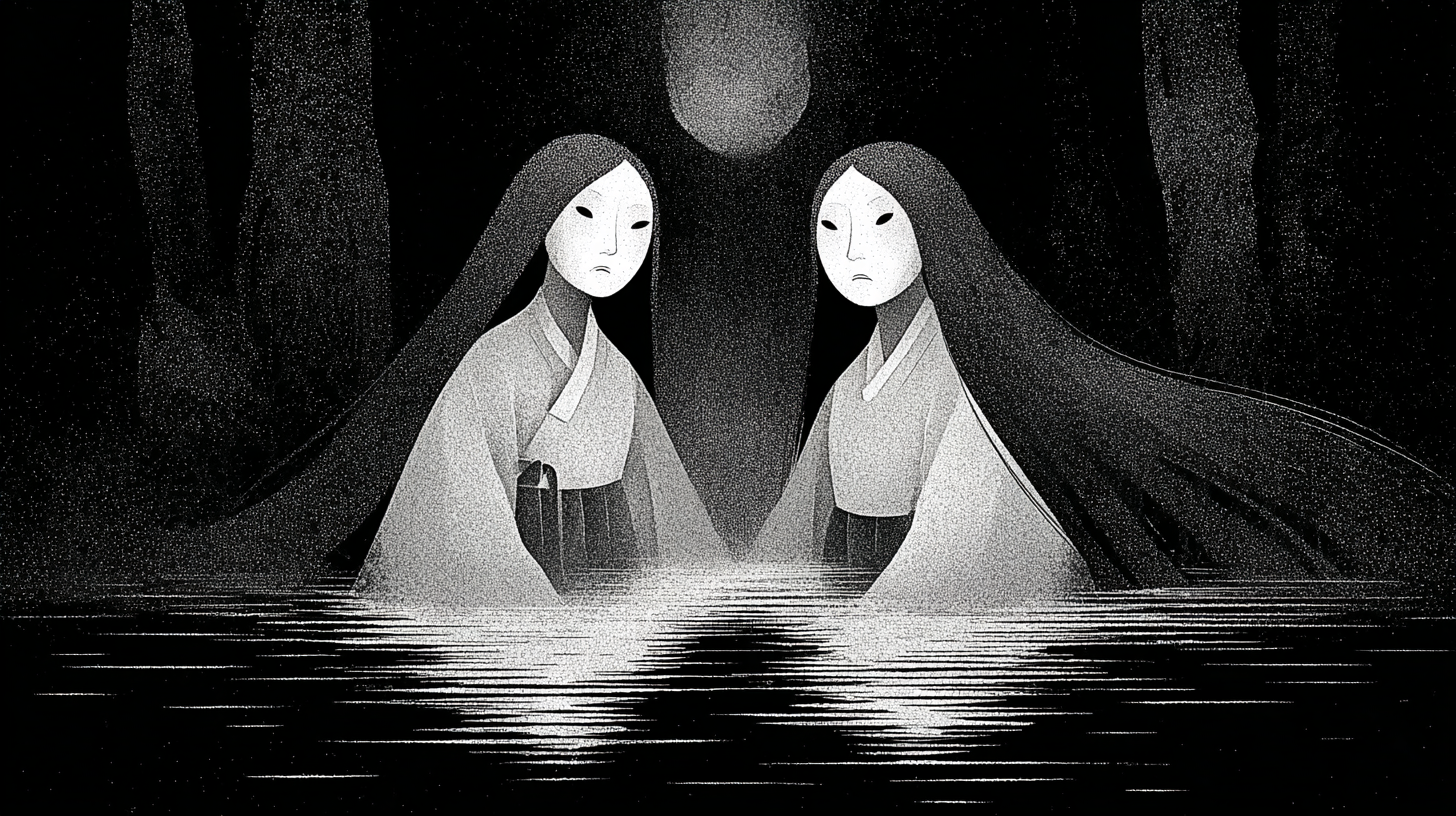
The Tale of Janghwa and Hongryeon
A Prosperous Beginning
During the reign of King Sejong the Great in the Joseon Dynasty, a nobleman named Bae Mu-ryong lived in Cheolsan, a district in Pyeongan Province. He served as the local jwasu (a community leader), and though he and his wife were prosperous, they had long wished for children. One night, his wife dreamed of a celestial figure descending from heaven, offering her a radiant flower. Within ten months, she gave birth to a daughter of remarkable beauty. They named her Janghwa—Rose Flower.
Two years later, a second daughter arrived. This child they named Hongryeon—Red Lotus. Both names were drawn from flowers deeply cherished in Korean culture, symbolizing purity, grace, and transcendent beauty. The family seemed blessed.
Tragedy Enters
When Hongryeon was five years old, their mother fell ill and died. Bae Mu-ryong, now a widower with two young daughters, eventually remarried a woman surnamed Heo. Lady Heo initially concealed her true nature, but after bearing three sons of her own, her demeanor changed completely. She viewed her stepdaughters as threats to her children’s inheritance and began treating them with increasing cruelty. The sisters, taught to be filial and obedient, never complained to their father about the abuse.
The Deadly Scheme
When Janghwa reached marriageable age and became engaged to a man from a respectable family, Bae Mu-ryong instructed his wife to prepare a proper wedding dowry. This enraged Lady Heo. Under Joseon inheritance customs, a daughter’s dowry often included substantial property from the household—resources Lady Heo wanted preserved for her own sons.
She devised a terrible plan. One night, while Janghwa slept, Lady Heo had her eldest son place a skinned rat—made to resemble a miscarried fetus—into Janghwa’s bedding. The next morning, Lady Heo brought Bae Mu-ryong to his daughter’s room and ‘discovered’ the evidence. She accused Janghwa of having conducted an illicit affair and secretly aborting the pregnancy—a scandal that would destroy any noble family’s honor.
Bae Mu-ryong, deceived by the fabricated evidence, was consumed with fury. Disgraced and terrified, Janghwa fled to a pond in the nearby woods. Lady Heo sent her son to follow. He pushed Janghwa into the water, where she drowned. According to some versions of the tale, at that very moment, a tiger appeared and attacked the son, tearing off one arm and one leg—an immediate supernatural retribution for his crime.
The Second Death
With Janghwa gone, Lady Heo’s cruelty toward Hongryeon intensified. The younger sister eventually learned the truth about her sister’s death—some say through confession from her now-disabled stepbrother, others say through a dream in which Janghwa’s spirit appeared and revealed everything. Unable to bear the grief and the escalating abuse, Hongryeon made her way to the same pond where her sister had died. She walked into the water and drowned herself.
The Haunting
After the sisters’ deaths, strange occurrences plagued Cheolsan. The pond where they drowned echoed with weeping day and night. More disturbing still, every newly appointed magistrate to the district died within days of arrival—usually of apparent shock or heart failure. Word spread that the position was cursed. Officials refused the posting. The problem was reported repeatedly to the capital, but no solution emerged.
Finally, a man named Jeong Dong-woo (based on the historical figure Jeon Dong-heul) volunteered to serve as magistrate. He was a military officer known for his courage and integrity. Unlike his predecessors, when the candle in his chamber blew out one night and two spectral women appeared before him, he did not flee or die of fright. He listened.
Justice from Beyond
The ghosts of Janghwa and Hongryeon told the magistrate their story. They explained how they had been framed and murdered, and they begged him to examine the supposed evidence of Janghwa’s ‘miscarriage.’ The next morning, Jeong Dong-woo summoned Bae Mu-ryong, Lady Heo, and her son. When he demanded to see the preserved ‘fetus,’ Lady Heo reluctantly produced it. The magistrate cut it open—and found not human remains, but rat innards.
The truth unraveled completely. Lady Heo and her son confessed. She was sentenced to death by dismemberment, a punishment reserved for the most heinous crimes. Her son was hanged. As for Bae Mu-ryong, accounts differ: some versions say he was released as another victim of the deception; others state he was punished for failing to govern his household properly.
Jeong Dong-woo recovered the sisters’ bodies from the pond, gave them proper burials, and erected a memorial stone. That night, the ghosts appeared one final time—not in terror, but in gratitude. They told the magistrate that his career would flourish, and indeed, historical records indicate he went on to serve as a naval commander and held numerous high positions.
Rebirth and Resolution
Some versions of the tale include an epilogue. Years later, Bae Mu-ryong married a third wife, surnamed Yun. On his wedding night, his deceased daughters appeared in a dream, telling him they had been granted permission to return. Lady Yun soon gave birth to twin girls, whom Bae Mu-ryong named Janghwa and Hongryeon. This time, the family lived happily ever after.