The Other One
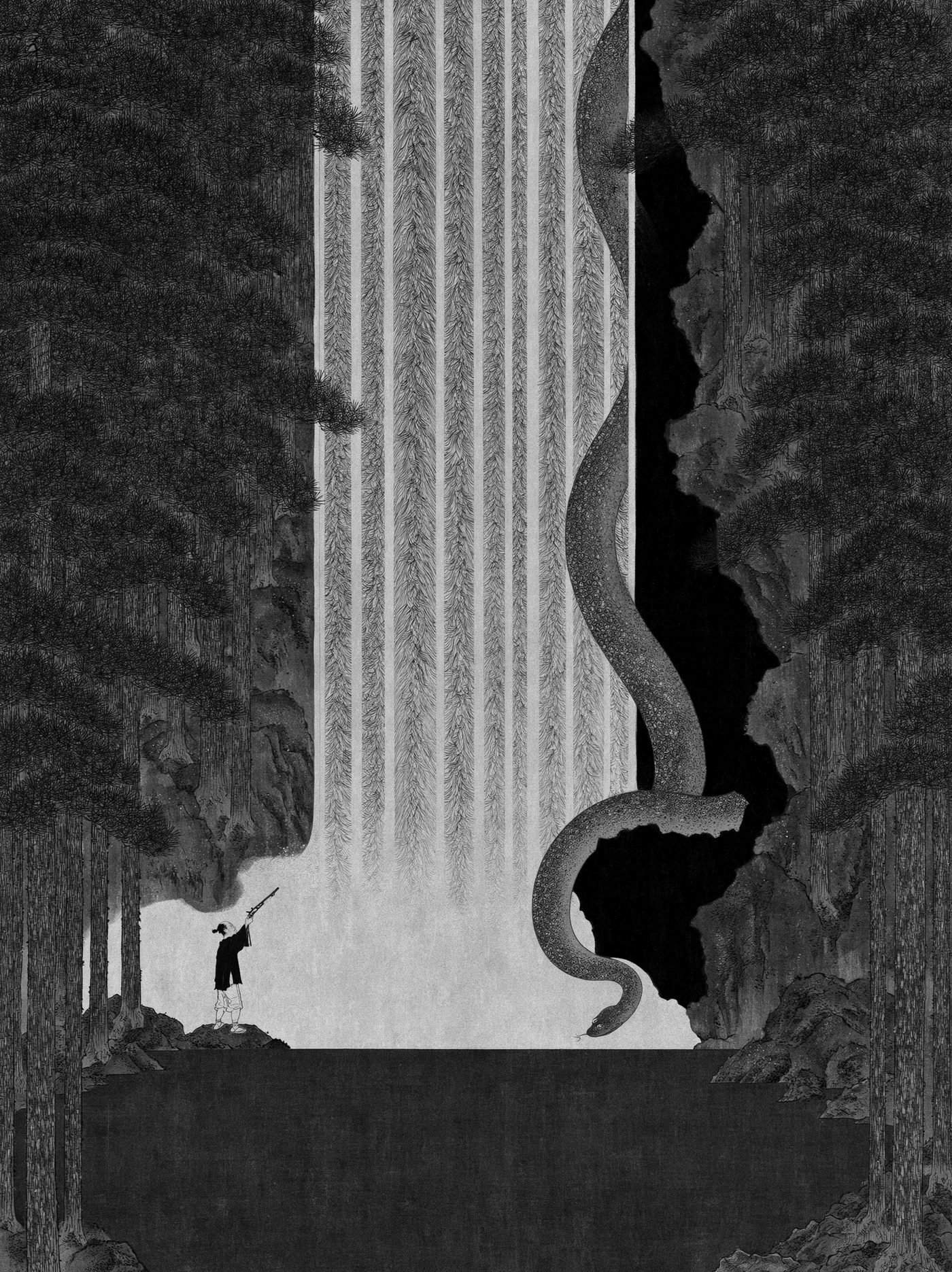
The Shinohara house stood on the far side of the mountain from the falls, and the man who kept it was a better shot than a farmer.
He worked his fields the way everyone worked their fields, and when the work let him go he took the matchlock and went from ridge to ridge after whatever was moving. The village at Ochi was deep in the hills of Takaoka, and the hills gave up game to a man who was patient. He was patient. He was also, and the village knew this about him, fond of coming home with something nobody else had brought home.
The falls were called the Great Barrel. They came down the mountainside south of the village in a white column tall enough that a man standing on Yokogura across the valley, where the child emperor lies buried, could see the upper half of them standing above the new leaves in early summer, and could hear them, faintly, on a still day.
He went there one morning to see what the water had brought down.
Cedars grew thick along the drop, and he came down beside them to the pool at the bottom. Spray hung in the air there as a fine mist, and the light that got through the branches stood in it and made small rainbows that moved when the air moved. He was crossing the rocks at the lip of the pool, meaning to get to the other side, when he looked down toward the foot of the falls and stopped where he was.
Out of a black cleft in the rock, low and to the right, something was coming up into the light. It was as thick through as the trunk of a pine. It had put half its length into the open and was working the rest of it up the wet stone, and its back caught what light there was and threw it back in a hard, wet shine.
He thought: I will take that.
He did not think much past it. He thought of the village and of what the village would say. He went back the way he had come and worked around the rim of the pool until the distance suited him, and he set his feet, and he took his time, and he put the match to the pan.
The whole valley came back at him at once. The long body fell into the pool.
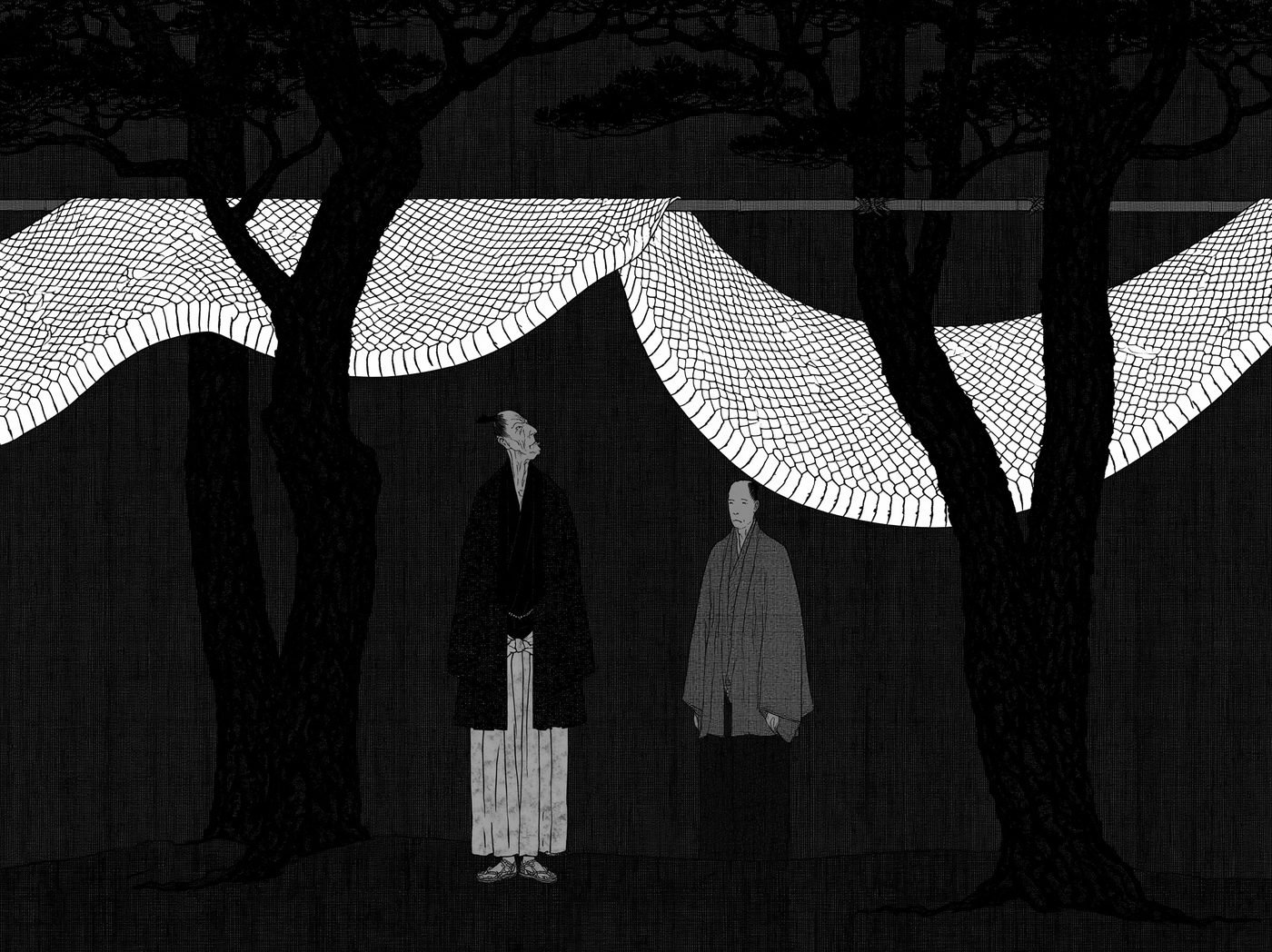
He walked home and brought back a cousin who also hunted, and the two of them took the skin. It came away in one piece. They carried it to the house and ran a length of bamboo between two standing trees in the front yard and hung it there, and by the middle of the afternoon most of the village had come to stand in front of it. He told them how it had been. He told them about the cleft in the rock and the shine on its back and how the sound had filled the valley.
Then he said the other thing.
“That one was the male,” he said. “There are two of them in there, the male and the female. I will have the female before long.”
That evening he had three or four of the neighbors in, and the cousin, and they drank. The talk did not go anywhere else. It went around the serpent and came back to it.
“I have heard of them that size,” one of them said. “I never saw one.”
“That is a thing to tell your grandchildren,” said another.
“I thought it would be smaller,” the cousin said. “I went down and it filled the pool. It gave me a turn.”
The master of the house sat with his cup and let them say it.
“It takes a certain kind of man to shoot a thing like that,” the cousin said. “There is not another man here who would have.”
“There is not,” said one of the neighbors, and looked at him.
He laughed and looked back, and while he was looking there was a black flash across the front of his eyes, and he went over backward.
The cup went with him. They got up to hold him and he struck their hands away and rolled on the floor of his own room.
“There. There. There,” he said. He was not pointing at anything they could find.
They watched his face and then they watched each other’s faces. He turned onto his back and onto his front and back again and fought whatever it was.
“There. There. There. There.”
When at last he stopped, they carried him to his bed, and they said what people say to a household at such a time, and they went down into the yard. Not one of them said the word snake.
It was black outside. There were no stars.
They walked close together and none of them spoke, and every one of them looked at the same place, which was the bamboo between the two trees.
Wind came into the branches above them. Some of them shut their eyes. It went through their clothes and turned the hems back.
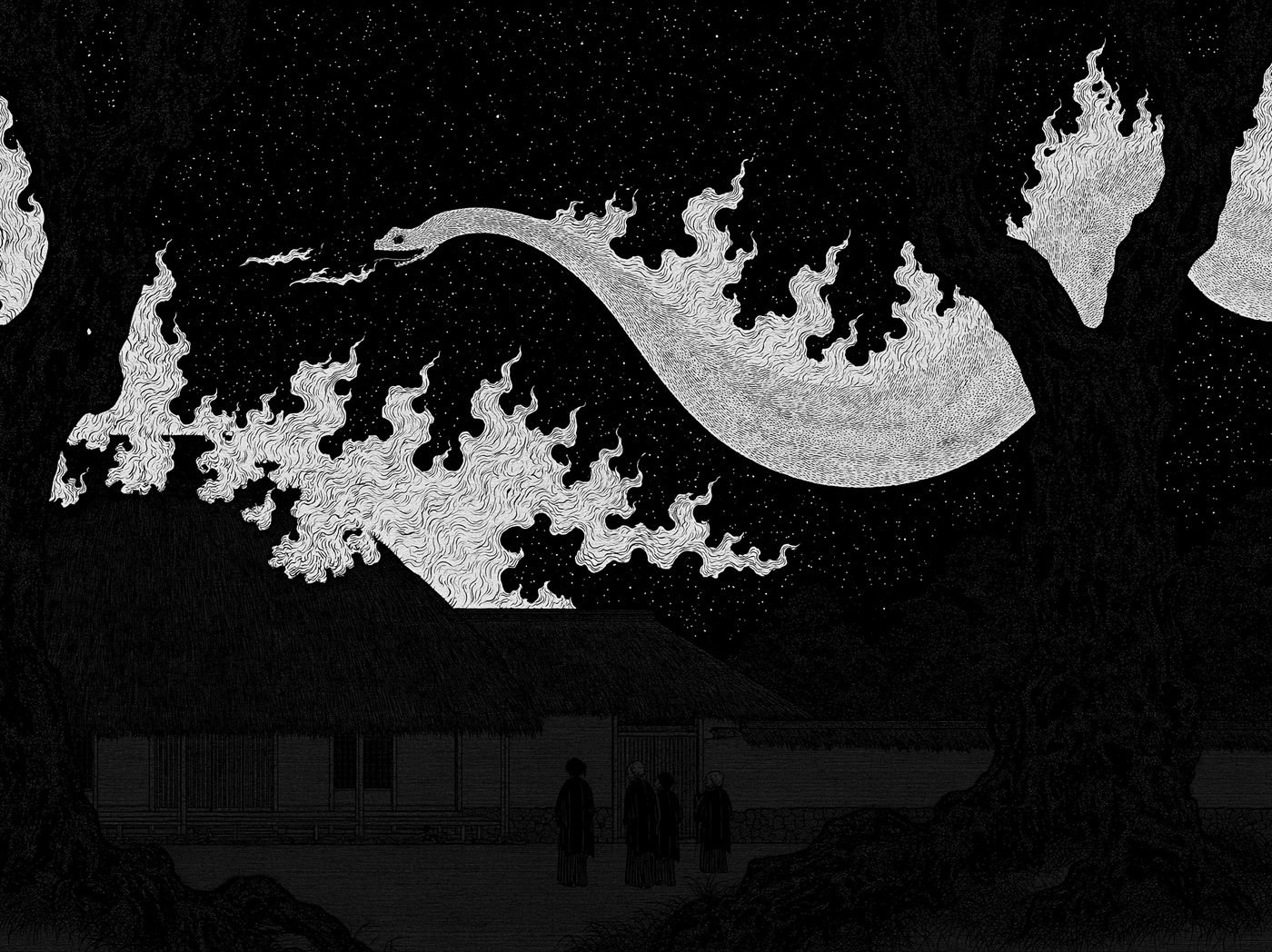
Then the place where the skin hung grew pale, as though a clouded moon had found it, and in the pale two threads of crimson came up and moved like a tongue moving. The light ran out along the skin faster than they could see the skin by, and the whole of it took fire and lifted, light as cloth, and went up and over the yard like a cloud going somewhere, and settled on the roof of the house.
The house went up. The fire stood into the sky and colored it. Then the upper half of the fire drew itself in and became one round body of flame, and that went off over the mountain toward the falls.
The master of the house died in it, and so did everyone under his roof. The cousin was not under it. What became of him afterwards has not come down.
That was not the end of it. After that, when a man of the Shinohara line went up toward the Great Barrel, the mist came down around him and took the direction out of the world, and he went into the water and did not come out.
They still say, in that part of the country, that the Shinohara cannot go near the Great Barrel.
Behind the Tale
This is a tale from Ochi, a mountain village in the Takaoka district of Kochi, on Shikoku. The waterfall is real and is still called the Great Barrel — Otaru — for the shape of the water coming down; the mountain across the valley, Yokogura, carries a long-standing local claim to be the burial place of the child emperor Antoku.
The version followed here was recorded by Tanaka Kotaro (1880–1941). The text used is the Aozora Bunko edition, which was set from Nihon no Kaidan II (Kawade Bunko, 1986); that volume in turn drew on Nihon Kaidan Zenshu — a collection of Tanaka’s kaidan published by Togensha in 1970, nearly thirty years after his death. Tanaka does not date the events. He says only that it does not seem to have been very long ago, which is the kind of thing said about something a living person’s grandfather claimed to remember.
Two details in his account are worth keeping in view. The first is that the serpent the hunter shoots is the male. The retribution, when it arrives, arrives on behalf of the one still in the cleft — the one he promised the room he would take next. Nothing in the tale describes her. She is present only as a sentence he said out loud in front of witnesses.
The second is that Tanaka marks the edge of what was passed down. The cousin who helped strip the skin disappears from the record, and rather than close the gap Tanaka writes that it is not preserved in oral tradition, and supposes he must have come to a strange end. We have kept the gap where he left it.
The belief itself outlived the story. Tanaka reports that people in the district still said, in his own day, that the Shinohara could not go near the Great Barrel.
This is the first of the 13 tales in HEBIONNA, each one followed by a note on where it comes from.