The Two Gaps
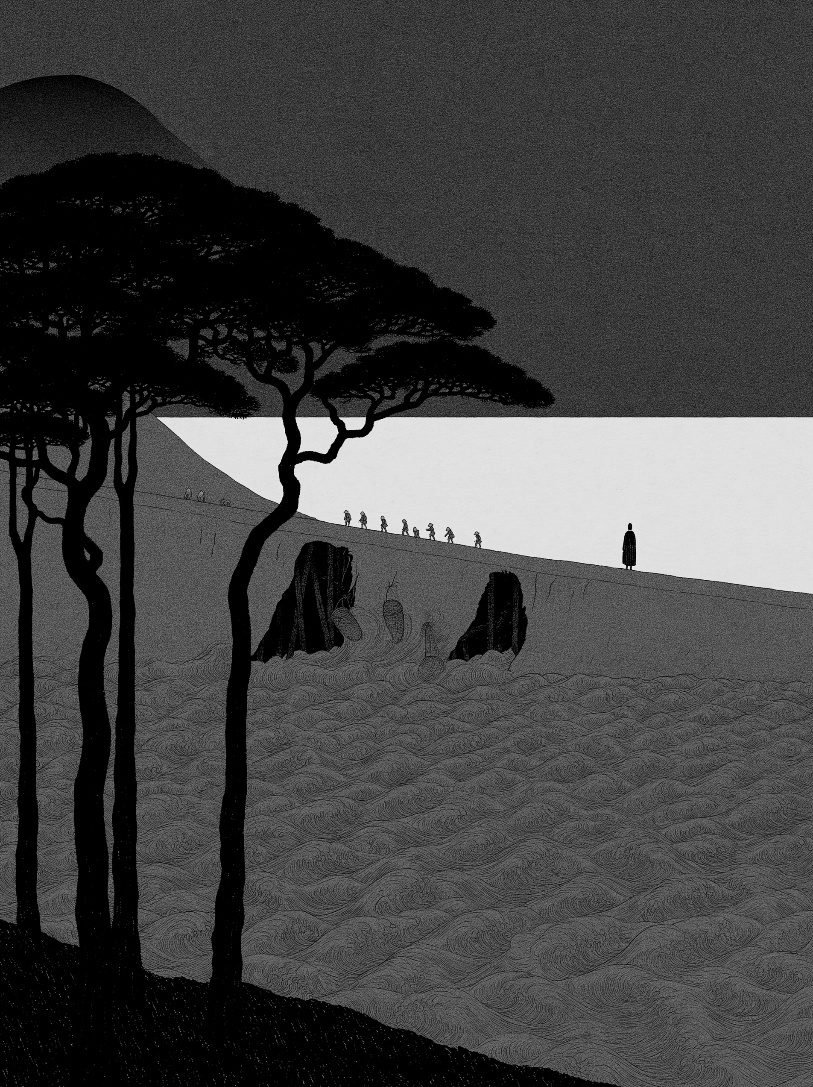
In the reign of the Emperor Nintoku — an age the chronicles count back to the fourth century — the plain of Kawachi was more water than land. The rivers came down out of the mountains and spread wide over the low country, and when the long rains met the sea-tide coming up, men poled boats between the roofs of their own villages, and the highways lay under mud. The Emperor looked at his land and set his ministers to cut the water a road: a channel dug north of the palace to carry the flood away to the western sea; and, against the northern river, a great embankment to hold it out of the fields for good — the Manda dike.
The dike went up. And in two places, it would not close. At night the two mouths could be heard from the workmen’s huts — not loud, a steady working sound, like swallowing.
Two gaps, and everything the workmen sank into them went down and away as if the river reached through from the far side and took it. Timber, stone, bundled earth by the hundred-load; the two mouths swallowed and stayed open. The work stood still at those two places, and the water ran through, and the season was turning, and men who had to pass the gaps after dark passed them quickly.
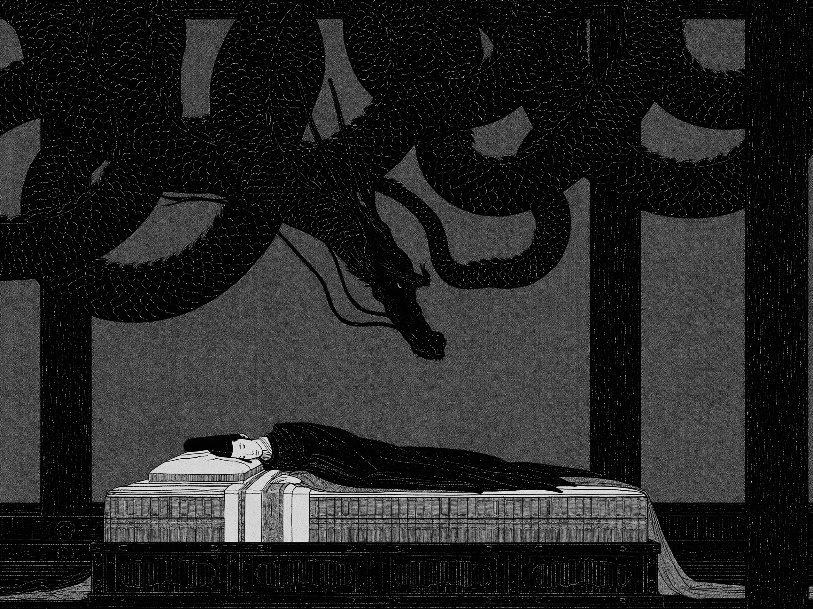
Then the Emperor dreamt. A god stood over him in his sleep and named two names, as plainly as an official reading a register: Kowakubi, a man of Musashi. Koromoko, a man of Kawachi, of the Muraji — the hereditary lords — of Manda. Give these two to the River-God, said the dream, and the gaps will let themselves be closed.
They were sought, and they were found — both at the first asking, as though the god had given directions along with the names: two men, in two provinces, going about their lives with their names already spoken over the water — one of them far to the east, in Musashi; the other a Manda man, whose family name was in the dike’s own name, living in sight of the work.
In Musashi the messengers came up a farm track at midday and asked a man cutting reeds whether he was Kowakubi. He said that he was, and asked what was wanted. They told him: a god had spoken his name in the Emperor’s sleep, a month’s road west of the field where he stood. He put down the knife, and looked for a moment at the reeds he had cut and the reeds he had not cut, and went with them.
Koromoko they did not have to seek so far. The dike stood in his daily sight, with his family’s name on it; when the order was read to him he looked at the two brown mouths in the embankment for a long moment and asked nothing. He said only that he would come, and that he would bring what was needed.
Kowakubi wept.
He did not resist and he did not run. He came to the dike, to the gap that was to be his, and he stood before it and lamented — openly, without shame, a man crying at the edge of brown running water while the workmen stood back and the officials looked at the ground. He mourned his own life, loudly, as a man mourns any other dear thing that is being taken from him. It went on a long time, and the work of the whole dike stood still while it went on, because no man could carry a basket with that sound in the air. Then, still weeping, he went down into the gap, and the water took him. For a moment longer the weeping went on under the water. Then it stopped.
The gap closed. The current that had swallowed timber by the hundred-load laid itself down, and the earth held from the first basketful, and that end of the Manda dike was made whole over him.
At the second gap, Koromoko came to the edge of the water carrying two dry calabashes.
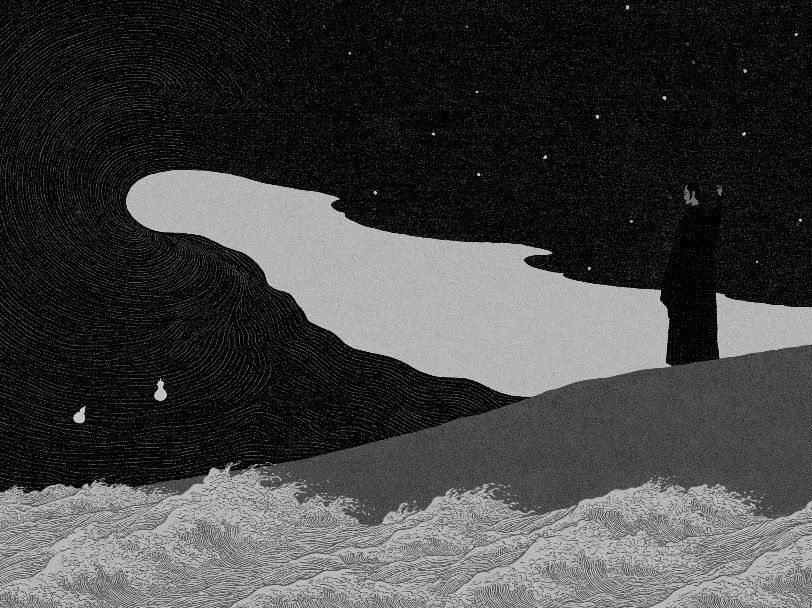
He stood over the current where it ran through, and he threw the two gourds out onto the middle of the stream, and he spoke to the river in a voice the whole work could hear. You have laid a curse, he said, and I have come to be your offering. If you truly want me, sink these gourds, and do not let them rise. Then I will know you for a true god, and I will go into the water of my own accord. But if you cannot sink them — then you are a false god, and why should I throw my life away for a false god?
Along both banks the work had stopped again, this time to watch a man scold a god. Some of those watching stepped back from him, as men step back from a tall tree in a lightning storm.
The river answered. Out of a flat sky a whirlwind came down the water, seized the two gourds, pressed them under, wrenched them — and the gourds came up. They came up dancing. The wind drove them and they rode it, spinning, light as air on the brown flood, and would not go under for the river’s whole strength, and the current carried them away down the wide water, out of sight, still afloat.
Koromoko watched them go. Then he bowed to the river, and went home.
And his gap closed too. The earth held there from the first basketful, the same as at the other place, and no one was under it. The dike stood whole from end to end, and the Kawachi plain came up out of the water into fields, and the granaries in after years were built on Manda land.
The men of that time gave the two places names: Kowakubi’s Gap, and Koromoko’s Gap. Side by side in the same dike, holding back the same river, and the two names still said over them long after: the gap that was closed with a man, and the gap that was closed with two gourds and a question.
Both of them held.
At night the two mouths were quiet, and men crossed the finished dike in the dark, over the one and over the other.
Behind the Tale
This is where the human pillar enters Japanese writing. The Nihongi, the court chronicle of 720, sets the story in the reign of Nintoku, at the building of the Manda dike in Kawachi — and what it preserves, at the tradition’s very first appearance, is not one story but two, in deliberate parallel. Aston’s 1896 translation (whose older spellings the quotations keep) holds the parallel exact: “Koha-kubi wept and lamented, and plunging into the water, died. So that embankment was completed.” And then, at the other gap: “the calabashes, dancing on the waves, would not sink … In this way that embankment was completed, although Koromo no ko did not die. Accordingly Koromo no ko’s cleverness saved his life.”
Read that closely and the oldest layer of the tradition is already arguing with itself. The same dream, the same god, the same dike — and the chronicle records, without blame in either direction, that obedience closed one gap and that calling the god’s bluff closed the other. The refusal is not punished. The sacrifice is not called unnecessary. Both names went onto the land. Aston’s footnotes add a quiet grace note: Kowakubi means “Strong-neck,” Koromoko “Garment-child” — a warrior’s name for the one who bent, a child’s name for the one who stood up. Of the finding, the chronicle says only that the two were sought and found; the reeds, the farm track, and the errand of the messengers are the retelling’s.
The chronicle even returns to the trick. A little further on in the same reign, a strongman named Agata-mori confronts a poisonous water-snake at a river fork, throws three calabashes into the pool, and offers the creature the same bargain — sink them or die. The gourds float; he wades in with his sword. Between Koromoko and Agata-mori, the gourd-test hardens from an escape into a weapon, and the water-god’s stock falls accordingly. The later history of these tales descends from the first gap. It is worth remembering that the second gap is just as old. (Nihongi, tr. W. G. Aston, 1896, vol. 1.)
This is the first of the 15 tales in HITOBASHIRA, each one followed by a note on where it comes from.