One Mouthful
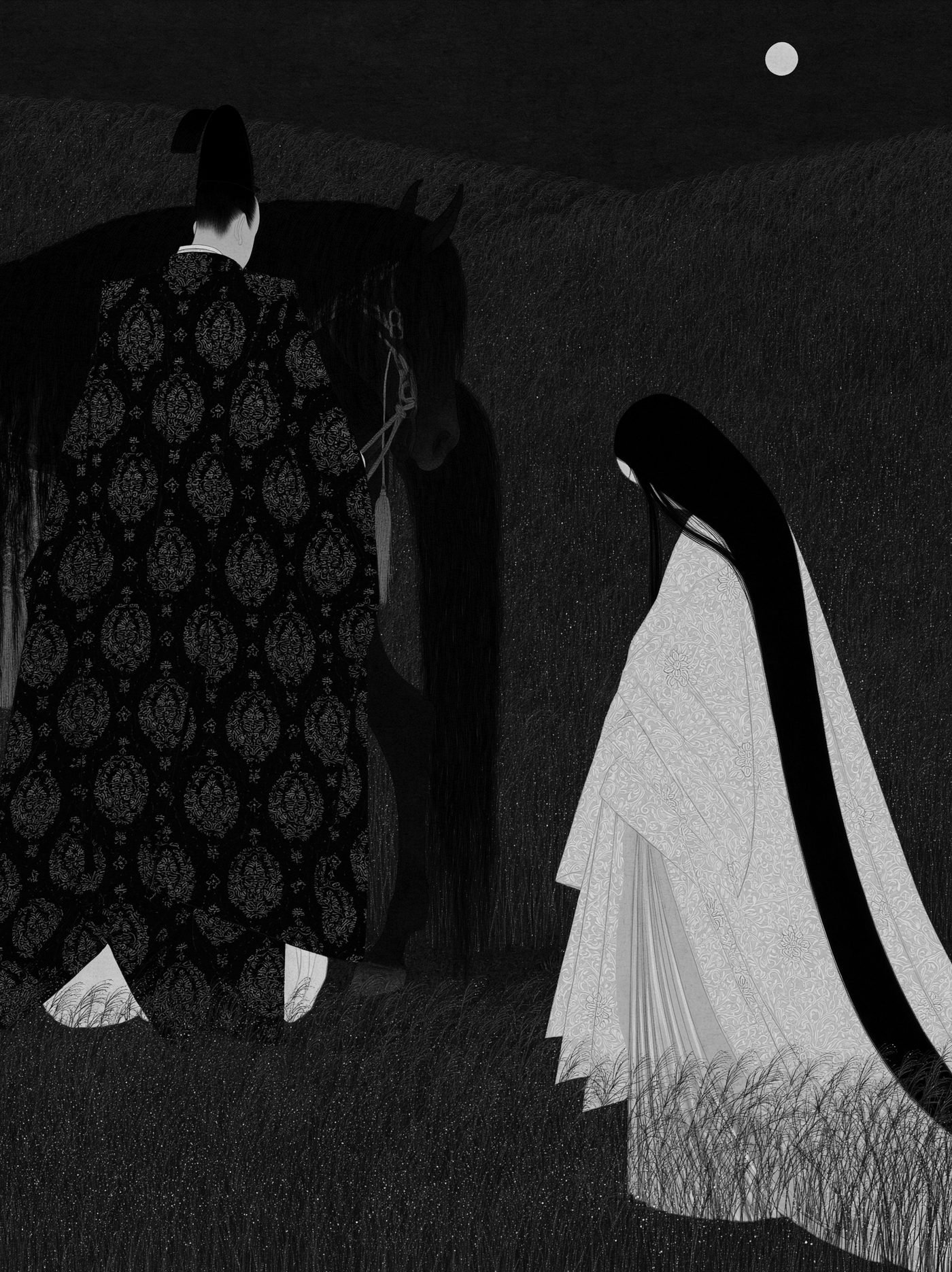
There was once a man who had set his heart on a woman he could not have.
She was of a rank far above him, kept deep in a great house where such daughters were kept — behind screens, behind curtains, behind the years of other people’s plans for her. He courted her anyway. He courted her for years, by letter and by go-between and by standing in the rain where her cart might pass, and the years told him no, and he did not stop. That is all the old story says of the courting: that it went on, and on, until it should have worn out, and did not.
And then one night her heart came over to his. There is no more explanation than that. The house slept, and the man came to an agreed door, and the woman put her hand in his, and he stole her out of the dark of one life and into the dark of another.
They went on foot, and fast. He meant to be far away by morning, and the road he took ran out past the edge of the city, along a river called the Akuta, through open country where the grass stood high and wet. The night was black. He went first, and she came behind him with her sleeve in his hand, a woman who had never in her life walked further than the width of a veranda.
On the grass beside the road the dew lay heavy, and caught what little light there was.
“What are those?” she asked him. “There — shining. Are they pearls?”
She had never seen dew. She had lived her whole life where the dew is on the far side of the shutters, and she stood in the open night of the world for the first time, asking her first question of it.
He did not answer. The way ahead was long, the night was already old, and a man stealing a woman from a great house does not stop to teach her the names of small wet things. He pulled her on. Later — for the rest of his life — he would have that unanswered question to keep.
Then the sky turned on them. Rain came down as though tipped from a vessel, and the thunder began — close, enormous, one crash climbing over another, a storm of the kind that makes even armed men look for walls. Ahead in the dark stood a storehouse, half in ruin, its roof at least whole. He did not know the place. He did not know what was said about the place, for the excellent reason that there was no one left in that country who would go near it after dark to say it.
He pushed the door, and it gave.
He put the woman deep inside, into the innermost dark of it, where the rain could not reach her, and told her to wait and to fear nothing. Then he set himself in the doorway, facing out, with his bow strung and his quiver on his back, and stood guard against the night. Robbers were what he feared. Pursuit was what he feared. He watched the road, and the rain on the road, and counted the thunder, and said to himself over and over the one prayer he had: let the dawn come quickly. Let the dawn come now.
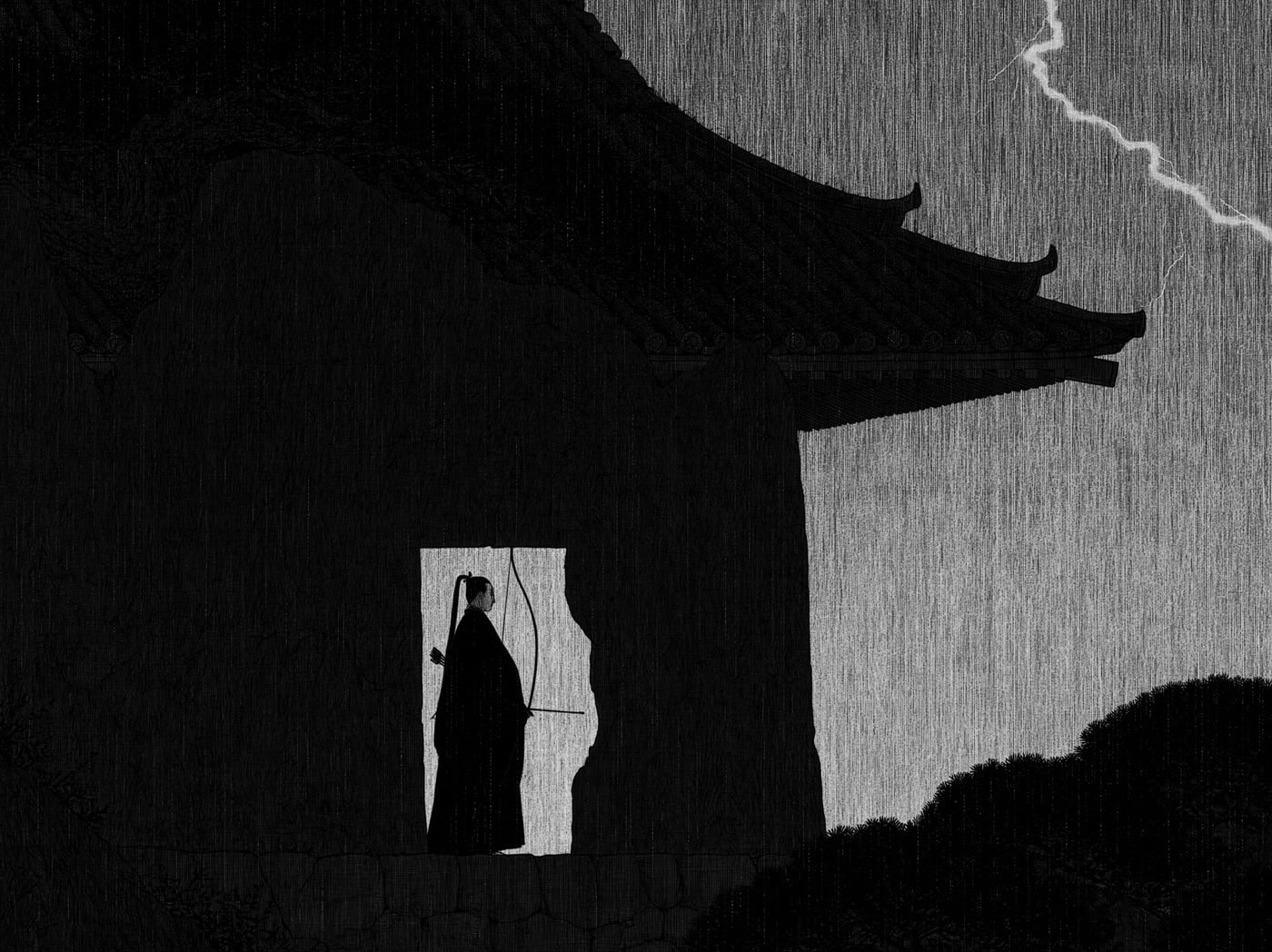
The thunder struck, and struck, and struck.
Inside, in the innermost dark, the oni ate the woman in one mouthful.
She cried out — once — “Anaya!” — half a breath of a cry; and the sky split exactly then, and the man in the doorway, guarding her with his strung bow against everything outside, heard thunder, and nothing else.
The rain thinned toward morning. The sky went grey, and the grass came back out of the dark, and the man turned from the doorway to tell the woman that the night was over.
The storehouse was empty.
He searched it — a floor, four walls, the dark corner where he had left her — and there was nothing to search. The woman he had brought was not there. No door had opened but the one he had held. He stood in the middle of the empty floor while the light came up, and understood nothing, and then, all at once, everything.
He stamped his feet on the ground and wept aloud, the way children weep, and it was no use at all.
They say he made this song of it:
”A pearl? or what is it?” she asked me, and I did not answer. Would I had said: it is dew — and vanished, as the dew does.
Behind the Tale
This is among the oldest tales in this book, and the shortest in its bones: it stands as the sixth episode of the Ise Monogatari, the poem-tales of the early Heian court, set down some eleven centuries ago. Its heart is a single sentence — oni haya hito-kuchi ni kuite keri, “the oni ate her, all in one mouthful” — and that phrase, oni hito-kuchi, “one mouthful for the oni,” has lived in the Japanese language ever since as the name for sudden and total loss. The storm, the borrowed shelter, the man at the door, the cry drowned by thunder: the whole engine of the tale is that the monster is never seen and never heard, not even by the reader. A thousand years before anyone taught the rule, this story knew to keep the oni off the page.
And then the original does a strange thing: it takes the story back. A note follows the poem, in the text itself, and says — this was really the lady who became the Empress from the Second Ward, stolen away in her youth before she was sent to court; her brothers rode after the pair, found them, and carried her home; and that is what is here called the oni. One of the oldest man-eating stories in the collection arrives with its own denial stitched to its hem. Believe the note, and there was no monster: only a girl who asked about the dew, dragged back to be made an empress, swallowed in one mouthful by a great family’s plans. The tale and its denial have been copied side by side for a thousand years, neither one ever quite eating the other; and the dew poem remains among the most famous verses in the language.
This is the first of the 20 tales in HITOKUI, each one followed by a note on where it comes from.