The Road to the Minister's Gate
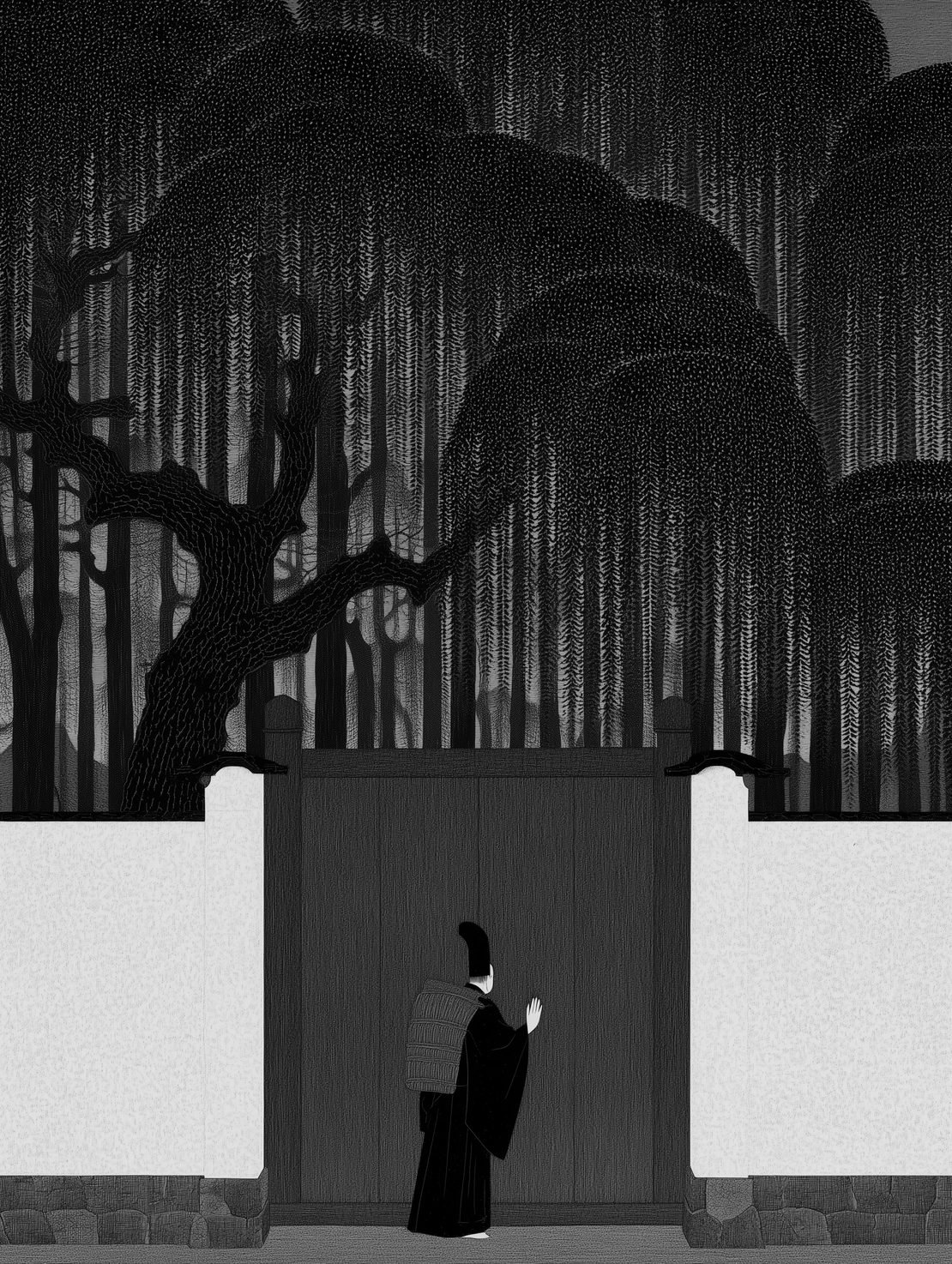
The man was a trader of the common sort and he was going down from the capital toward Mino, and he left in the dark because the road was long.
He had meant to go at first light. He woke somewhere in the small hours with the particular alertness that will not be argued with, lay there a while listening to the house, and then got up and made his pack and went out. It was that hour when the city has stopped being one thing and has not begun being the other. Nothing was open. Nothing moved. He walked the middle of the street out of habit, because a man walking alone before dawn does not walk near the walls.
At the crossing near the edge of the city there was a woman standing in the road.
She was on her own. She wore something pale — a bluish colour, as much as he could tell — and she had her hem gathered up in one hand, the way a woman holds it when she has been walking on a bad surface. There was no servant with her. There was no lantern. There was nothing at all to explain her.
He put his head down and went to walk past her.
“Where are you going, if I may ask?”
He stopped. A voice behind him in an empty street stopped him.
“Down toward Mino. Owari after.”
“Then you are in a hurry, and I am sorry for it.” She had not moved. “There is something I badly need. Would you stand still a moment?”
“What is it?”
“There is a house near here belonging to a gentleman — the Minbu no Taifu. I have been looking for it and I have lost my way entirely.” A pause. “Would you take me to his gate?”
He did the arithmetic in his head and did not like it. The Minbu no Taifu’s house was seven or eight blocks off, and it was seven or eight blocks in the wrong direction, and he had a full day’s walking ahead of him and had already lost the coolest part of it.
“That is a good way from here,” he said. “And I am going out of the city, not into it. If you wait until it is light, anyone will take you.”
“It is a matter of the greatest importance.”
“So is my road.”
“Please,” she said.
She did not raise her voice and she did not come any closer, and she did not give him a reason. She simply stood in the middle of the street in her gathered hem and asked him again, and he heard himself say:
“Very well. Come along.”
“Thank you,” she said. “You cannot imagine.”
He noticed the first thing before they had left that street: she made no sound behind him.
He put that down to the hour. Straw does not sound like leather and a woman does not walk like a porter, and at three in the morning a man will explain a good deal to himself rather than turn round.
He noticed the second thing at the corner of the third street. He had been going fast on purpose — it was his road she was costing him — and when he glanced back to see how far behind she had fallen, she had not fallen behind. She was at exactly the distance she had been at when they started. He slowed down deliberately for half a block and looked again, and she was at exactly the same distance.
The third thing took him longer to name, because it was the absence of something.
A person walking rises and falls. The head goes up a little at each step and comes down; the shoulders answer it; it is why you can pick out someone you know from the end of a street without seeing their face.
Her head did not move.
He turned to the front and kept going. Whatever she was, she had asked him a civil question and had thanked him twice, and he had spent thirty years on roads among strangers and had learned that you do not look hard at other people’s business unless you intend to do something about it.
Twice he thought of telling her that this was as far as he went. Both times he did not, and both times what stopped him was not fear exactly. It was that she had asked, and he had said yes.
The wall came up on their left, and then the gate.
It was a large house — the doors shut for the night, the bar across, the plaster showing pale.
“That is it,” he said. “That is the Minbu no Taifu’s.”
“You have brought me a long way out of your road.”
“It was not so far.”
“I am the daughter of a family in Ōmi,” she said. “In such a district, at such a place. You are going east — our house is close to the road you will take. Please call when you pass. There is a very strange thing here, and if you come to us I shall be able to explain it to you.”
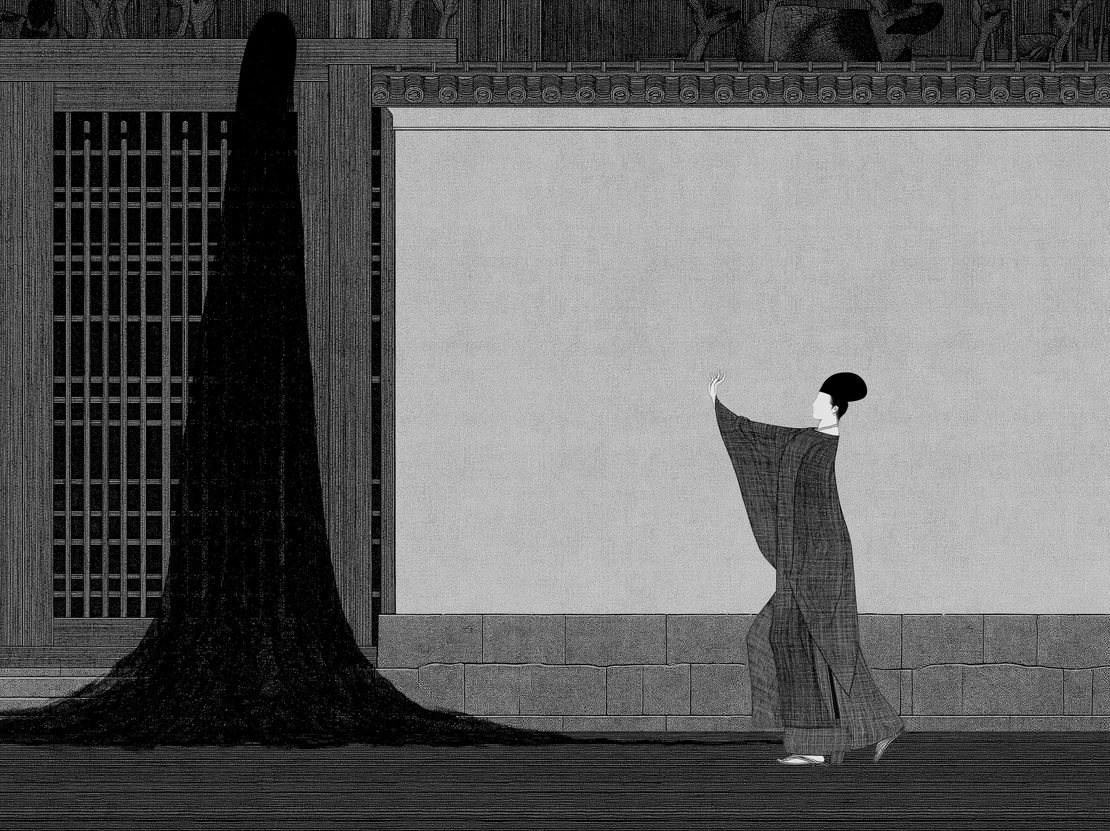
She was still speaking when she stopped being there.
He stood in the street with his hand partly raised.
The first thing he did — and he was proud of it afterwards, because it was the act of a man whose mind was still working — was to look at the gate. If the gate had been standing open he could have told himself that she had gone in through it while he was blinking. He walked up and put his hand flat on it. It was shut and it was barred from the inside and it had not been touched.
Then his scalp came up off his skull.
He could not move his arms. He stood in the road exactly like a man who has walked into a web in the dark, with his hands out and nothing in them.
Inside the wall, somebody began to scream.
It went on. A door went over. Feet on boards, a great many of them, all in one direction. A woman’s voice going up and up and then cut off at the top of it, and men shouting at each other flatly, too late for shouting to be any use.
He stood in the road and listened to a household find out.
He did not knock. He thought about it and did not do it, and he stayed where he was until the sky over the eaves had gone from black to the colour of ash, because he could not think of anywhere to go that would be better than standing there.
When it was late enough for calling on people he went and found a man he knew slightly who had connections in that house.
The man had already heard.
“The gentleman is dead. He went at dawn.
“He had been ill for some days. There is a lady in Ōmi — she was his wife once and he put her away — and they have been saying in that house for a while now that her living spirit has been coming in at night. Then this morning there was talk that it had been in the house again. And he died.”
The trader stood there.
While the man was still talking, his temples began to ache. It came on quickly, a dull pressure behind both eyes, and it kept getting worse while he stood in the street being told about a death he had walked to the door of.
It is the thanks, he thought. She thanked me and I took it and now I have got some of it in me.
He turned round and went home, and lay down for the rest of that day and the whole of the next.
It was three days before his head was clear enough to travel.
When he came into Ōmi he found the district she had named and asked at the second village, and the house was there, exactly as she had said, on a rise a little back from the road. He stood outside it long enough for a man in the yard to notice him.
Then he sent in his name and word that he had come about a certain night.
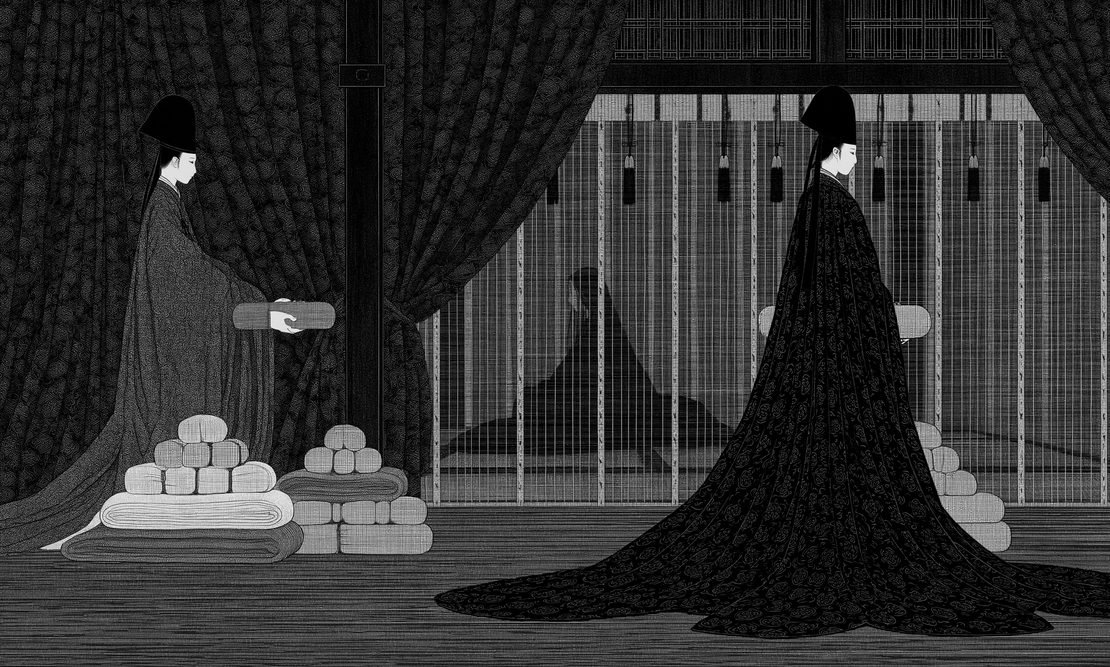
He was not kept waiting long. Somebody came out and said that the lady of the house would see him, and he was brought in past the yard and up onto the boards and seated in a room with a blind across it, and after a moment there was a shape behind the blind.
“I have never forgotten what you did for me that night,” she said. “I shall not forget it for the rest of my life.”
She had them bring food. Then she had them bring cloth — bolts of it, silk and hemp both, the good kind, more than a man could carry conveniently.
He thanked her and refused twice and took it on the third time. He did it well; he had been thirty years among strangers.
Then he got out.
He went down toward Mino with the cloth in his pack, and he was a long time on that stretch, and he was frightened the whole way.
Behind the Tale
Source. Konjaku Monogatarishū, book twenty-seven, item twenty. Early twelfth century.
The collection’s twenty-seventh book is its section on spirits and demons. Few things in it ask a favour, and fewer pay for one. The compiler ends by saying that a woman’s heart is a fearful thing, which is not quite what his own story shows.
The source gives the encounter in a single clause; the road and its three observed details are reconstructed here.
On what she is. The entry’s own title calls her a living spirit, and its closing line says she became one and killed with it. She is not a demon and the compiler does not treat her as one: she gives an address, receives her caller, and pays what she owes him in cloth.
This is the first of the 18 tales in IKIRYŌ, each one followed by a note on where it comes from.