The Man Who Leapt the Torii
The man of Shioma made his living by salt and sea-grass. Shioma is a small shore-place near Futami in Ise, and its men carried salt up to the capital as their fathers had, so that the road was as familiar to him as the tide; he could have told a stranger every well and every shrine gate on it.
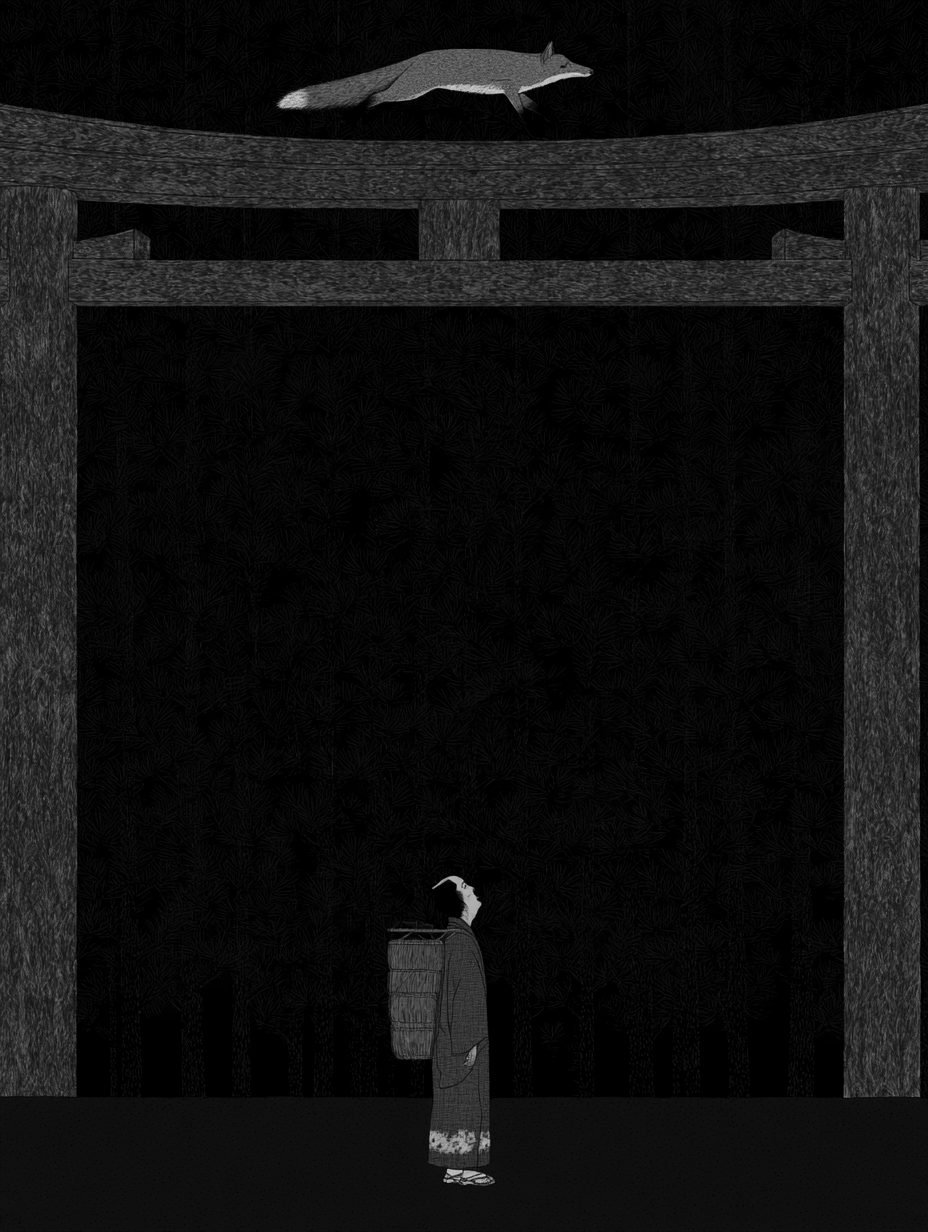
It was at the greatest of the shrine gates that it happened — the great torii of the Inari shrine, on the edge of the capital, where the road he travelled passed under the vermilion posts. An old fox came out from among the trees there, unhurried, in the open light of afternoon. It looked up at the torii, and gathered itself, and leapt it. Clean over — over the crossbeam that a man on another man’s shoulders could not have touched — and came down soft on the far side, and turned, and looked at him.
He should have gone on. He knew that afterwards; likely he knew it then. But it was a marvellous thing to see, and it pleased him, and he stood in the road with his salt on his back and watched the old fox go over the great torii a second time, and a third, until there was nothing in the world but the red beam and the rising fox.
And you, said the fox. Cross it too.
He laughed and said it was hardly a thing the likes of him could manage.
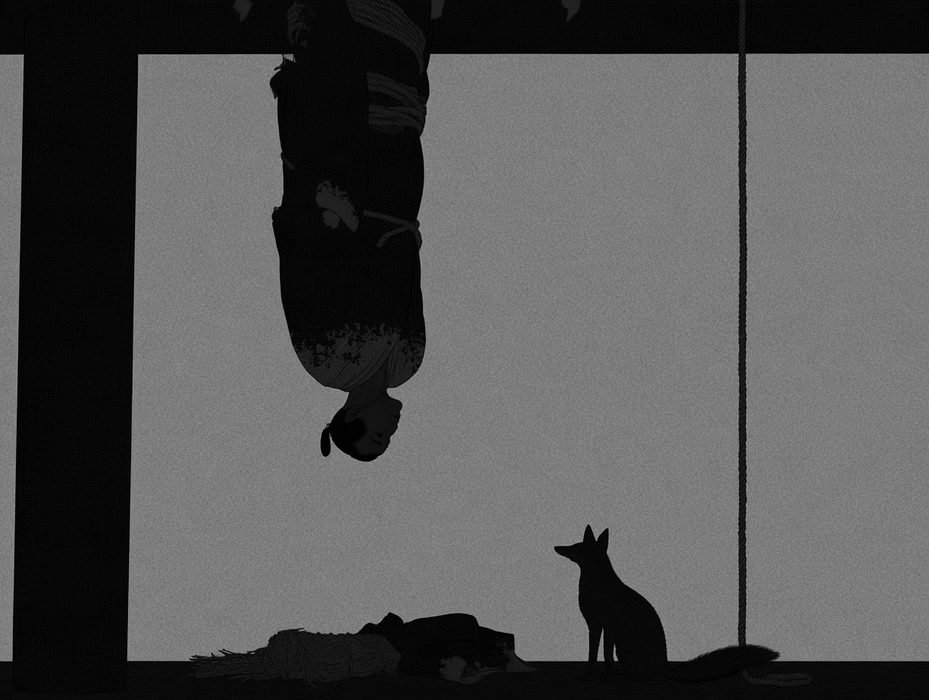
What the fox did then, he could never put in order afterwards. It had his haori off him — he did not remember undoing it. There was a rope, a long one, about his body, and the end of it went up and over the torii, and then he was hauled. This way; that way; his feet leaving the ground and finding it; the sky and the crossbeam changing places, once, many times, the red of the paint swinging past him close enough to touch. And through all of it, growing in him like water coming through sand, the feeling — clear, bodily, past argument — that he had leapt it. That he had risen from the road of his own strength and gone over the great torii as the fox had gone.
Then the road was still. His salt lay where it had fallen. His haori lay by it. The fox was gone, and the rope was gone, and the afternoon stood empty and ordinary around him, and he stayed a long time under the torii, dazed, like a man set down in a country he did not know.
He went home. It is a long road from the capital down to Ise, and he walked it without counting it; his feet found the way while he turned the thing over and over. He felt no different. He looked at his hands on the pack-rope and they were his hands, brown and cracked at the thumbs, the hands he had salted with for thirty years. By the time the pines of his own shore came in sight he had half made the whole matter into a tale for telling.
It was evening when he reached his door, and he called out as he always called, and heard the ordinary sounds within stop.
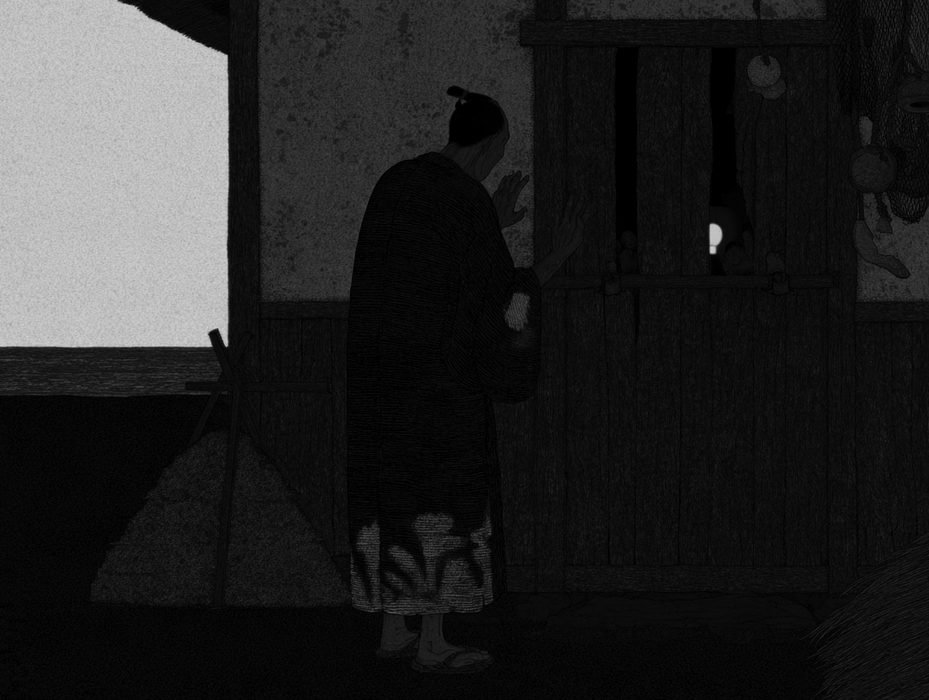
The door did not open. Through it came his wife’s voice, pitched high, not speaking to him at all — speaking past him, to the children: Oh, a fearful old fox, a terrible one — bar it, bar it — do not let it into the house!
He said her name. He said his own. He heard the bar go down, and the children beginning to cry, and their feet going back away from the door, all the small sounds of his own house closing itself against him. He put his hands flat on the wood — his hands; he could see them; there in the last light they were nothing in the world but his hands — and on the other side of an inch of door his family crowded away from what stood knocking, and what they saw he could not see, and what he saw they would never see again.
He did not force the door. He stood back from it in the road, and what came out of him then came out in one cry, loud enough that the neighbours heard it through their walls: I have fallen into the way of beasts, alive!
And he wept, and the door stayed barred.
He did not try the village after that. He went down to the sea, which asks nobody what shape they are, and lived on the shore below Shioma; he ate the green weed off the rocks, and the scales and leavings where the fishermen cleaned their catch, and if boats passed near him the men at the oars looked once and did not look again. Seasons went over him. What he was to himself in those years, he told no one, for there was no one to tell.
Then, long after, word came into the village — brought by a man of the place, who said it not as his own but as given to him to say: that having no settled dwelling he was at a loss in the world, and begged that some fitting home be appointed him at last. The people of Shioma heard it, and pitied him, and cut timber, and raised a small shrine above the tide-line, and worshipped him in it, and called it the Inari of Shioma.
It stood where the salt-carts passed, going up toward the capital.
Behind the Tale
The tale is from the Shin chomonjū, a large collection of things heard, compiled under the name of Kamiya Yōyūken and printed in the 1740s; it stands in the book of wonders under a plain and terrible title, A man becomes a fox while alive. No year attaches to the event. The geography is real and precise — Futami on the Ise coast, the salt trade to the capital, the great torii of the Inari shrine — and the story keeps to it, moving between the two places a working carrier would actually have joined.
What the story rests on is the Buddhist figure of the way of beasts, one of the six paths into which a soul may fall — ordinarily at death, after judgement. The horror the tale names is falling into it alive, with the judging left to one’s own wife and children at a barred door; and its ending belongs to an equally old habit of practice, by which what cannot be driven off or restored is instead given a house and a cult. The angry dead were settled so; here it is a man no longer taken for a man, settled as the Inari of his own village on the strength of a message and the villagers’ pity. The record itself never says what the family saw in the doorway. It gives their cry, the bar, and the man’s one sentence about the beasts’ path, and leaves the gap between his eyes and theirs standing open; that gap is the source’s, and it has been kept. The fox’s invitation, the haori and the rope, the feeling of having crossed, the shore-living on weed and scales, the relayed petition, and the little shrine are all the collection’s own. The long walk home, the hands on the pack-rope, and what the man made of himself in the years on the shore are this telling’s reconstruction, and the record is silent where those stand.
This is the first of the 25 tales in KITSUNE, each one followed by a note on where it comes from.