The Sleeve
Tamayori fell asleep looking at the moon. It was the seventh month, and she and her husband had gone up to the upper floor of the house at Byōbugaura, in the Tado district of Sanuki, and opened the shutters on the side that faced the water; and there was the inner sea below them, and the islands in it, and the moon over the islands, and they had sat with it a good while without saying much. The sound of the water did what it does. She slept where she sat. Beside her, Saeki no Yoshimichi slept too.
In her sleep there was music. It was above the house, in the air, and she looked up for it, and where she looked the sky had a cloud in it of a colour between violet and the red that comes before sunrise. There was a light inside the cloud. Out of the light a man came. He was a holy man — there was nothing else he could have been, from the robes and from the way he held himself — and at the same time there was nothing about him that was like any monk she had seen at any temple, and she could not have said afterwards what the difference was. He spoke to her.
“I mean to come down into the world, to be of use to people. I will borrow your womb for a while.”
Then he came into her. He came the way moonlight comes through a paper screen, without sound and without weight, and it did not hurt. Her body went clear. She could see through it, and it gave off a light like gold; and for the space of a breath it seemed to her that the three times, the one that had been and the one that was and the one to come, were laid out in front of her eyes, and she could have looked into any of them she chose. Then she woke.
The moon had not moved far. Her husband was asleep against the pillar. She woke him and told him, all of it, in order, while it was still in her.
Yoshimichi heard her out. He did not laugh, and he did not tell her it was the night air.
“A saint is going to come down on this house,” he said. “There is no better sign than that. We must be careful now — both of us. In what we do, and in what we think.”
So they were careful. Through the months that followed they lived in that house like people who are keeping something safe and do not yet know its shape. She kept her body quiet and her mind quiet, and stayed away from what was unclean, and he did the same in the way of a man, which is to say by watching her. The autumn went off the inner sea and the winter came on to it and went, and the spring. On the fifteenth day of the sixth month of the year after the dream, the child was born.
He came out with his hands together. They were joined in front of his chest with the fingers laced, in a form his mother had seen monks make before an image and had never seen a newborn make, and they stayed like that until someone gently undid them. The room was full of a light like gold. Over the roof a yellow cloud stood and did not move off. And when the child cried, the cry was not like a baby’s crying: it had a shape to it, rising and falling like a voice reading sutra.
They called him Mao.
That same season a monk came through Sanuki on his rounds. His name was Hōshin. He was a man of the Tang who had crossed the sea long before in the company of Ganjin and had never gone home, and he was old now, and he was going round the province, and the house at Byōbugaura gave him a night’s lodging as it would have given it to anyone in a robe. He ate. He was shown to a room. He lay down.
In the night the baby cried.
The sound came through the house to where the guest lay, and he opened his eyes in the dark and listened to it, as a man listens to a thing he thinks he has misheard. Then he sat up. He had spent his life among people who recite, and there was something in the rise and fall of that crying — a turn in it, and a turn again, a length and a stop and a length — that made him get up off the mat and go to the door of the room and stand there with his head bent and his hand on the frame. He stood there. He said it aloud, in the dark, to no one.
“That is the dharani of the Buddha’s Crown. And that — that is the Great Wish-Fulfilling. The child is reciting them.”
He stood at the door until the crying stopped, and then he did not lie down again.
In the morning he asked to see the master of the house. Yoshimichi came, and the monk looked past him to where Tamayori stood with the child against her shoulder, and then back to the father, and spoke as a man speaks who has decided in the night what he is going to say.
“This child is not an ordinary child. In the years to come he will spread a great Law, without fail, and he will be the model for the whole country under heaven.”
Then he did a thing that no guest does to the infant of the house where he has slept. He went down on his knees on the floor, and put his forehead to the boards, and bowed to the baby. Tamayori stood and held the child and let him do it. When he had gone she stood a while longer.
They raised him as one holds a jewel in the hand, with the hand closed round it.
There was a mountain to the north-west of the house, a hundred chō off, high, with a bare crown. In the summer of his seventh year the child went up it alone.
He went at first light, before the house was moving, out through the gate and along the paths between the fields with the dew still on them, and then up. The path became a track and the track became rock. There was scrub, then there was not; there was a wind that had not been there below; there was, at the top, a rock that stood out over a valley so deep that the trees at the bottom of it were the size of moss. He climbed on to the rock. He stood on the edge of it with the valley under his toes and the wind pulling at the front of his clothes, and he spoke, having thought about what he was going to say and not about anyone hearing it.
“I mean to spread the Buddha’s Law and save the people who are living. If the World-Honoured One has any power, let him show it, and prove me. If it is not to be — if what I mean to do will not be done — then let this life go to pieces in the valley.”
He put his hands together. He went off the rock.
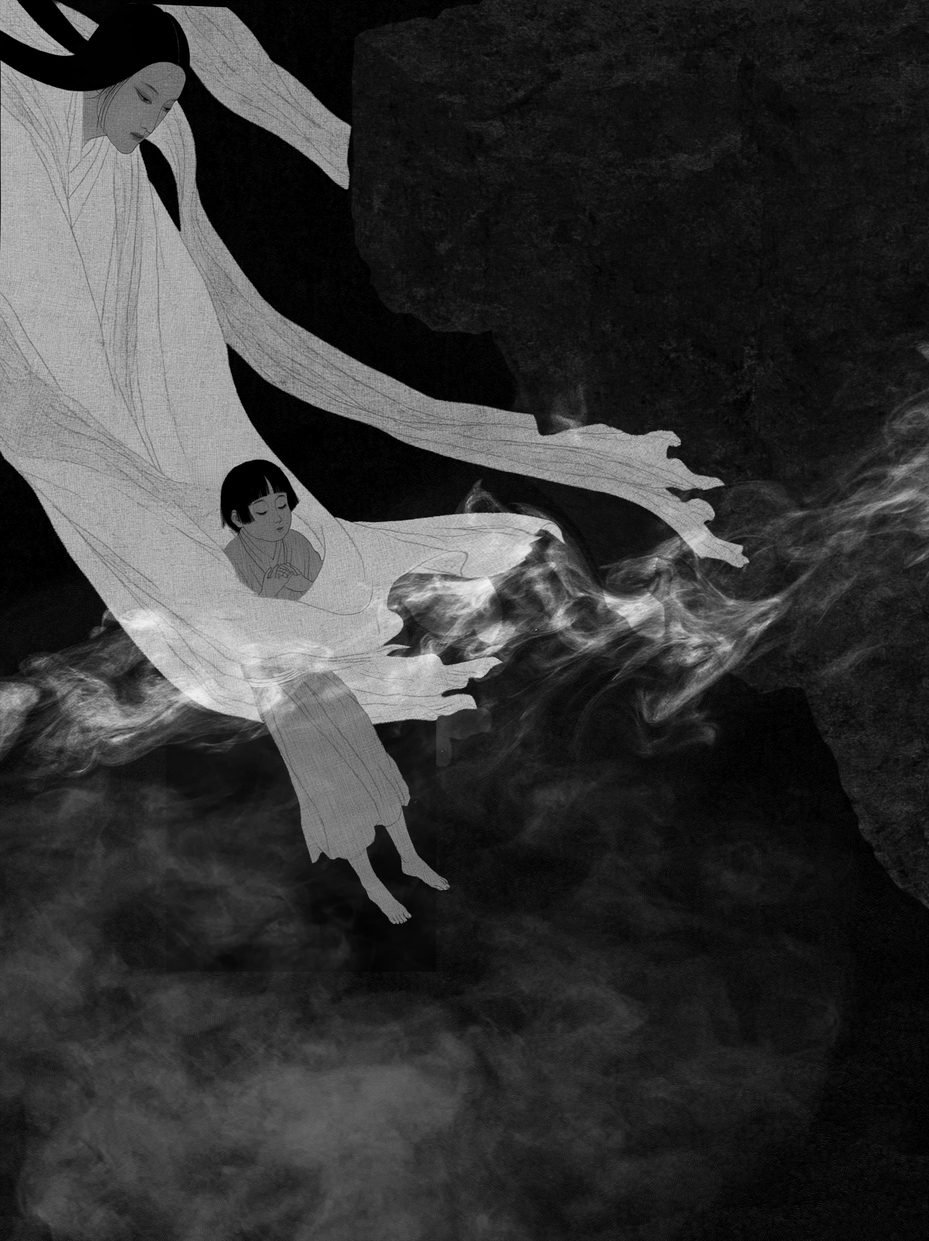
Out of the air a heavenly being came down to meet him, all the way down, faster than he fell, and the sleeve of the robe it wore came round him and gathered him in and held him; and a voice said —
“Wait. Do not be in such a hurry.”
— and the sleeve lifted, and carried him, and set him down on the mountain where he had stood.
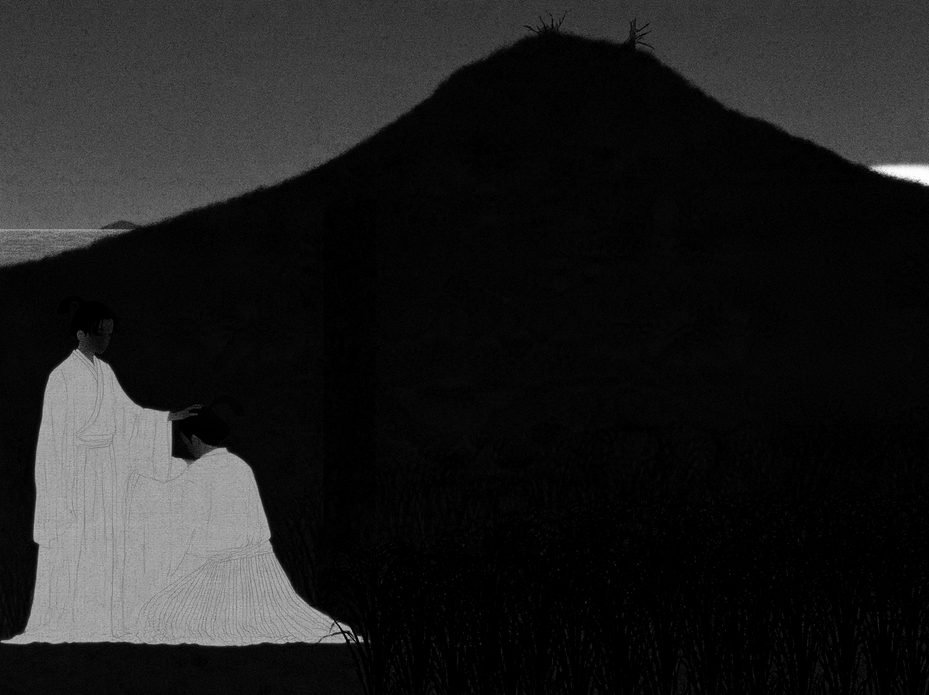
The valley rang. It rang from wall to wall as if something had struck it. And in front of the child, on a lotus that had not been there, Shakyamuni sat, and a light came out from between his brows and lay on the boy; and the Buddha reached out a hand and laid it on the boy’s head, and left it there, and spoke.
“Good. The great vow will be fulfilled. There is no doubt of it.”
The child wept. He wept for joy, and he went down on the rock with his face on the stone and his hands out in front of him, the whole of him on the ground; and when he lifted his face the Buddha was going, with a cloud of good omen round him, and then the cloud was going, and then there was the crown of the mountain and the wind.
At Byōbugaura his mother had been looking for him since the house woke. She had looked in the rooms, and along the shore, and at the edges of the fields, and had asked, and nobody had seen him go. It was a long day. She did not know where he was. She did not know anything, and there was nothing she could do with what she did not know except stand at the gate, and she stood at the gate. Towards evening she saw him coming along the path between the fields with the dust of the mountain on him from his hair to his feet. She went out to him. She put her hands on him — on his head, his shoulders, his arms, both of them, all the way down — and there was nothing wrong with him anywhere.
Behind the Tale
The birth, the night-crying and the leap are told as one continuous chapter in the Kōbō Daishi goichidaiki of Yamagata Genjō (1909), a devotional life, under the headings of the nativity and the wonders of childhood, and this retelling follows that telling in its order and its size. The telling gives the dates: the dream in the seventh month of 773, the birth on the fifteenth day of the sixth month of 774; the year of the leap, 780, is supplied by the Kōbō Daishi goden of Saeki Yūsan (1922), a devotional life, which has the same three episodes in the same order. Behind the modern lives stand older texts: the parents’ dream, the child’s pet name of “the treasure”, and a dream of an eight-petalled lotus are in the Goyuigō, the testament attributed to Kūkai himself; for the leap, the Kōbō Daishi gyōjōki, an older Life of the Daishi in Japanese, given under the name Ichion and read in its printings of 1894 and 1913 (the second illustrated, as Kōbō Daishi gyōjōki zue), gives, in the passage used here, only the child seeing Shakyamuni in a cloud above a lone peak. The mother’s name Tamayori, the father’s name Yoshimichi, the monk Hōshin as a companion of Ganjin, the two dharani he heard, the hundred chō to the north-west, the heavenly being with the sleeve and the Buddha’s hand on the boy’s head are all in the 1909 telling. The boy is called Mao here, the childhood name the lives give him; in the world of these tellings he is not yet Kūkai, a name that belongs to his years of practice after leaving home, and the tales of those years in this book call him by it.
The tellings differ in who dreamed. The 1909 life gives the dream to the mother alone, and this retelling keeps that; the Goyuigō and most of the other modern lives give it to both parents, and in the testament the parents say they saw a holy monk come from India and enter their arms, and that the child must be a disciple of an old Buddha. The holy man is described differently from book to book — a figure of the Tanabata night in one, a light from the sky in another. Several lives say the pregnancy lasted twelve months; the 1909 life gives only the two dates, and so does this retelling. The birth with joined hands is quoted by one life from an eleventh-century court scholar. Some tellings put the recitation of dharani at two or three years old rather than in the cradle. The rescue on the mountain is told in more than one way in the lives used here: the heavenly being and the sleeve; or nothing happening to the body at all and the Buddha’s voice; or a Buddha in a purple cloud; or a vow worded “if not, then kill me”. The mountain is given different names, among them Gahaishi-yama, Shashin-ga-take and Fude-no-yama, and the temple Shusshakaji at its foot has its founding legend from the leap; the 1922 life adds a poem by the twelfth-century poet Saigyō on the place. None of the tellings used here gives the child a companion or a witness on the mountain, and none says whether or what he told his parents afterwards.
This retelling adds the night on the upper floor and the open shutters, the husband asleep against the pillar, the months of waiting given as seasons, Hōshin at the door with his hand on the frame and his words spoken to no one, the mother standing with the child while he bowed, the climb at first light and the shape of the rock, and the mother at the gate and her hands on the boy. The 1909 life compares the child to the Snow Mountain Boy of the sutras; the comparison is not repeated here.
This is the first of the 26 tales in KŪKAI, each one followed by a note on where it comes from.