The Tub at the Cave Mouth
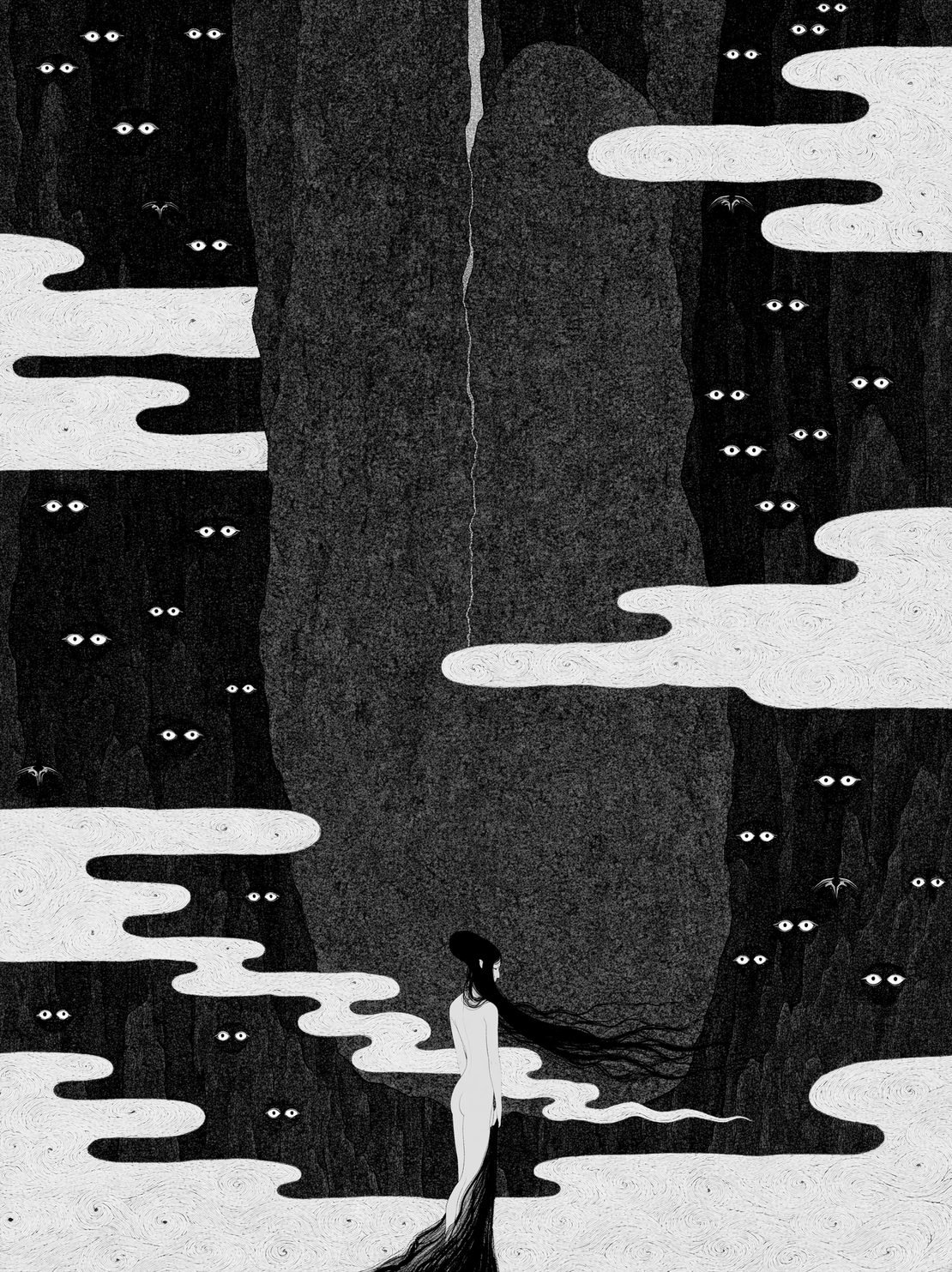
The door of the cave was shut and the sun was inside it, and the gods stood in the dark outside working out what could be done.
The dark was not a figure of speech. It had come down all at once when the goddess went in and drew the rock across, and it had stayed. On the high plain there was no morning. Below, in the country of reeds, the rice stopped and the water went bad, and things that had always been careful to keep to the night came out and were heard moving about at all hours, because there was no longer any hour.
Down there they went on doing the work anyway, in the way of people who do not know how long a thing will last. They kept fires going at the ends of the fields because a fire is the only clock there is when the sun has gone. They carried water further, because the near water had turned. They lost the seedlings and then they lost the seed. A man would come in from a field he could not see and sit down and not say anything, and his household would not ask him, because there was nothing to be asked that had an answer.
The reason she had gone in was in everyone’s mind and nobody was saying it, because the reason was her brother, and her brother had done the last of it inside her own weaving hall, and a woman who worked there had died of it.
So they held a council in a dry riverbed, and the god of counsel worked out a procedure.
The riverbed was chosen because it was the only place wide enough to hold them all and low enough that a voice carried. They came down the banks in the dark and found places on the stones. Nobody could see who was speaking. That turned out to matter later.
It was a long procedure and every part of it was made by hand, and the making took time, and during the time the country below went on being dark.
They went up the river to where the iron is and quarried it out and gave it to a smith, and he worked it and it came back wrong, and he worked it again. They sent for a stone-worker and had five hundred curved stones strung on a single cord, and that is a length of cord and a long job in the dark, and the man who did it had to be given a fire of his own to see by. They went to the mountain and took a sakaki tree out of the ground whole, with the roots still on it and the soil still in the roots, and carried it down and stood it up in the riverbed, and hung the mirror in the middle branches and the stones in the upper and lengths of white cloth in the lower, so that the whole thing stood there in the firelight looking like something that had been prepared for a festival nobody was going to enjoy.
They brought the long-crowing birds of the Everlasting Land and set them where they could be made to call, because a cock crowing is what morning sounds like and they were prepared to try it.
They took the shoulder-blade of a stag and the bark of a birch and burned the one against the other and read the cracks, and the reading came back that the thing could go forward.
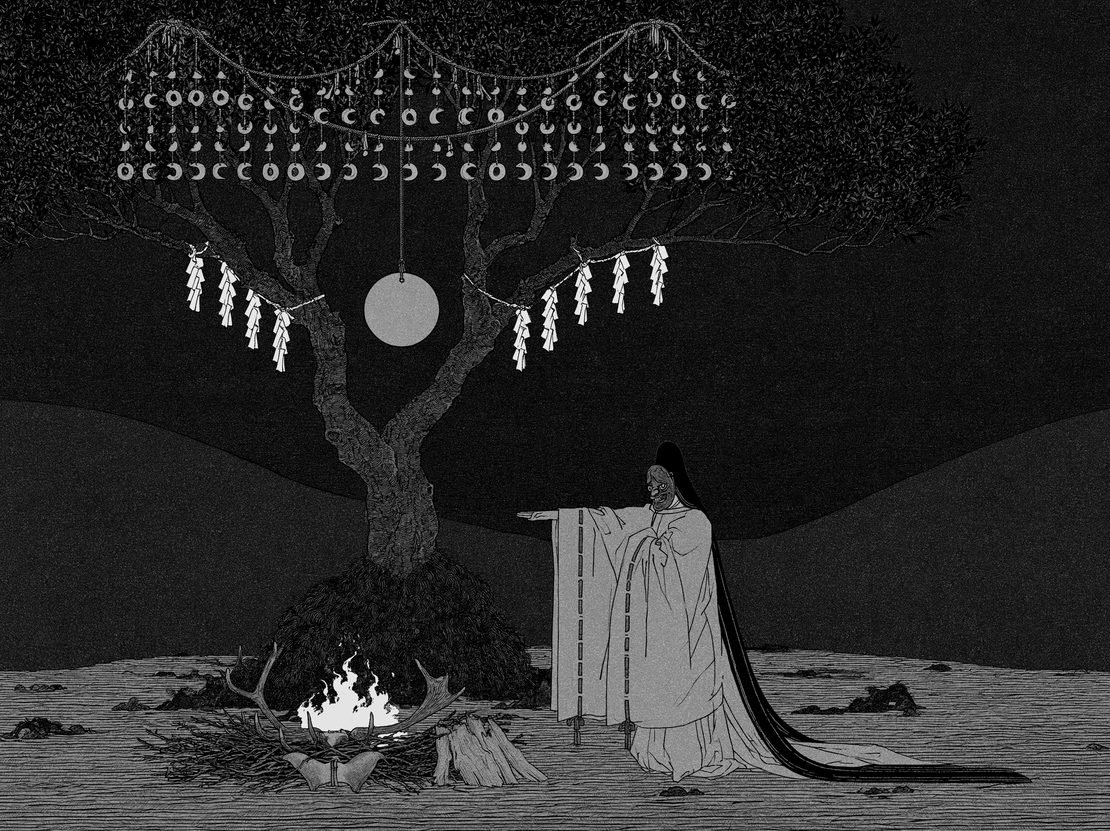
Then they divided the work. Two of them were to hold the tree up. One of them was to say the words. The strongest of them went and stood beside the rock, on the side where the door would swing, where he could not be seen from inside, and he stood there for a long while before there was anything for him to do, which is the part of that night nobody tells.
Every part of it was preparation for one moment, and the moment depended on a woman getting the goddess to open the door.
There was nothing in the procedure that could make that happen. That was the hole in it. They could make a mirror and they could hide a strong man behind a rock, but somebody had to produce, out of a plain of gods standing in the dark with nothing to be cheerful about, a sound convincing enough to be worth opening a door for.
Nobody afterwards claimed to have been the one who said her name.
It came up the way such things come up in a council that has run out of procedure. Somebody proposed the birds, and the birds were tried, and they crowed, and the rock did not move. Somebody proposed that they should all call out together, and that was tried too, and it came out as noise and not as anything, and it stopped raggedly and left the plain quieter than before. Somebody said that what was wanted was not a summons but a reason. Somebody said that it would have to be something that could not be prepared for. Somebody else said that it would have to be a noise, but a particular one. And then there was a pause, and then the assembly was looking at one god and not at the others.
She did not decline it. That is all that is on record about the appointing, and it is more than most appointments get.
She asked for the things she needed and they were brought. Vine from the fragrant mountain, to loop over the shoulders and tie back the sleeves, which is what a woman does before any work that uses the arms. A twist of masaki for the hair. Leaves of bamboo-grass, bound into two bundles, one for each hand. All of it is the ordinary equipment of somebody about to do something in front of a god, and all of it was assembled in the dark by people who had run out of ideas.
The tub was somebody’s. It had been brought out full of something and emptied for this, because a tub in use is not standing about a riverbed waiting to be turned over, and whoever it belonged to had to say yes and then watch what was done with it.
They turned it upside down in front of the cave.
Uzume got up on it. It took a moment to find the middle of the boards. The wood gave slightly and she stood there and let it settle.
She began with her feet. She brought her heel down on the boards and the sound of it went out across the plain and came back, and she did it again, and again, and the beat came up out of a walking pace into something faster, and the tub started to knock and shift under her, and she kept her feet.
Then she opened her robe at the collar and put her breasts out, and pulled the cord at her waist until the skirt of it came down and she was showing everything there was, in front of eight million gods, on a washtub, in the dark.
She was not there for it. Her eyes had gone out of focus and stopped taking anything in. She had the bundles of leaves in both hands and they were still going; her hair was down and flying and there was sweat coming off her in the cold, and none of it belonged to her any more.
One of them laughed.
It came out of somebody as a single sound, and somebody else went after it, and then it caught along the whole plain, the way a fire crosses dry grass — eight million of them, bent over, holding themselves, roaring in the dark in front of a shut door.
The rock moved.
A line of light came out at the edge of it, and the voice from inside said: What is this. I have hidden myself. Heaven and the reed plain should both be dark. Why are you enjoying yourselves?
Uzume did not stop dancing. She answered between breaths.
There is a god here better than you. That is why we are glad.
The two who were holding the tree came forward fast and put the mirror into the gap.
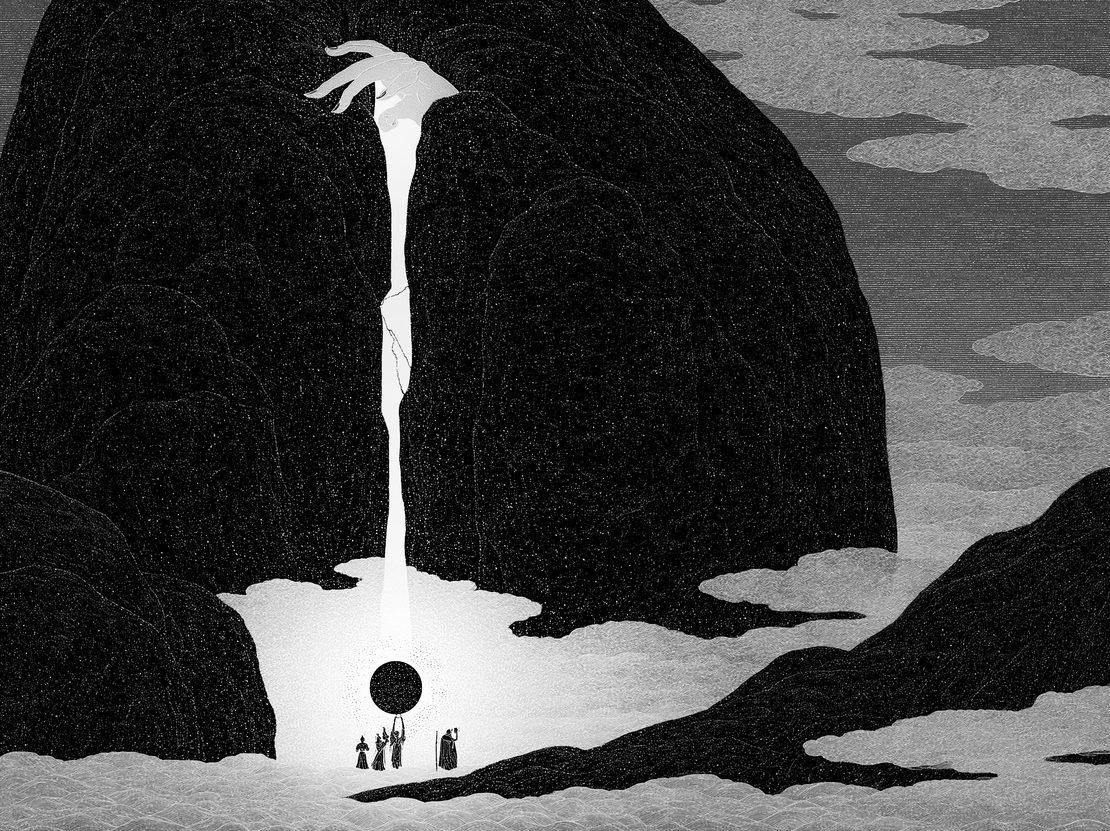
The goddess had never seen her own face. What looked back at her was bright and strange, and she leaned out to get a better view of it and pushed the rock wider — and the strong one had her by the wrist and had her out of the cave, and the rope went across the doorway behind her before she could turn round, and the god whose work it was said the words over it that meant she was not to go back in.
Light came back over the plain, and over the country of reeds below it, all at once. In the fields down there it arrived without warning on people who had been standing in the dark, and they put their hands up in front of their faces, and some of them sat down.
On the tub, Uzume came back into her eyes and found herself standing over a field of gods who were still laughing.
The tub was taken away afterwards by whoever owned it. Nothing in the account says it was kept.
Behind the Tale
This is the founding scene of the Japanese medium, and it is recorded twice, in the Kojiki of 712 and the Nihon Shoki of 720, and neither of them uses the word miko.
They do not need to. Everything the word would later mean is being done on top of the tub. The word the Nihon Shoki reaches for is wazaogi — the performer who amuses the gods — and it says she did it skilfully, which is the language one uses about a professional. The dance is the ancestor of kagura, the sacred performance still done at shrines; and the state she is in while she does it, in which her eyes are open and she is not behind them, is the state every woman in this book is hired for.
The plan could have failed.
It is easy to read the episode as a piece of divine machinery — mirror, tree, strong man, door — and to treat the dance as the funny part in the middle. But the chronicles are quite clear about the sequence, and the sequence is that everything else is equipment. The equipment does nothing until the door opens, and the door opens because of a noise, and the noise has to be manufactured out of nothing by one woman standing on a washtub in the dark. If she cannot get eight million frightened gods to laugh, the mirror is a piece of polished metal in a tree and the world stays dark permanently.
The exposure is not a joke either, and the chronicles do not treat it as one. It is a technique. She is doing a thing that would be unthinkable in any other circumstance, in front of the entire assembly, in a condition where she is not aware of doing it — and the account states both facts side by side without smoothing either of them out.
Her later career is a separate matter and is not in this chapter. She goes down to the crossroads and stares out the giant who has stopped every other envoy; she takes his name and is given it to carry; her descendants, the Sarume, hold ritual office at court for centuries, and it is said that the last of the line was the person who held the Kojiki in memory before it was written. Those are good stories and they are stories about a career. This one is about a night when the thing had not worked yet.
The council’s exchanges, whose tub it was, and Uzume’s return to ordinary awareness are reconstructed here; the dance, the laughter, the mirror, the opened door and her reply at it belong to the chronicles.
This is the first of the 14 tales in MIKO, each one followed by a note on where it comes from.