A Man with a Sword
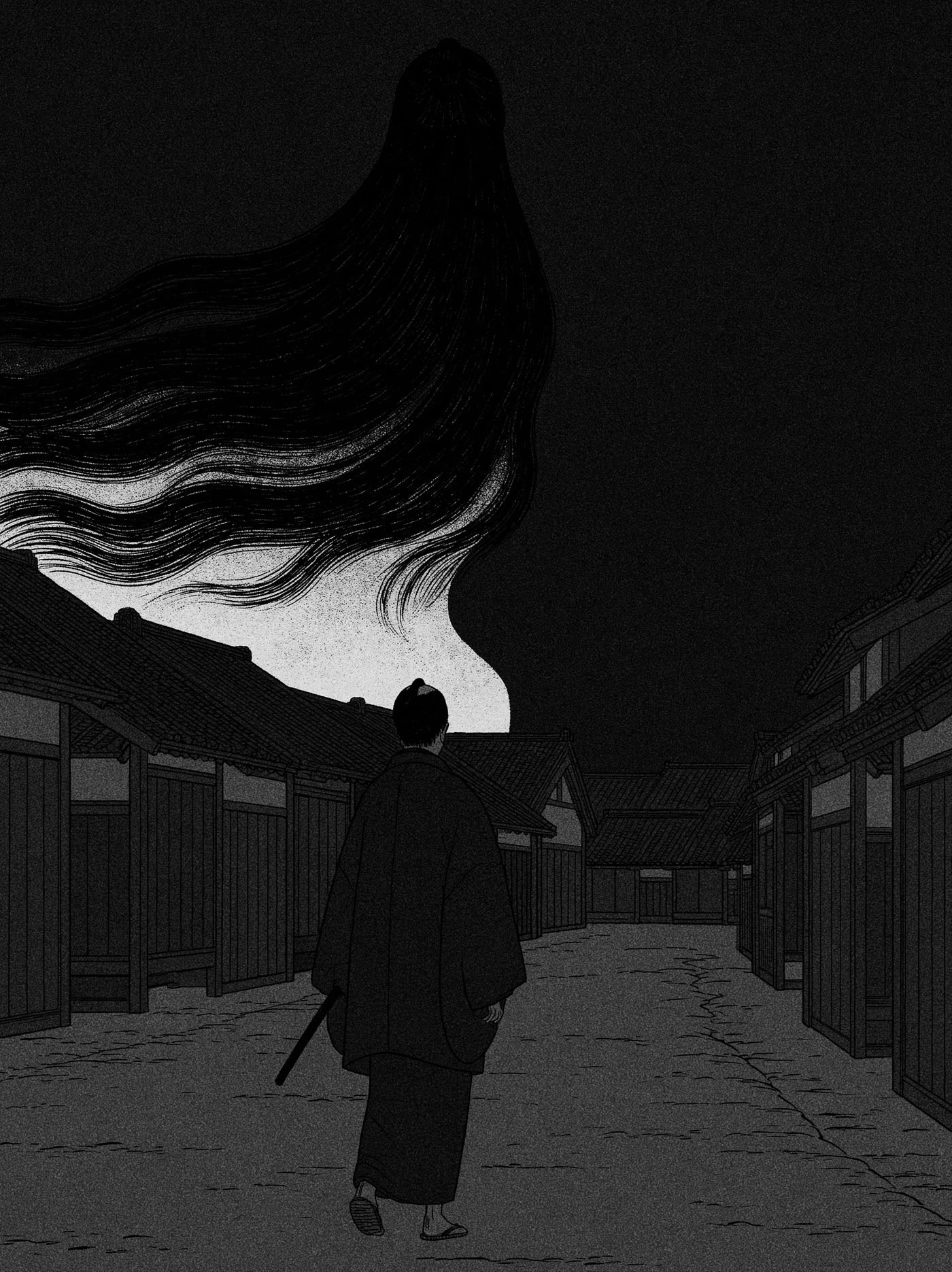
He was from Kita, and he had business in Fuchū, and neither fact explains anything that happened to him afterward. Men went up and down that road all year with less reason.
He came into the town later than he meant to. The shutters were closed along Kamiichi, and the lanes between the houses had gone the particular blue that comes an hour before anyone is willing to call it night. Somewhere behind a wall a dog gave two barks and thought better of it. He was thinking about where he would sleep, and about whether he had been cheated that afternoon, and about nothing else at all.
Then the air changed, the way it does in a room when someone has come in behind you.
He looked up because there was no reason to look up.
It was above the roofline, out over the middle of the street, and at first he took it for a paper lantern that had got loose. It was pale and it was moving without hurry. It came along the line of the eaves the way a person walks a familiar corridor in the dark, and when it turned he saw that it had a face, and that the face was a woman’s, and that below the jaw there was nothing at all.
The hair came after it like water.
He had drawn his wakizashi before he had decided to. That is worth saying plainly, because he thought about it for a long time afterward and could never find the moment where he chose. His hand simply had the blade in it, and his arm was up, and he was already moving.
She smiled at him.
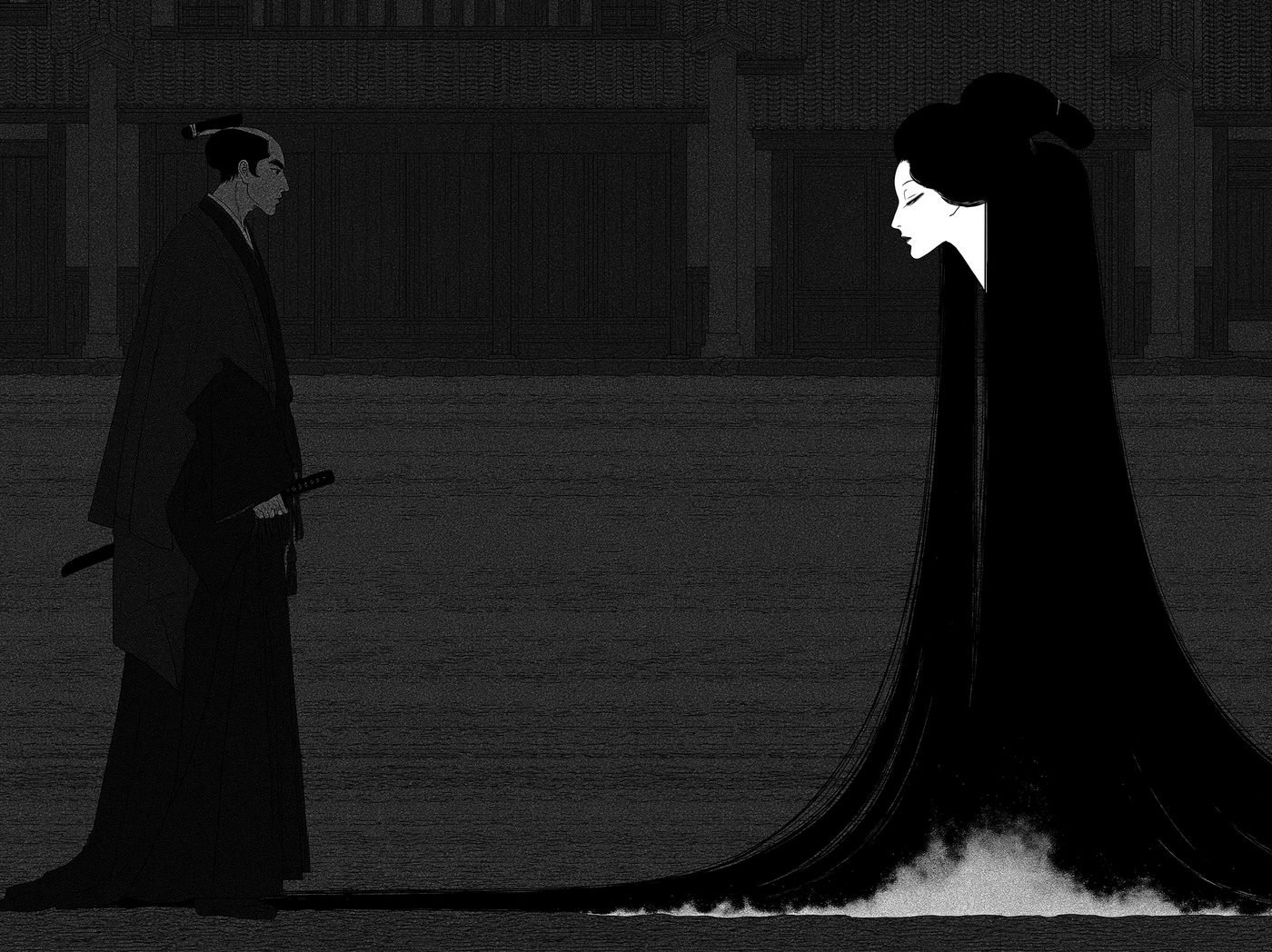
Not a grimace. Not the face a thing makes before it comes at you. She smiled the way a woman smiles at a stranger in the street who has caught her eye by accident — mild, a little amused, entirely without threat — and then she went away from him along the eaves, unhurried, and he ran after her with a sword in his hand.
He was not brave. He wanted that understood. A man who is frightened enough will run toward a thing rather than stand still with it behind him.
The town was asleep and the town stayed asleep. That was the strangest part of the whole night, he said later — that he could run down the middle of Kamiichi with a blade out and no one opened a shutter. The lanes went past. A stack of firewood. A well-cover. A cat that did not move. His sandals were loud on the packed earth and nothing in that town heard them. She kept ahead of him without ever seeming to try, and twice she looked back, and both times she wore that same mild expression, as if he were something she would have to mention to someone in the morning.
At the corner of the fourth house she rose, cleared the wall, and dropped out of sight into the yard beyond.
He stopped with his hand on the wall.
It was an ordinary house. That was the thing he could not get past, standing there with his heart going and the sweat cooling on him. It had a mended shutter and a broom leaning where a broom leans in ten thousand houses. There was a little light in it, turned low, the way a house keeps one going all night without meaning anything by it.
He should have gone away. He knew that even then.
Instead he went to the door and struck it with the flat of his hand, and kept striking it.
“Get up,” he said. “Get up. There’s something in your house.”
Inside, the light moved. A man’s voice came through the wood, thick and slow. “What’s the hour?”
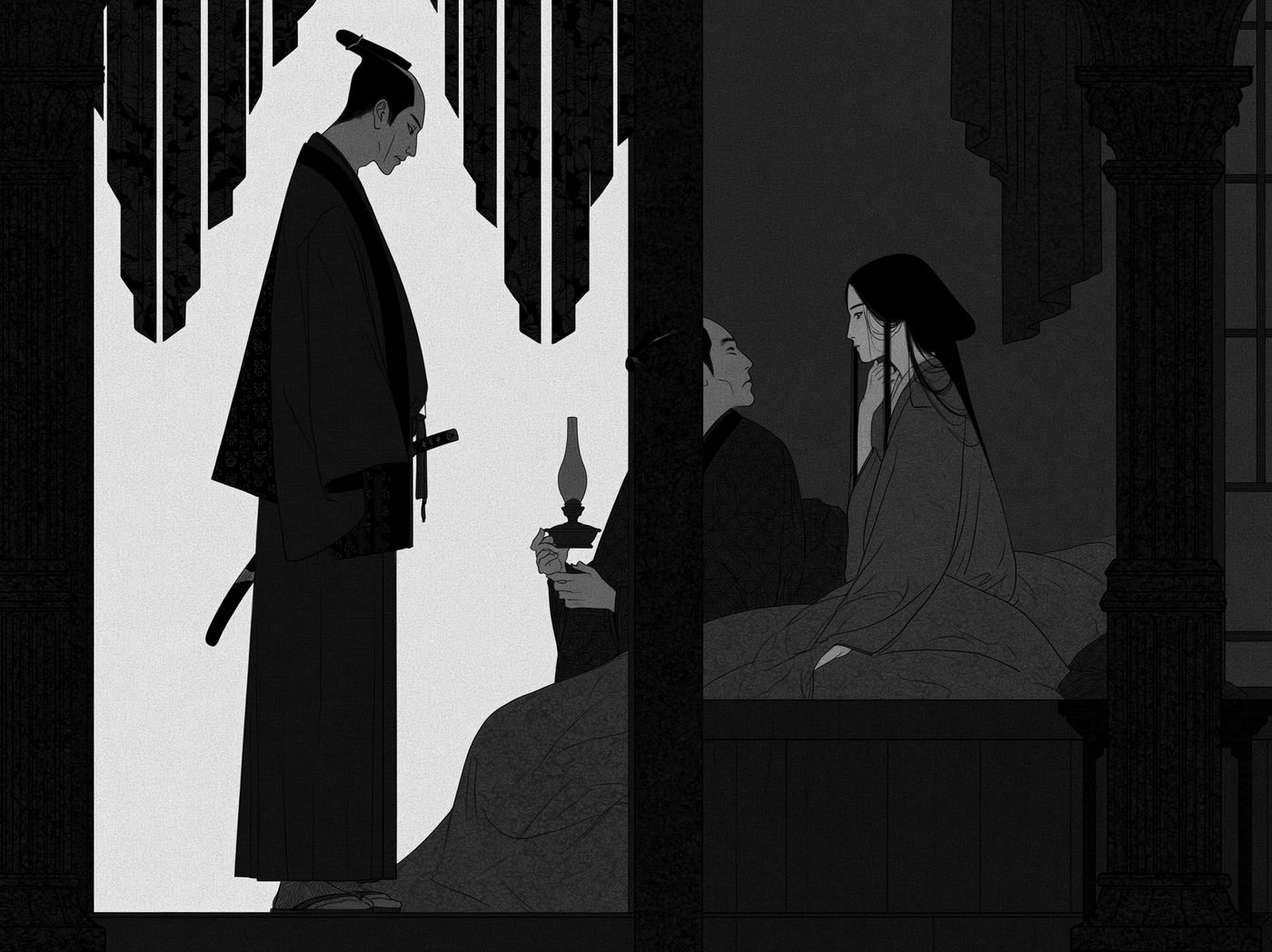
Then the door came back, and there was the householder with a lamp, the flame leaning hard as he came, and behind him at the edge of the light his wife was sitting up in the bedding with her hair down and her hand at her collar.
The householder saw the sword and stopped where he was.
“Put that away.”
“I followed it here.”
“Followed what?”
“A woman’s head.” He heard himself say it. He said it anyway. “It came along the eaves from Kamiichi. It went over your wall not a minute ago.”
The householder did not answer that. He held the lamp a little higher and looked at him for a while, at his face and at his feet and at the blade.
“You’ve been drinking.”
“No.”
“A fox, then.” He said it the way a man says a thing he would like to be true.
“It had a face.”
“Foxes have faces,” the householder said. “And I’d thank you to lower your voice, because there is no head in my house, and my wife —”
“I was dreaming,” she said.
Both men stopped.
“Just now,” she said. “A man was chasing me with a sword.”
The householder laughed. It was the short, relieved noise a man makes when he has decided that the strangeness in his house is going to turn out to be a misunderstanding after all.
“There,” he said. “There it is. You’ve stood shouting at my door and frightened my wife into a dream about you.” He turned back to the room. “Go to sleep. It’s nothing.”
Neither of the other two was listening.
She had put her hand up to her throat while she spoke, the way a person does when they are remembering a dream and have not finished waking. She held it there. And the man in the doorway looked at the place where her fingers were and thought about the pale thing going along the eaves without hurry, and about how it had smiled at him — not the smile of something hunting, he understood now, but the ordinary smile of a woman who has met a stranger’s eye and thinks nothing of it — and he found that he could not make his mouth work.
The householder was waiting.
He put the sword away.
“I was mistaken,” he said. “A fox. Or a lantern. I’m sorry to have woken the house.”
The householder shut the door.
He did not sleep, and he left the town before the shutters opened.
He told someone. Men do. The story got about the way stories do in a place that size.
Later, the story says, she withdrew to Saga, in the hills west of Kyoto. There she had a small hut built at the far end where the road gives out, and devoted herself to prayer, and in time died a good death. It does not say why she went.
People said afterward that such things as rokurokubi do exist. They said it in the tone men use for weather and for prices — a thing established, no longer worth arguing. He never said it.
He had run through a sleeping street with a blade in his hand, chasing something above the eaves. She had lain beside her husband and dreamed that a man with a sword was coming after her.
And he was.
Behind the Tale
The telling used here was printed in Kyoto in 1677, in a collection of a hundred strange stories, and it is very short — a few hundred characters. The original gives the chase, the dream, and the hut at Saga, west of Kyoto; the scenes between them have been opened out here.
A closely related earlier telling exists, printed fourteen years before, and in that one the word rokurokubi never appears. What goes through the air is not a monster with a name. It is called a woman’s lingering attachment — her mind, wandering out of her while she sleeps, and getting itself seen. The name arrived with the retelling.
Neither text will tell you whether her head physically left her body. Neither one says, and this retelling preserves that uncertainty: nobody in the story checks.
The old text does not say why she withdrew to Saga. It gives her the hut, and a good death, and no explanation. That silence has been left as it was found.
This is the first of the 15 tales in ROKUROKUBI, each one followed by a note on where it comes from.