The Wand That Would Not Lift
While Seimei was away across the sea, learning the deep parts of his art from masters in China, his enemies at home had not been idle.
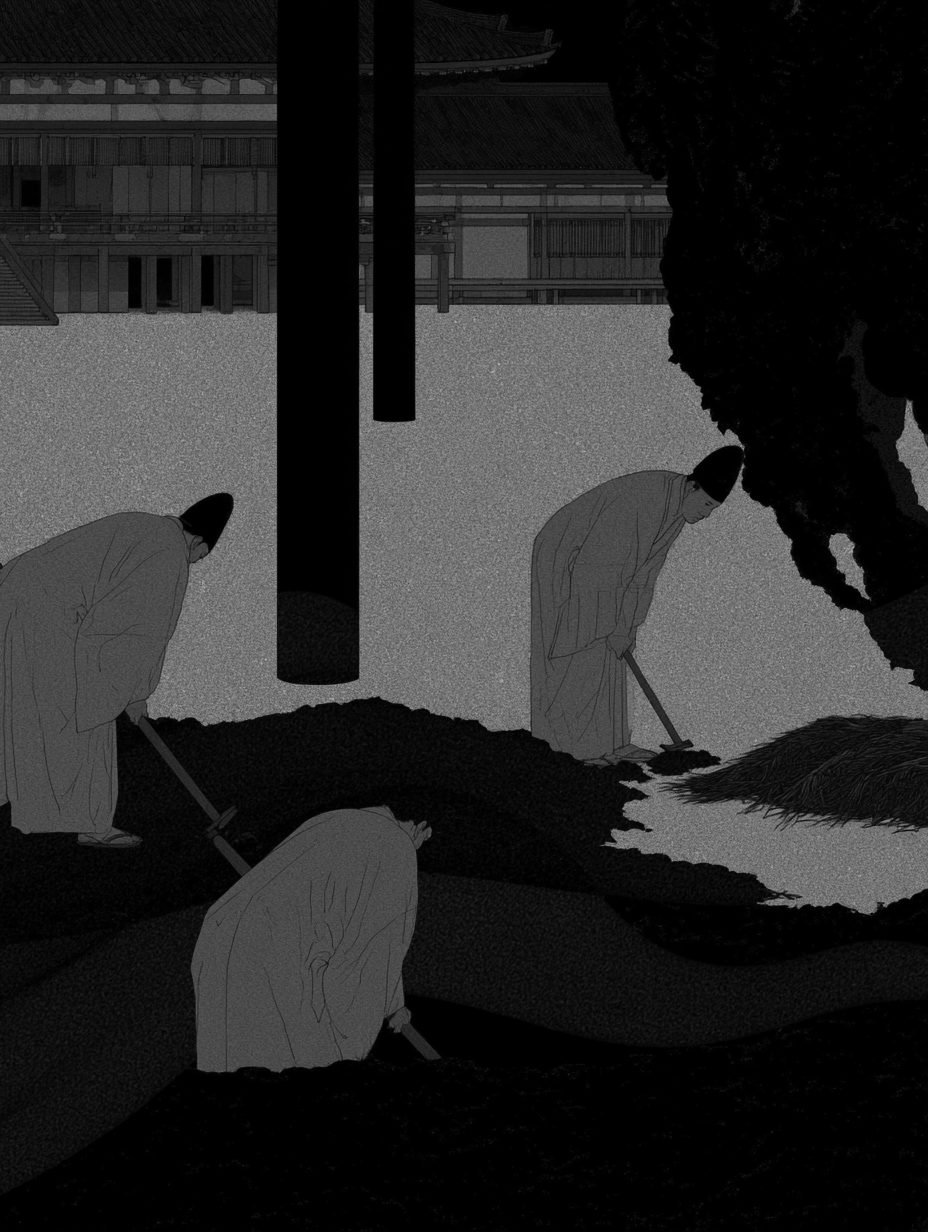
Fire had been carried into the palace grounds one storm night — carried in, struck at, and never brought alight, as a later tale will tell — and the blame for the carrying had been laid, with great care, at the door of two brothers of the Minamoto house — loyal men, soldiers, the kind the court could least afford to lose. The men who had built the trap had built it well. The evidence ran one way. The brothers protested their innocence, and the protest counted for nothing, and the sentence was decided: trial by ordeal. Three pits would be dug in a courtyard, each deep enough to take a man to the waist; the men would be set down in them and bound so they could not climb; and grass would be heaped around them and fired — cut green and bound damp, for the ordeal was not made to burn a man. It was made to smoke him, slowly, until heaven or his own throat gave an answer. Heaven, it was said, would spare the innocent.
Three pits, for the ordeal had three names in it: the two brothers, and the man whose confession had put them there — the self-declared hireling, already condemned out of his own mouth, who was to stand the smoke beside the men he had sworn against. The logic was admired: if he came through it with his story unshaken, the story stood.
One man at court did not like it. The Minister of the Right observed that if this was to be done at all, it should not be done in the yard of the police bureau, out of sight; let it be done before the Great Council itself, in the open, in front of every official in the capital. He could not stop the ordeal. He could make certain there would be witnesses.
The move into the open spoiled, though nobody said this aloud, certain small arrangements that are possible in a bureau yard and not in front of a hundred officials — which side of a man the grass is heaped on, which way the wind is allowed to lean, how damp the bundles are bound and for whom. Before the whole court, the smoke would have to be honest, whatever else was not. So the pits were dug in the great courtyard, and stood open while the court found its day; and the brothers waited under guard in sight of them, which was itself a punishment no one had had to order.
That was how matters stood when Seimei came home.
He came quietly, and the tale is exact about why he came at all. His teacher — the old master across the sea, who read skies for a living and distance for nothing — had called him in one day and given him his leave unasked: in great Japan, the master said, a matter has arisen that touches the lives of two brave men; go home and stand in it; and when it is finished, come back to me. A hundred days he gave him. Seimei asked no questions the tale records. He came the way any traveler comes — on foot, in road clothes, his baggage on a porter’s back. So he heard the whole business the way travelers hear things: in pieces, sideways, from men who did not know his face. A ferryman had it that two Minamoto soldiers had burned the palace and would die for it. A carter, further along, had the same story with the fire twice the size. At the gate of the capital the gatekeepers knew the day appointed for the ordeal, and were arguing over whether smoke could be relied on to respect a Minamoto more than the next man. And one of them, making conversation with the dusty stranger, told him about Seimei — the great diviner who had gone over the sea years ago, who could have read the truth out of a business like this in an afternoon, and who was far away, and no use to anyone.
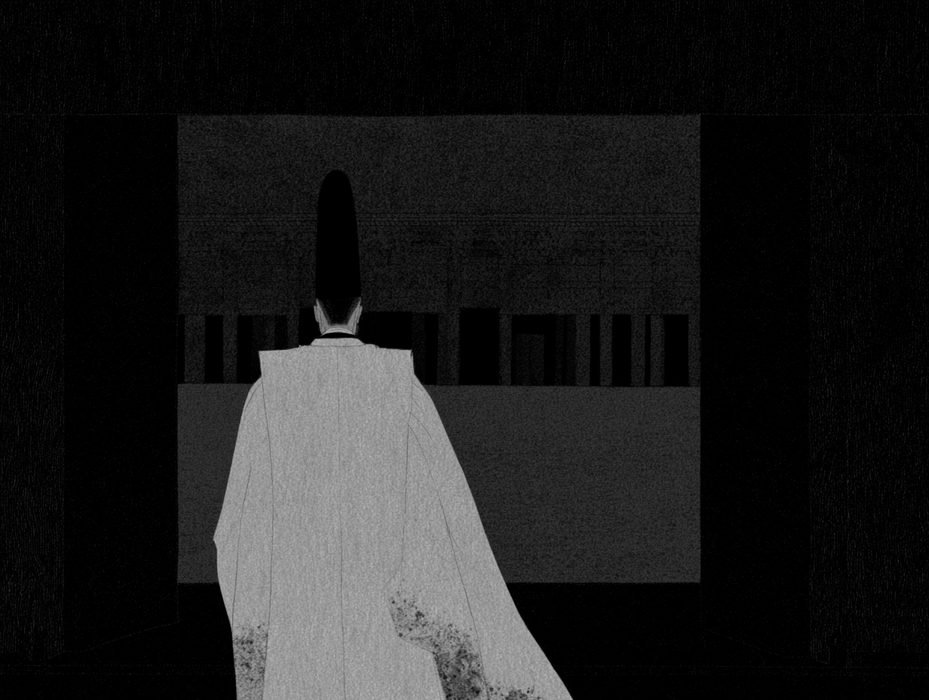
He did not go to his house. He went to the Great Council, dust and whiskers and all, and had his name cried in at the gate: Abe no Seimei, returned this day from across the sea, asking leave to enter. One thing every line of the telling keeps is the hall’s first sight of him. The name went in ahead — Abe no Seimei, the great diviner, home from over the sea — and what came in behind it was a traveler: road-clothes gray with wear, the hair and beard of a man long past barbers; and the assembly, says the teller, started at the sight as one man. What was said next, the tellers enjoy telling and do not entirely agree on. What matters is that the fire had not yet been lit.
What he carried with him, among the instruments of his art, was a wand of office — a short ceremonial staff hung with folded paper, the kind held up at purifications, the kind a child could lift with two fingers. In front of the assembled court he set it down on a stand, and bowed to the officials, and said what he had come to say.
This is an instrument for the judging of true and false, he said. It weighs nothing in an honest man’s hand. Let each man concerned in this matter come forward and raise it.
The brothers were brought out first, half-dead already from waiting — men who had sat for days under guard in sight of pits with their names on them. The elder was so worn that two officers helped him to the stand; the court watched his cracked hand close on the shaft, and the wand went up like what it was, paper and a stick, the lightest thing in the courtyard. He stood holding it aloft as if he could not believe the weight of it, or the lack. Then the younger did the same, and something went through the assembly that was not quite sound.
Then the officers of the accusation were called forward, one by one, because the trial was public now and no one could decline to be tried — no one, that is, whose hands could plausibly have touched the thing. The wand was offered to officers and serving-men; the lords of the accusation were not asked to lift so much as a sleeve, and nobody in that courtyard found the exemption strange. This is the part the tellers linger over — the list. Man after man came up to the stand, and every man in that line knew, walking, that the stick weighed nothing and might weigh anything; and the court learned to read each verdict in the instant before it was given — in the set of a shoulder, in the breath let out as the wand rose. Some lifted it briskly. Some lifted it the way a man puts his hand into fire. It rose, and rose, and rose; and every time it rose the courtyard grew a little quieter, because the wand was working its way down the accusation, and there was nothing waiting at the end of the line but the truth.
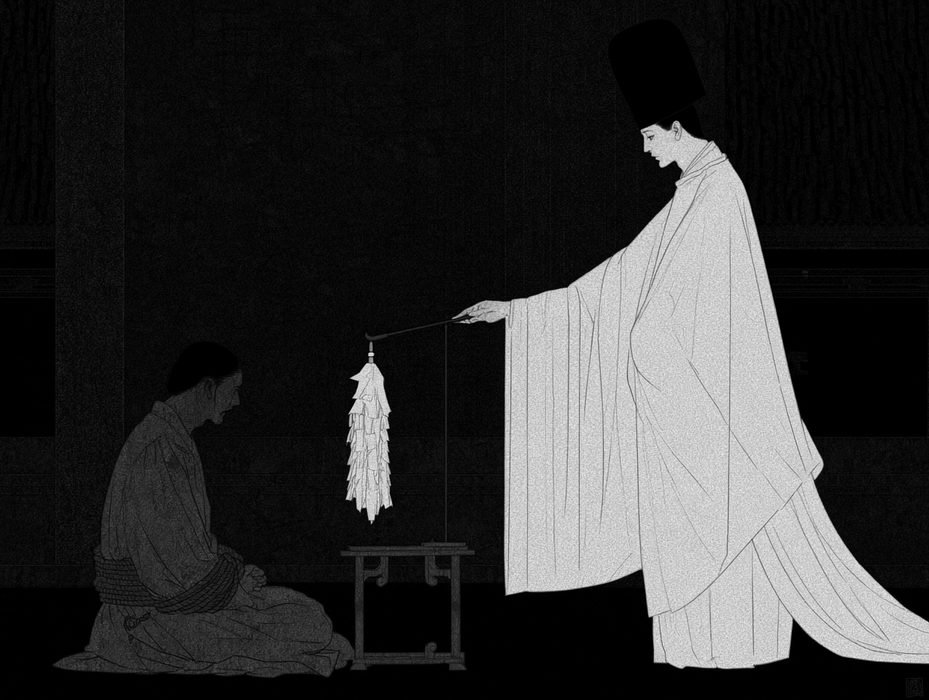
Last of all they brought the confessed man himself, up from his guard, in the good borrowed clothes he had been taken in — the man whose sworn story was the whole of the accusation, and who had held that story through every question put to him. The wand was one more question. He stepped up to the stand briskly, the way he did everything, and took hold of it.
It did not lift.
He set his feet and pulled, and it did not lift. What he was holding no longer weighed what paper weighs; by his face, and by the cords of his neck, it weighed more than any number of men could raise, and it sat on its stand like a mountain sitting on the floor of the world, and the whole court watched him strain against a stick of wood until something in him gave way.
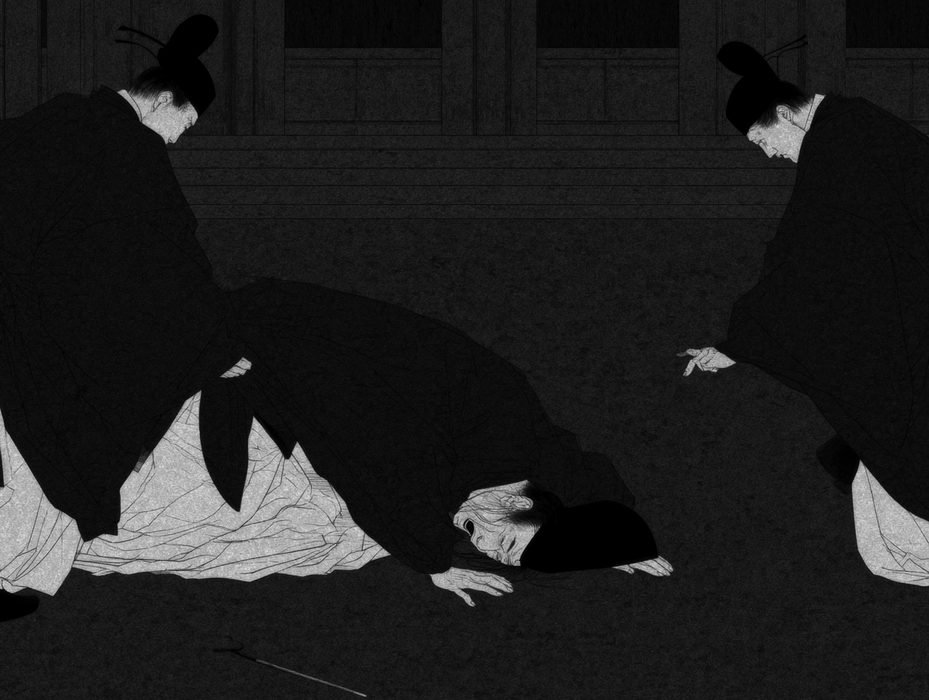
He confessed from the ground. The night in the palace garden had been his work — his hands, his flint, on instruction. And when they pressed him for the name of the man whose instruction it was, he bit through his tongue, and died in the courtyard in front of the assembled officials, and took the name with him.
Seimei looked at the dead man for a long moment. Then he said — and the court kept the words — that the man had died rather than speak, and that it would not matter: heaven shines plainly on such things, and the day would come, of itself, when the wicked one stood exposed. He said it to the whole courtyard; and somewhere among the robes at the courtyard’s edge, in one breast or another, a relief that had just begun to breathe stood still again for the length of that sentence. The tale does not say whose. It did not need to, and neither does this book — the next tale supplies the rest.
The brothers were cleared before the sun moved. Seimei went back to his office and his house. The court, which had been ready to smoke two innocent men to death in a bureau yard, went on with its day.
There is one more thing, which the tellers who kept this story never let fall out of it. Among the things Seimei had brought home from China was a small sealed box, given him by his teacher. It stood in his house through everything that came afterward. He never opened it. Nobody ever opened it.
Behind the Tale
A wand of office is the lightest thing in any ceremony — a short stick hung with folded paper, held up at purifications — and that is why a storyteller looking for an instrument of judgment reached for this one. The weight is supposed to be nothing, so any weight at all is a verdict. The ordeal it displaces is worth a moment: smoke rather than fire, grass cut green and bound damp, heaven expected to spare the innocent — and a minister who could not stop it moving it into the open, where a hundred officials would be watching which way the wind was allowed to lean. Half the justice in this courtyard is done by procedure before any wonder arrives. The men who kept this story were working in the printed storytellers’ books of late-Meiji and Taishō Japan, and their court is a storyteller’s court. It takes real names and real era-dates and moves them freely: the Motokata of the record was a Great Counselor dead a dozen years before the storm night these tellers date so exactly, the reign they chose had no regent at all, and the capital of that century carried out no executions. The dates are the tellers’ furniture, not the calendar. The sea-crossing is theirs too — the record shelf never sends him abroad, and the master in China, the hundred days and the sealed box all belong to the legend that grew around him centuries after. They do not agree with one another either. In one line there is no wand at all: the homecoming is announced by a thunderbolt on the roof of the Great Council, and prayer does the judging. Common to every line: the three pits, the insistence that the ordeal be public, the confession, the bitten tongue, and the name that was never spoken. Here the box stays shut, and the hundred days are never counted out.
This is the first of the 18 tales in SEIMEI VOL.02, each one followed by a note on where it comes from.