The Mansion on Cat Mountain
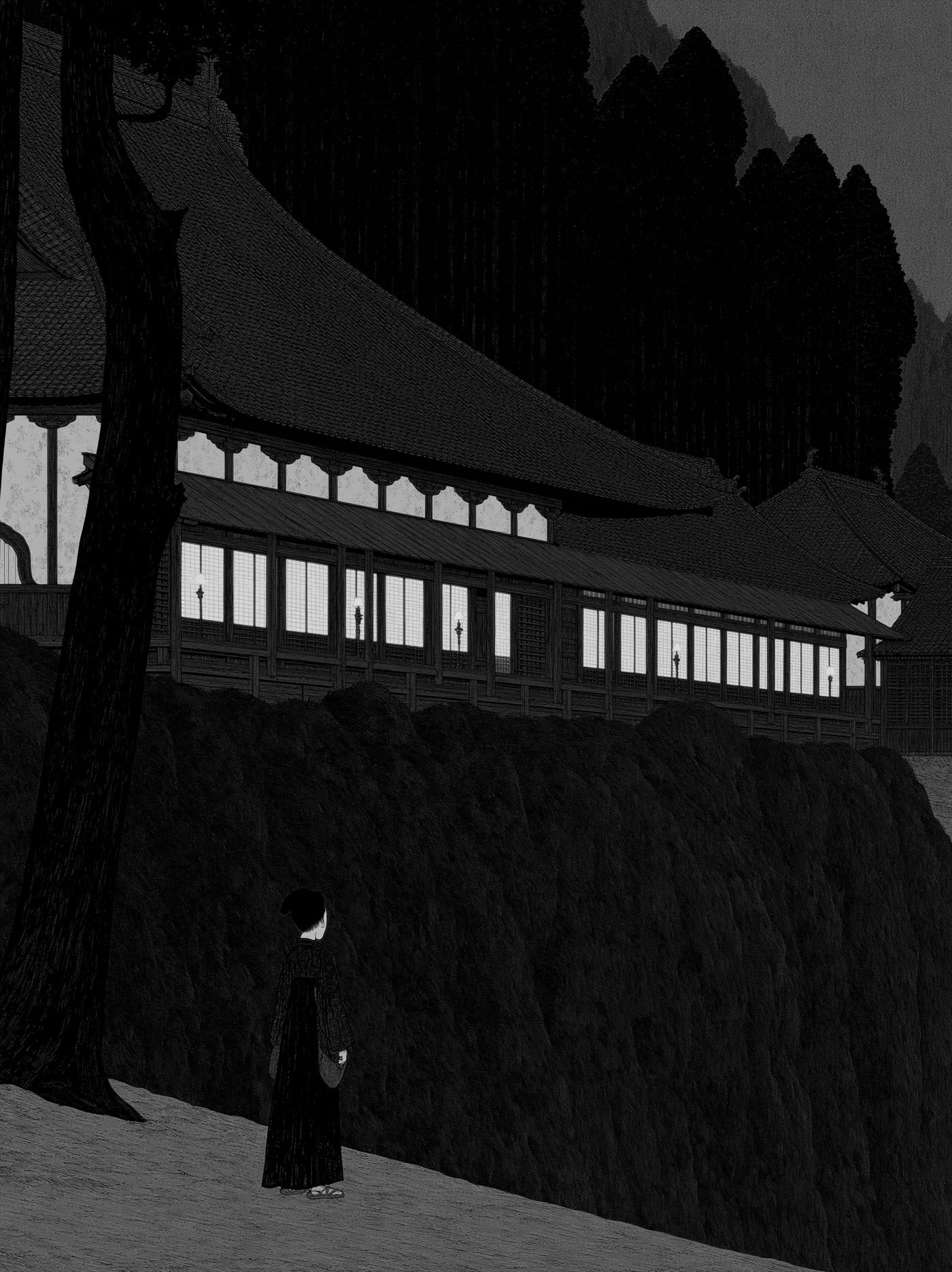
Oume came to the big house the year her parents could no longer feed her.
Her service had a length to it: a number of years, fixed before she arrived, agreed between her father and the master. She was told the number once. After that she counted it down each winter, the way other people count money. The work she could bear. It was the rest of it she could not — a house full of people who had known one another all their lives, and a girl in it who belonged to none of them.
She found the kitten in the drainage ditch behind the kitchen, in the season when the rain does not stop. It was half-drowned and no bigger than her two hands. She dried it inside her sleeve, fed it from her own bowl, and when it lived she tied a small bell at its throat so she would always know when it was coming. The sound arrived everywhere a moment before the cat did. Suzu, she called it. Bell.
After that the house was not silent.
The mistress could not abide cats. She raised her foot at every soft shadow that crossed her path and threw hard words after it.
“Why do you feed such a creature? It eats what you eat. Drive it out.”
Oume bowed her head and said nothing, and went on halving her rice.
The number went down. Oume grew — out of her sleeves, out of being the newest and most useless person in the kitchen — and every winter she took one off it and put it away. Suzu grew too: heavier, then slower, then grey around the mouth, until it no longer troubled to hunt anything it could not reach from where it was already lying. The bell went everywhere. The other maids stopped hearing it the way you stop hearing rain. The mistress never did.
Then one morning there was no bell.
Oume listened for it through the water-carrying, through the sweeping, through the long grey afternoon. She listened for a week. The mistress breathed more easily. Oume did not eat much.
A travelling monk came through at the end of that month and found her at the well.
“You’ve been crying,” he said. Not unkindly.
“A cat I kept. It’s gone.”
“Then don’t grieve. Cats go to the mountain when they get old.” He said it plainly, as a man gives directions to the next village. “There’s a mountain away in the west where they gather. If it’s living, it’s there.”
“How far?”
He looked at her a moment, as though he had not expected the question to be serious.
“Days,” he said. “More than you have.”
She asked for leave that evening. The mistress laughed at her, and then, seeing her face, stopped laughing and gave it — not out of pity, Oume thought afterward, but because a few days lent to a girl cost the house nothing it could not take back later.
She left before dawn with rice tied in a cloth and no clear idea of the road.
She walked for three days. The first day the country was the country she knew. On the second the fields ran out, the road began to climb, and the people she passed answered her in an accent she had to lean into. On the third there was no one left to ask. The cedars closed over the road and the light came down green and thin, and the wind on the ridges still had winter in it, though it was spring in the valleys below. She slept once under a shrine’s eaves and once in a woodcutter’s hut with no woodcutter in it. Her sandals gave out. She bound them with cord and went on.
On the evening of the third day she met an old man coming down with wood on his back — the last person she would see — and asked him for the mountain where the cats went.
He did not laugh. That was what frightened her.
“Keep to the road,” he said. “Further than you’d think. And girl — come down before dark.”
She did not come down before dark.
The light went while she was still climbing and the cold came up out of the ground, and she understood, too late for it to be useful, that she had nowhere to be. Then she saw a lamp.
A mansion stood in a fold of the mountain where no house had any business standing: too large for the thread of road that reached it, too fine for the country, with no village within a day’s walk. There was no dog. No smoke. No voices. She went to the door anyway, because the alternative was the cold, and asked, as any traveller might, for a night’s shelter.
A beautiful woman opened it. For a moment her face was kind. Then something crossed it, quickly, and her nails went dark at the tips.
“Shelter,” the woman said, and breathed in, slowly, through her nose.
Oume stepped back — but another was already coming out of the dark of the hall, an old woman, small and bent, waving the younger one aside.
“Forgive my daughter. She forgets herself.”
The old woman smiled, and went on smiling a little longer than she needed to, and while she smiled her eyes went over Oume — the shoulders, the wrists, the hollow under the cheek — the way a woman looks over fish laid out at a market.
“Come in, child. There’s no need to stand out in the cold.”
Inside there was steam rising off the bowls, and clean bedding laid ready, and a fire. The old woman filled Oume’s bowl twice and watched her eat both times.
“Poor thing,” she said. “Nothing but bone.”
The food was good. The room was warm. Oume lay down in the clean bedding and could not sleep at all.
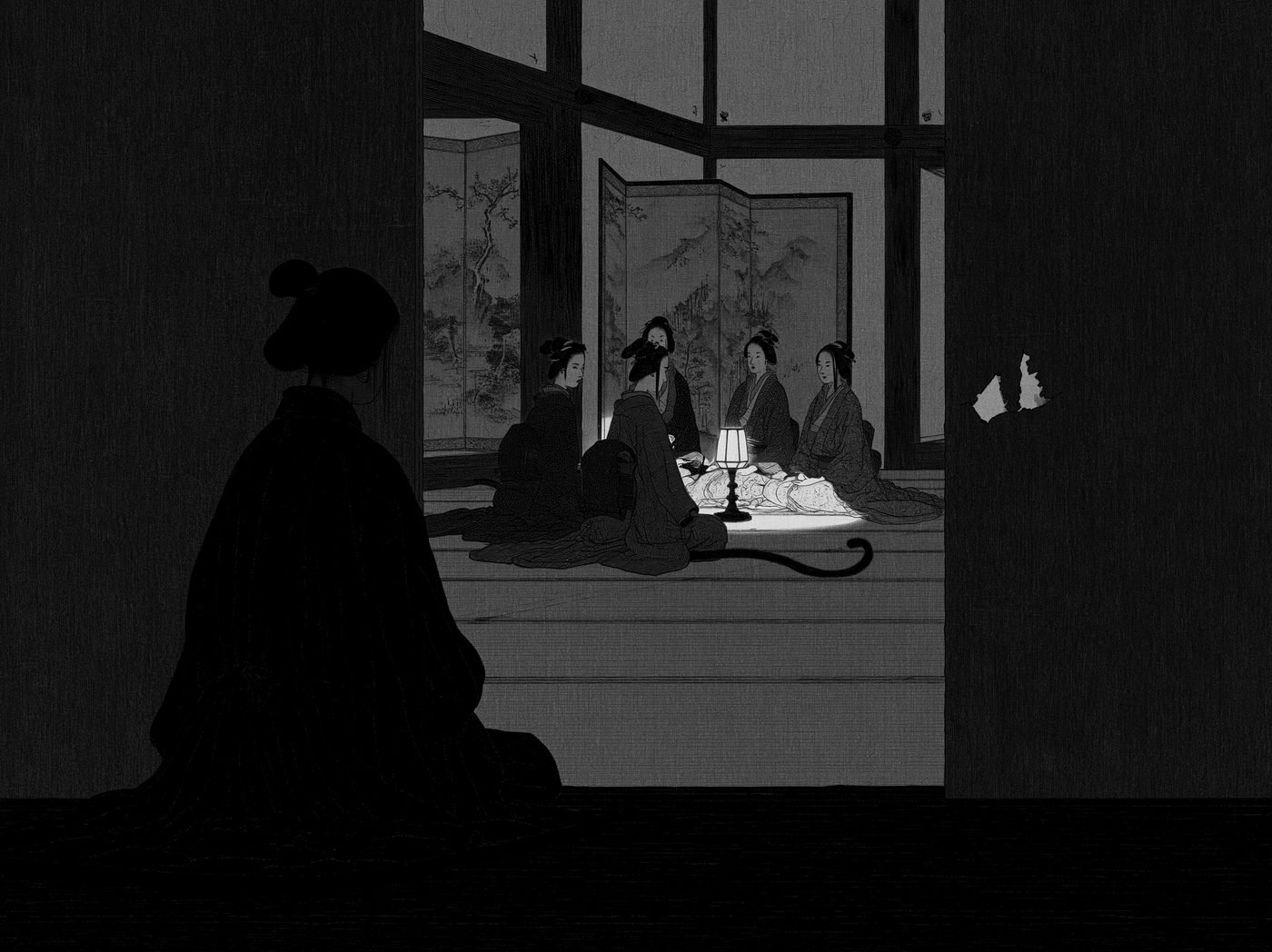
Near midnight, voices moved on the far side of the paper screen. She wet a fingertip and drew it down the seam until the paper gave.
Four of them sat in a ring in the lamplight. They were beautiful. One was stretching, and as she stretched a tail slid out from beneath the hem of her robe, thick and dark, touched the floor once, and was gone again under the cloth.
Oume did not breathe.
“She’ll keep till morning.”
“She’s walked three days. There’s nothing on her.”
“There’s enough.”
And then the old woman’s voice — patient, indulgent, the same voice that had filled her bowl twice.
“Let her sleep first. They’re better asleep. And you will wait your turn. You forget yourself at the door, and one night you’ll have us all going hungry.”
The others laughed. It began as a laugh. It did not end as one.
Oume understood then what she had walked into. Everything in it was as a house should be — the fire, the clean bedding, her own bowl still warm on the floor — and all of it was kept by cats that had lived too long and learned to wear a woman’s face. Bakeneko, people called them, when they said the word at all.
She was gathering her things — slowly, slowly — when she heard it.
A bell.
It came across the boards toward her, small and unhurried and completely familiar, and Oume put both hands over her mouth and made no sound at all.
Suzu came out of the dark and sat down in front of her. Its ears trembled. It looked at her a long moment before it spoke.
“You came,” it said, in a human voice. “All that way.”
“I looked for you,” Oume said. “I looked everywhere.”
“I know.” Suzu bowed its head. “Don’t grieve. Nothing was done to me, Oume. This is only what comes to some of us, if we live long enough — we come up here.” It did not say home. “Among our own kind, coming here is counted a rising in the world.”
It said this gently. To Suzu the news was good, and it seemed sorry that Oume could not hear it that way.
“But it’s no place for people. And I can’t come back with you.”
She reached out, and stopped, because she did not know any more whether she was allowed.
Suzu pushed its head up into her palm anyway.
“You pulled me out of a ditch,” it said. “I’ve not forgotten. But they don’t know you. To them you’re only a human, in a place people don’t come. I am only one cat, and there are many of them. I can’t answer for what they’ll do.”
It nosed something toward her across the boards: a small white bundle, tied shut.
“Don’t open it. Not here, not on the road. If they come, hold it out in front of you and keep walking.”
“What is it?”
“Something they’ll understand.” The bell moved as Suzu turned its head toward the corridor. “Go now, while the door still opens.”
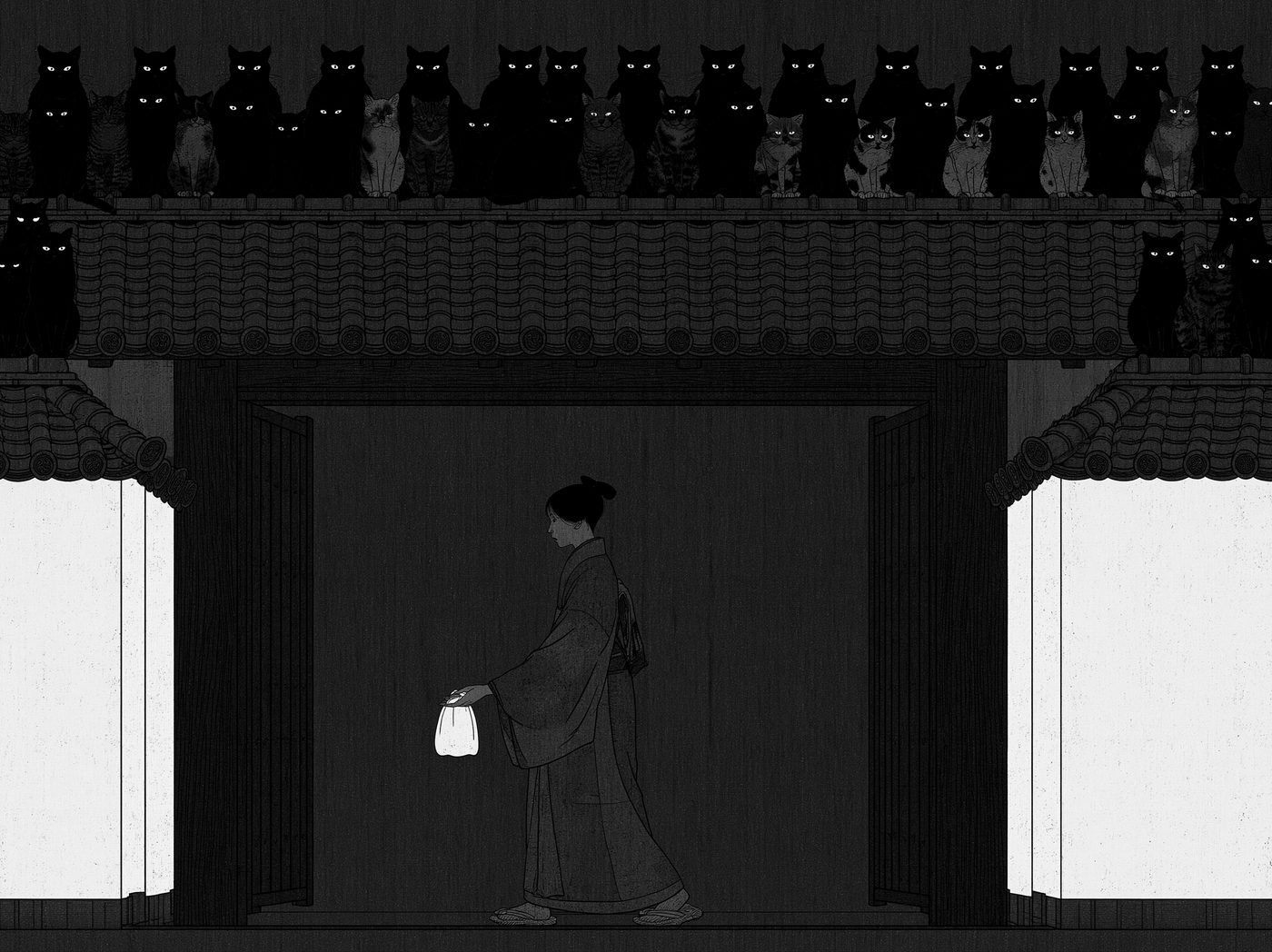
They were waiting at the gate.
Not women. Cats — more than she could count, banked up the walls and along the roofline, and every one of them turned to her at once, and their eyes took the little light there was and gave it back doubled.
Oume held the bundle out in front of her in both hands.
She never knew what they saw. They went back — all of them, together, the way water goes back off a stone — and the sound they made going was not anger. It was closer to fear. Oume went down through the dark with the cloth held out at arm’s length, exactly as she had been told, the only thing between her and them, and did not look at anything but the road.
She walked three days and did not open it.
She opened it in the kitchen of the big house, in daylight, with the door shut behind her. Inside was a sheet of paper, and on the paper a dog: brushed in ink, thick-necked, teeth bared, drawn so fiercely that she put it down on the boards before she meant to. In its mouth it held ten gold coins.
She was still looking at it when the coins came loose from the painted mouth and fell into her lap, one after another, and rang.
There is no keeping ten gold coins quiet in a house like that.
The mistress came down to the kitchen herself. She had kept the household’s accounts for thirty years and had a way of looking at money that was not quite greed; it was arithmetic. She looked at the coins on the floor and did the sum.
“Where does a servant come by such money?”
Oume told her everything and left nothing out: the mountain, the mansion, the old woman, the bowl filled twice, the voices behind the screen. She told her about the gate. Telling it, she believed she was giving a warning.
The mistress heard something else.
“Ten,” she said, “for a girl who scrubs the floor.” She was quiet a moment, adding. “Then the mistress of this house is owed a hundred.”
She went the next morning. She took a horse as far as horses go, and a man to carry her things, and sent him back at the tree line, because she did not intend to share. She would not be argued with. She went up singing.
The mansion was where Oume had said it would be. The beautiful woman came to the door, looked her up and down the whole length of her, and went back inside without a word. Then the old woman came out and gave her the same slow look she had given Oume, and found a great deal more to like.
There was no sound at midnight. The mistress slid the screen open anyway, because she had come for something and meant to have it.
They were sitting in a ring, waiting, and they were not women.
Her legs went out from under her. When she tried to scream, only air came.
Then one of them came forward — a cat she knew. She had kicked it out of her way a hundred times in her own corridors and had not thought of it once since the morning it stopped being there.
“You know me,” Suzu said.
She found that she did. She heard herself say the name aloud, in a voice that came out like a child’s.
“You never did before.” Suzu came on, unhurried, the way it had always come up the path to be fed. “You know me tonight because you want what I gave her.”
Its mouth opened. It kept opening.
It went for her throat, and it was quick.
By morning there was only the mountain.
The mistress did not come back. The house waited a season for her and then stopped waiting, and in the confusion of it nobody thought to ask why the girl in the kitchen wanted to settle her account. Oume counted out what was owed on her remaining years and put it into the master’s hand, and it did not take all ten coins.
She went home in the summer. Her mother looked at her twice before she knew her.
She kept the picture. It hung above the household altar in her parents’ house for the rest of her life — the dog still snarling, its mouth empty now, and it never gave up another coin.
And sometimes at night, when the wind moved the blinds, she heard it: a small bell coming up the path, unhurried, completely familiar. Stopping, always, just short of the door.
Behind the Tale
The earliest documented version currently identified was written down by Miyamoto Tsuneichi, the ethnographer born on Suō-Ōshima, the island in the Inland Sea. He published it as Nekoyama no hanashi — “The Tale of Cat Mountain” — a short account associated with Ōshima District, Yamaguchi, in the folklore magazine Tabi to Densetsu in December 1934.
Its shape is stranger than a summary suggests. A maidservant follows her lost cat to a splendid house on a mountain in Kyushu, where the cat comes to her by night, tells her that for a cat to arrive there is a rising in the world and no place for a human being, and sends her home with treasure; later the mistress of her household copies her, climbs the same mountain, and a cat she once kept bites through her throat.
A widely circulated televised retelling gives the characters and objects their familiar modern form: the girl’s name, Oume; the cat’s name, Suzu, after the bell at its throat; the fixed term of service she is working off; the cats in human shape debating whether to eat her; the closed white bundle; the fierce dog brushed on paper; the ten coins; the return to her parents. This edition follows that lineage. Which of these details are Miyamoto’s own and which came in with later adaptation is not, in the end, something we can say for certain.
The strangest detail is the bundle itself. Oume carries it closed. She holds it out closed, and the cats go back from it, and only afterward — safe, at home, in daylight — does she open it and find the dog. The cats need never have seen the picture at all. Perhaps they simply know what is folded inside; the tale leaves the mechanism unexplained, and this edition leaves it unexplained as well.
Kwaidanote retains the inherited structure while expanding its characters, journey, and horror, and adding original connective scenes. The mistress’s fatal imitation already belongs to the documented tale; we have expanded her motives and the staging rather than invented the episode. The ditch, the halved rice, the years that pass so that a kitten has time to grow old, the three days of road, the hospitality that is really an appetite, and the bell that comes up the path at the end are ours.
The currently identified record concerns extraordinary old cats at Cat Mountain, and nothing in it requires the forked tail associated with the nekomata; the later adaptation lineage this edition follows treats them simply as bakeneko. The present title therefore follows Cat Mountain itself.
The peak has never been pinned down. How a Kyushu mountain became the destination in a tale recorded from Suō-Ōshima, nobody can now say. But that seems only right. Cats have always kept their own maps.
This is the first of the 12 tales in BAKENEKO, each one followed by a note on where it comes from.