The Forbidden Match
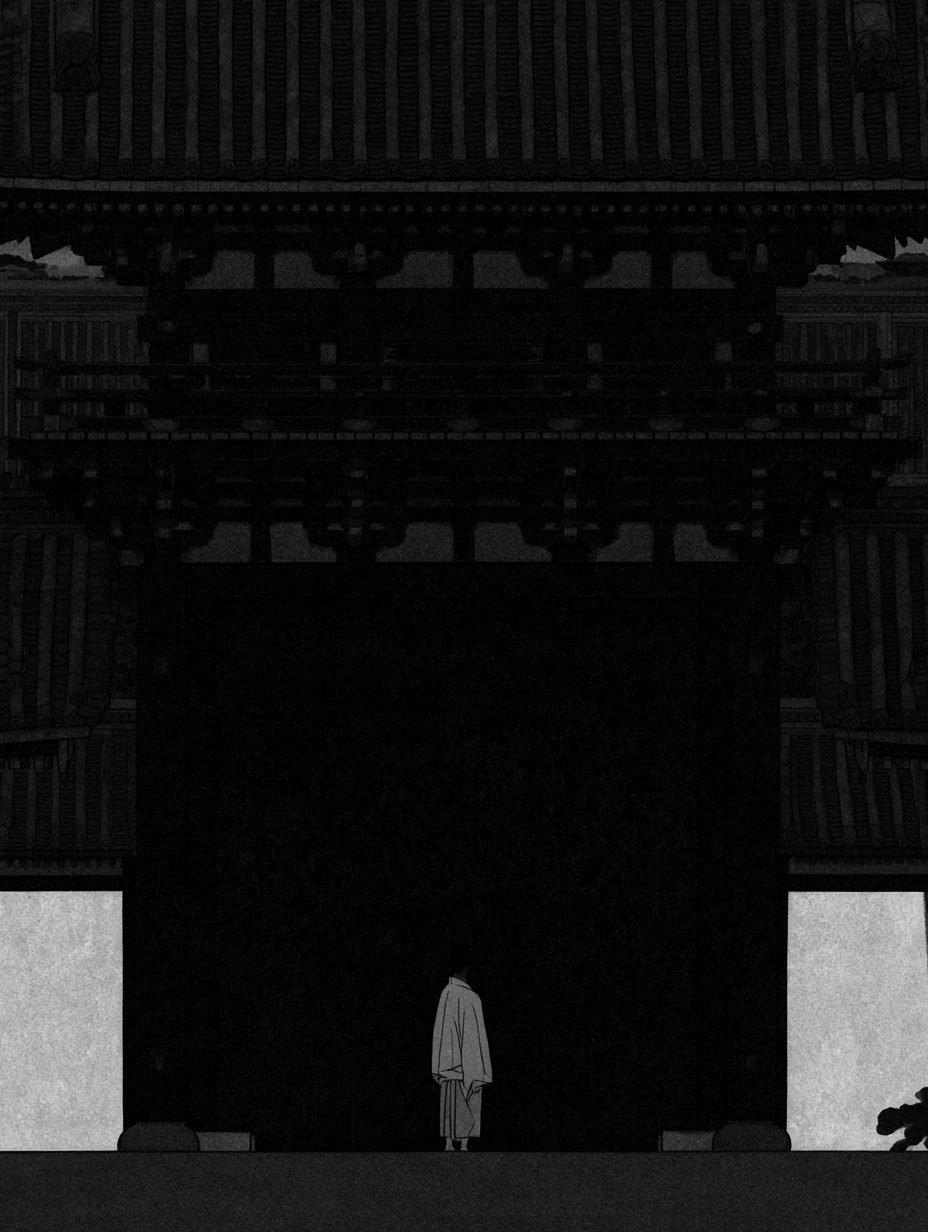
Two hundred years after the Treatise came home, in the village of Abeno in the province of Settsu, the house of Abe had come down in the world. The man who carried the name now, Abe no Yasuna, plowed the fields his ancestors had been granted for scholarship, and the neighbors who hired out their backs beside his knew his lineage only as a story he did not tell. A great house fallen to the soil keeps two possessions: its graves, and its resentment. Yasuna kept the graves swept. The resentment he turned into a plan.
For the house of Abe still owned one thing that no bad harvest could touch. In a lacquered chest, wrapped against damp, lay the Treatise of the Golden Crow and the Jade Hare — unread now for three generations, because the art of reading it had died with the family’s fortunes. How it had come home at all was the one story Yasuna’s father had told with the shutters closed. A son of this house, Abe no Nakamaro, had crossed the sea to Tang and been shut up in a tower there for knowing too much of it; he was never permitted to copy it, and he never came home. What he left, when every road was closed to his body, was written on the robe he died in, in his own blood — the openings of the great Treatise, the order of its chapters, the names under Heaven, and a poem about the moon over Mikasa — a dead man’s testament, folded and waiting in the tower. The book itself came home by later hands, in the embassy the realm remembers; but the family told that part differently: that no embassy would have carried anything home if the dead man had not gone ahead of it and opened the road — for the dead, said Yasuna’s father, finish their errands. A house may lose the art of reading such a book. It does not sell it. That book was the whole estate of Abe no Yasuna, and he looked at the chest each morning the way other men look at a debt.
So he went up to the capital, to the gate of Kamo no Yasunori, Master of Yin and Yang, Doctor of the Heavens, the first diviner of the age. The gatekeeper took one look at his hands and told him the school did not feed laborers. Yasuna agreed that it did not, and stood where he was. He stood through the morning; and when Yasunori himself crossed the courtyard at noon, the farmer bowed and named himself: Abe no Yasuna, of Abeno in Settsu — the Abe that had once been the Abe of the chronicles — and he had nothing else to offer, he said, except the name, and hands hard from the plow, and a book at home that his house had carried for two hundred years and could no longer read. Teach me to read it, he said, and set the price at anything I have.
The master looked at him a long moment — at the hands, longer than at the face; a man who reads faces for a living reads other things as well. What is the book? he asked. And when Yasuna answered — the Treatise of the Golden Crow and the Jade Hare — the first diviner of the age stood silent in his own gate for the space of three breaths, and then told the gatekeeper to feed the laborer, and took him in.
What he had read showed itself quickly. Yasuna learned the way dry ground takes rain. Within three years the pupil from Abeno stood above every senior disciple in the school, and the master began to speak of him, half in jest and wholly in earnest, as the one who would inherit the seat. Two people in that household watched his rise with particular attention. One was the master’s daughter, Kuzuko, who had begun to find reasons to pass the study where he worked. The other was a senior pupil named Yamamura Tomoo.
Tomoo had served the school for years, and he had let himself believe two things were promised him: the succession, and the daughter. The newcomer from the fields was now taking both, and taking them without effort, which is the taking men forgive least. Tomoo said nothing. Men of his kind never say anything until they say it to the right person. He only watched, and waited for Yasuna to make the mistake that every fortunate man makes at last.
The mistake was a moon.
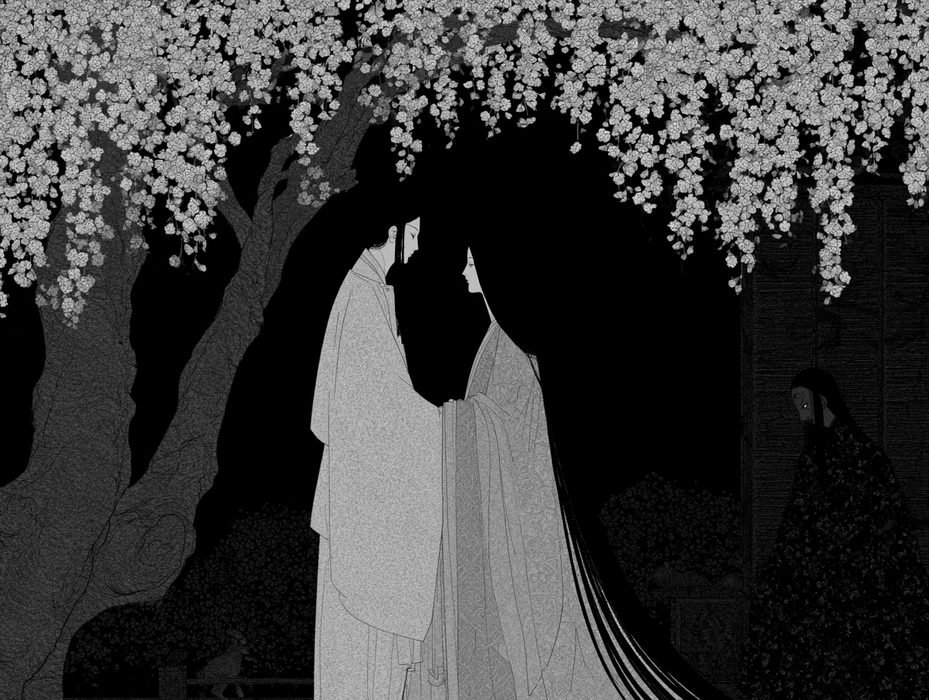
On a night in the eighth month, when the household had gone to bed and the garden was white, Yasuna and Kuzuko met beneath the old plum tree by the east wall to view the moon together — which is what lovers called it then; and the moon, that night, was thoroughly viewed. They had made no vows their families knew of. In that age, in a master’s house, that was not a small impropriety; between a daughter of rank and a pupil of none, it was a matter for magistrates.
From the shadow of the storehouse, Yamamura Tomoo watched them for the better part of an hour, and then he went away quietly and slept very well.
He did not go to the master. A household scandal, hushed inside the household, would ruin no one worth ruining. He carried it instead to a man who collected other men’s misfortunes the way connoisseurs collect tea bowls: the Great Counselor Fujiwara no Motokata, who had uses for a weakened Kamo house.
He was received at night, in a small room smelling of aloeswood, and the Great Counselor listened to the whole of it without once looking up from the brazier — the plum tree, the hour, the two figures, the particulars a watcher gathers in the better part of an hour. When Tomoo had finished, Motokata himself took up the wine-ladle, which a Great Counselor does not do, and filled the pupil’s cup, and watched him fail to drink it. You have done the school of Kamo a great service, he said at last, pleasantly. Though I expect it will be some years before they thank you for it. Then he sent the man home by the back gate, and sat on alone by the brazier, arranging a garden tryst into a rot in the pillars of Heaven’s learning — a corruption of morals, he would tell the throne, in the very school that kept the calendar of the realm.
The judgment came down within the month, and it fell the way judgments fall when a great man leans on them. On a gray morning an official of the Great Council stood in the gate of the Kamo school and read the decree aloud, in the flat ceremonial drone that makes ruin sound like weather: the school closed, the house broken, master and daughter to go down into exile at Kurumaza in Sagami, to a coast where nothing needed divining but the weather. Old Yasunori knelt in his own courtyard to receive it, in full robes, correct to the last syllable of the response; Kuzuko knelt behind him with her face perfectly still; and the seals went up on the gates while the household wept in the outbuildings.
Yasuna heard it from the road, among the crowd of neighbors, because a pupil in disgrace is not permitted past the seals — heard his master thank the voice that was destroying him, and could do nothing at all, which is a lesson the capital teaches early and Abeno never does. Through the gate, in the moment before the seals went up, he could see her — her eyes held on the middle distance where trained daughters keep them. She did not look toward the road. He understood that she knew exactly where he stood, and that not looking was the last gift she had left to give. He himself was beneath the court’s anger, being a man of no rank; he was simply expelled from the capital and sent back to Abeno, to the fields, to the chest he could now almost read.
And into the emptied seat, smooth as water finding a low place, came a new Doctor of the Heavens: one Ashiya Dōman, a diviner from the western provinces, sworn brother to the Great Counselor Motokata and raised to the office by his hand. Yamamura Tomoo entered the new master’s service the same week. The men who had broken the house of Kamo now held its keys.
Yasuna went home. He did not rage, and he did not petition, for peasants do not petition against Great Counselors and live quiet lives afterward. He did the one thing left to a man who owes everything to a ruined master: he kept faith. The forest of Shinoda lay a morning’s walk from Abeno, and in that forest stood the shrine of the Shinoda Myōjin, the god his master had served above all others. Every day, in every weather, Yasuna walked to the shrine and prayed — not for himself, but for the pardon of Kamo no Yasunori, and for the health of a woman in Sagami whose name he did not say even to the god, on the grounds that the god would know. He walked it in the sixth month, when the path steamed and the cicadas drowned his prayers; he walked it through the typhoon season with the offering rice tied inside his jacket to keep it dry; he walked it in the first snow, when his were the only footprints going up and the shrine crows watched him come; and on the morning of the new year he swept the steps before he prayed, because the priest had grown old and someone ought. The village decided he was mad in a respectable way. The forest had decided something else: that it was being visited by a man who kept accounts the way its own people kept them — daily, exactly, and without asking for a receipt.
He had been a year at this when the forest gave him his answer, though it did not look like an answer. It looked like a hunt.
He was on the path home at dusk when the undergrowth broke open and something white poured out of it — a fox, white as the inside of a shell, running the way animals run only when what is behind them is death. It saw Yasuna. And instead of swerving, it did what no wild thing does: it came straight to him and stopped, shaking, pressed against his legs. It set its forepaws together on his knee, one over the other, like hands. It looked up into his face, and its eyes were wet, and it bowed its head to him, twice, three times, in the full manner of a petitioner at a shrine.
It could not speak. Remember that it could not speak.
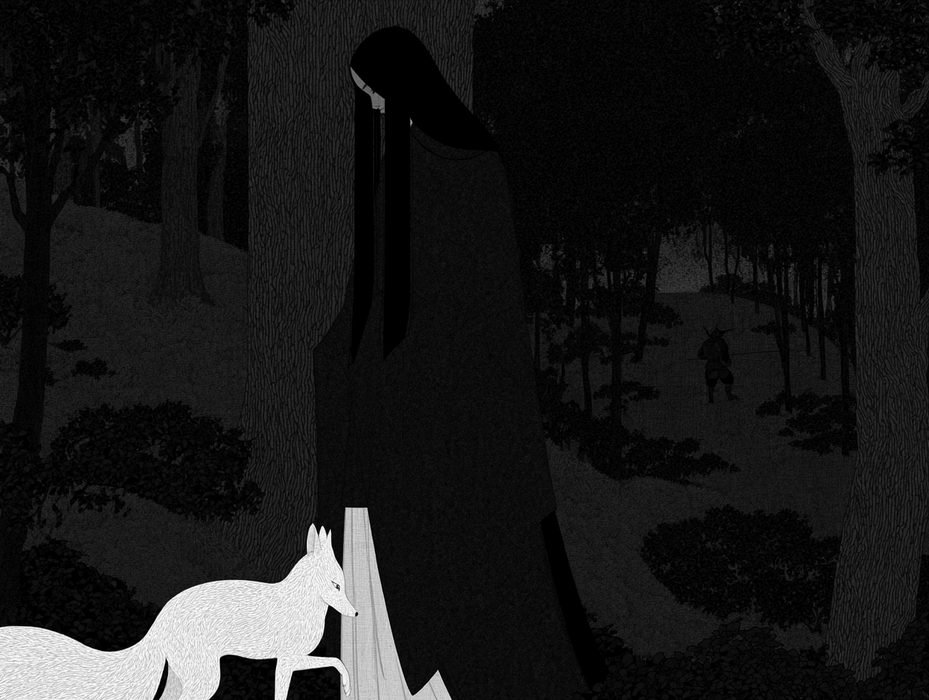
Down the path came the hunter — Akuemon, a leather-faced professional from two villages over, bow strung, dogs somewhere behind. A white fox’s pelt bought rice for a winter, and its liver, sold to the medicine men, bought the spring as well. He looked at the farmer standing in the dusk and asked, civilly enough for a man out of breath, whether the white fox had passed this way.
Yasuna felt the animal trembling against his shin, hidden by no more than the skirt of his work clothes and the failing light.
I have seen no white fox, he said. I have never in my life seen a white fox. Is there truly such a thing?
Akuemon studied him. A man who prays daily at a fox-god’s forest, standing very still at dusk, telling a hunter there is no fox. Whatever he concluded, he was tired and losing the light, and a lie delivered that flatly leaves no seam to pick at. He grunted, called his dogs, and went back the way he had come, and his footsteps were a long time fading.
The fox stepped out from the shelter of a poor man’s clothes. It looked up at Yasuna once more, and this time the wetness in its eyes overran them, which is a thing hunters will tell you foxes cannot do. It bowed its head again — slowly, deliberately, an animal performing, with terrible care, a courtesy it had watched humans perform at the shrine. Then it turned and flowed away between the trees, behind the sanctuary, and was gone.
Yasuna walked home in the dark. He told himself he had done a small kindness and told a large lie in a holy forest, and that the two might cancel each other before Heaven. He understood nothing of what had actually happened, and no one in his position would have. He did not know that the fox was of the household of the Shinoda god. He did not know that in the ledgers such beings keep, a life saved is a debt recorded, and that their debts do not lapse, and do not forgive themselves, and are repaid in coin the lender never imagined owning.
He knew only that his knee was warm where the creature had leaned, all the way home.
The pardon he had prayed for was years away yet. But from that evening, the prayers of Abe no Yasuna went up from Shinoda forest with something added to them that no diviner in the capital could have detected: underneath the man’s voice, a second petitioner, white, silent, and patient, praying in the only direction a fox can pray — toward the chance to pay what it owed.
Behind the Tale
A diviner in these tales is a government official. The court kept a Bureau of Yin and Yang, and its calendar — which days were fit for planting, travel, building, burial — went out to the provinces under the court’s seal. So the ruin at the gate is not the closing of a school of magic. It is a department of state shut by memorandum, on a slander about a garden, because a great man leaned on it; and Yasuna, having no rank, has nowhere to appeal from. That is the whole of what the capital teaches him in a morning. One word in the sources does more work than it looks. Yasuna is called a domin, a man of the soil — not a caste term but the description of a fall: a gentry line sunk to farming, keeping its graves and its books and nothing else. The tellers need him poor enough for a gatekeeper to turn away, well-born enough for a master to take in the moment he names the Treatise. One word carries both, and the tale hangs on it. The fox never speaks here and is never named. Both lines keep her an animal in this scene — a hunted thing that presses against a stranger’s leg and bows because it has watched people bow at the shrine — and the restraint is the point: everything the next tale does depends on our meeting her as a creature first. The two lines differ only in smaller things: the informer is Tomoo in one and Sakuo in the other, while the hunter Akuemon carries the same name in both, word for word — which is how you can tell they drew on a common stock.
This is the first of the 10 tales in SEIMEI VOL.01, each one followed by a note on where it comes from.