The God Who Asked for His Son
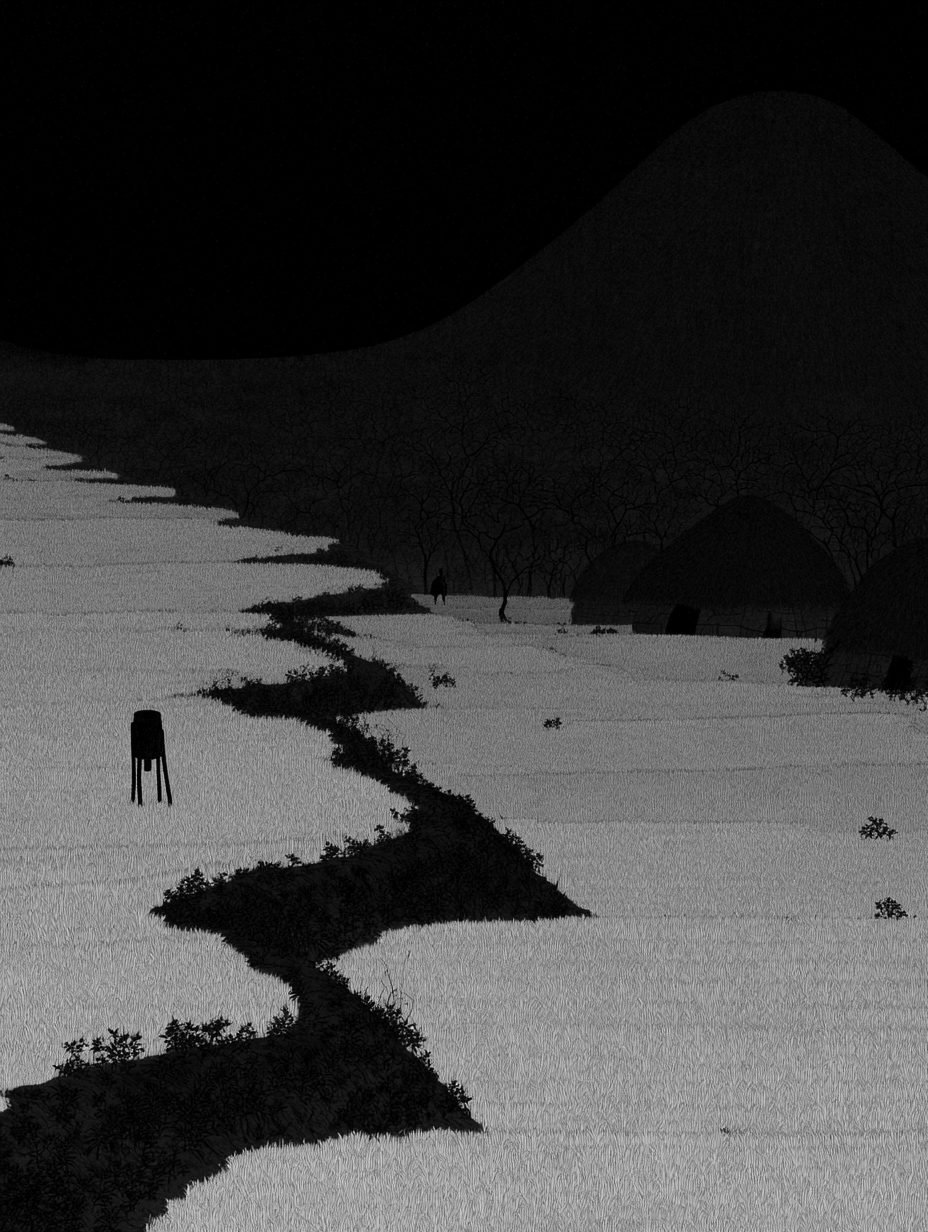
In the fifth year of the reign of the Emperor Sujin, the land began to die.
It did not come as war comes, from one direction, with a name. It came into the houses. The chronicle counts it in one line: pestilence through the whole country, and of the people, more than half were gone. There was no enemy to send an army against, no province to blame. The dead were everywhere and the cause was nowhere.
What a thing of that size looks like from inside is not a battlefield but an absence of ordinary noise. Fields stood with the work half done in them. Households that had been ten were four, and the four did not have the hands to do what ten had done; the mortars went quiet; the paths between hamlets grew over at the edges because fewer feet were using them. By the sixth year those who still lived had stopped planting. Some drifted away from their villages; some rose against what remained of order, and the court found that neither virtue nor punishment reached them. The emperor rose early and lay down late, and asked pardon of the gods of heaven and of earth. He did not know yet which of them he was speaking to.
There was a thing in the palace that no one had thought to fear. From the founding of the line, two gods had been worshipped inside the emperor’s own hall, under his own roof: the great goddess of the sun, and the god who is the soul of the land of Yamato. It had been meant as honour. Now, in the sick years, the emperor grew afraid of what he had always lived beside. The chronicle says it plainly: he dreaded the power of those gods, and was not at ease dwelling with them.
So they were sent out. The sun goddess was entrusted to the princess Toyosuki-iri-hime, and worshipped at the village of Kasanui, where a sacred enclosure was raised. The soul of the land was entrusted to the princess Nunaki-iri-hime.
And the land god was too heavy for her. Nothing in the record accuses her; no fault is named, no rite done wrongly. It says only what happened to her body. Her hair fell out. Her flesh wasted from her bones. She became too thin to stand before the altar, and the worship could not be performed. The first to feel the god directly was not a rebel or a blasphemer but the woman appointed to serve him — and what she felt was weight.
In the seventh year, in spring, the emperor went looking for an answer to a question no one could answer. He went out to the plain of Kamu-asaji-hara, the field of sacred reeds, and assembled the eighty myriads of gods, and put the question to divination: what had brought the disaster.
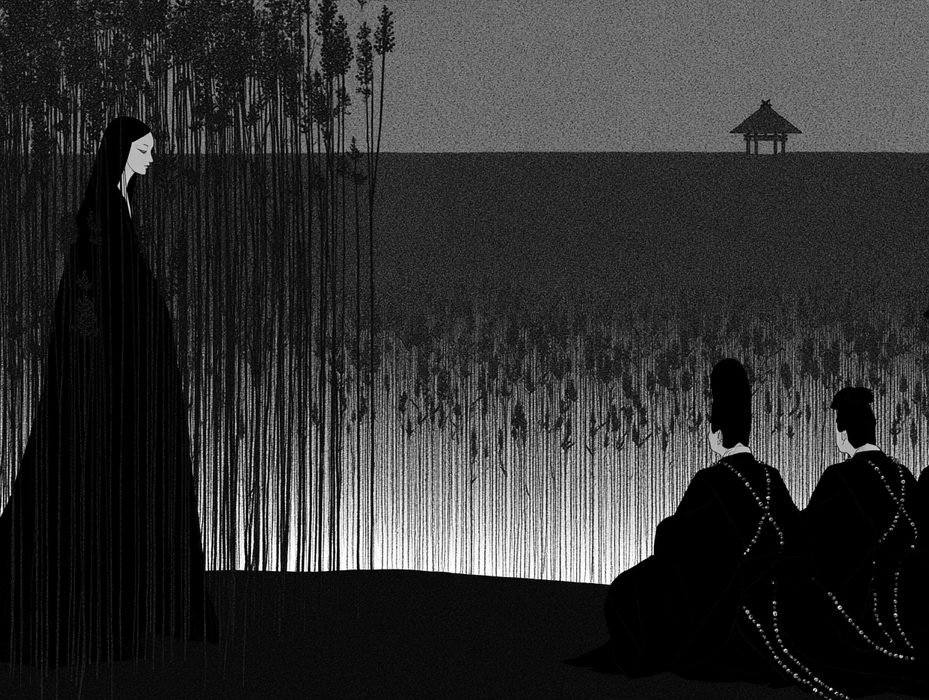
The answer did not come through the diviners. It came through a woman. The god descended into the princess Yamato-totohi-momoso-hime, and spoke through her mouth to the emperor:
Why does the emperor grieve that the land is not governed? If he honoured and worshipped me, it would settle of itself.
The emperor asked which god spoke so. The voice said: I am the god who dwells within the borders of the land of Yamato. My name is Ōmononushi.
They did as the voice had taught. Offerings were made, rites performed, to the great god by name. And nothing changed. The dying went on exactly as before. The god had named himself, had been worshipped, and withheld the cure. The emperor bathed, and fasted, and purified the hall, and prayed again: Have I not yet served you fully? Why do you not accept? If there is more, teach it to me in a dream, and finish what you have begun.
That night a man of noble bearing stood in the doorway of the sleeping hall. He called himself Ōmononushi, and he said: Let the emperor grieve no more. That the land is not governed — that is my will. If my child, Ōtata-neko, is made the one who worships me, then all will be calm at once. And there are lands beyond the sea that will submit of themselves.
That is my will. The god gave no grievance and no grounds. He did not say the court had wronged him, or the people had forgotten him, or a shrine had fallen into neglect. The plague that had emptied half the houses of the land was his, and the record lets his ownership of it stand without one word of justification. What he stated was not a complaint. It was a condition.
In autumn, on a single night, three people dreamed the same dream — a noblewoman of the reed plain, an ancestor of the Hozumi clan, and a man of the weavers of Ise. Each saw the same figure, and each was told the same thing: make Ōtata-neko the master of worship for Ōmononushi, and make Nagaochi the master of worship for the soul of the land, and the realm will be at peace. Three mouths, one message, none of them the emperor’s. When they spoke, the emperor’s dream stopped being a dream and became an instruction.
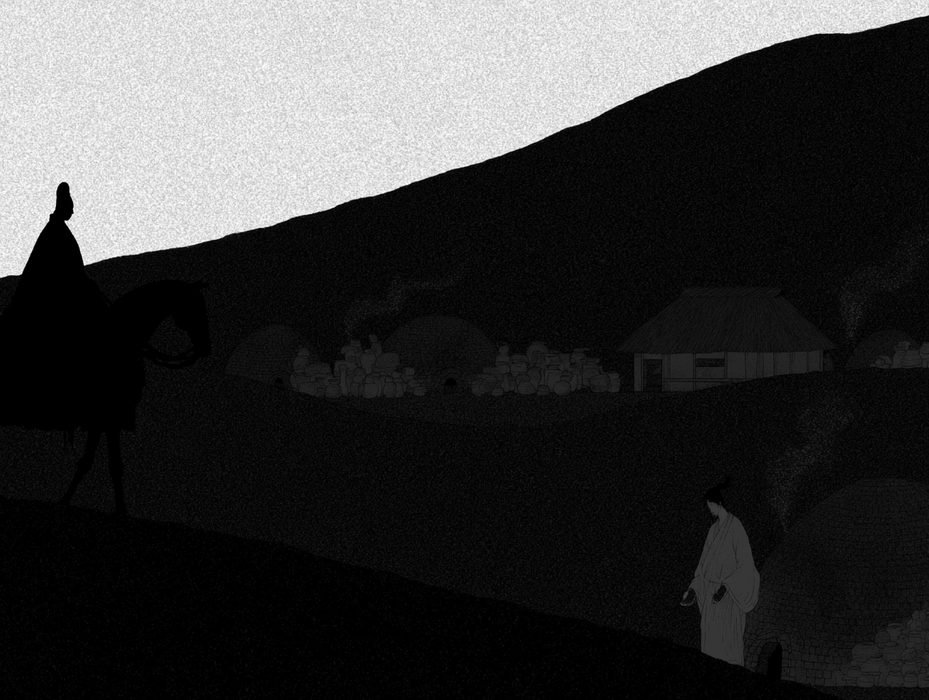
Then the search began, and the record’s phrase for it is exact: messengers were sent out to the four quarters. Not to a district, not to a family — to the four quarters, because the court did not know where to look. Riders went out along the roads of a country in the third year of a plague, into villages that had buried half of themselves, asking at each one for a man named Ōtata-neko: not a lord, not a priest, a name with nothing attached to it. Somewhere in the district of Chinu, in the potters’ village of Suemura — a settlement of kilns and clay-pits and smoke, the sort of place a court has no reason to know exists — somebody said yes, that is a name here. And the man was found, and brought back across the country to the reed plain, where the emperor waited with the princes and ministers and the eighty clans standing assembled.
The emperor asked: Whose child are you?
The man answered: My father is Ōmononushi, the great god. My mother is Ikutamayori-hime, the daughter of Suetsu-mimi.
He said it the way a man gives his village and his trade. A god had asked for his son by name; the son, when found, was a man of a potters’ town who could recite his own descent from the god as ordinary fact. The emperor said: Now prosperity will come. The tortoise shells were heated and read; to have Ōtata-neko serve was fortunate, and to worship the other gods as well was fortunate; and to widen the worship further was not.
In winter, in the eleventh month, it was done as everything had said it must be done. Ōtata-neko, child of the god, was made master of the worship of Ōmononushi. Nagaochi was made master of the worship of the soul of the land. Then, and only then, the other eighty myriads of gods were given their festivals, and the shrines of heaven and the shrines of the land were fixed, and lands and households were set aside to serve them — the ordering of worship that the realm would keep from that time on.
And the record closes in the same dry voice with which it opened: thereupon the pestilence ceased for the first time. The land grew quiet by degrees. The five grains ripened, and the people had plenty.
The plague had asked for nothing but the right priest. For three years the emperor had offered virtue, vigilance, penance, and the god had let the people die; what ended it was a man from a potters’ village, standing where his father wanted him. The houses filled again. The fields bore. And in the emperor’s hall, where two gods had once lived under the king’s own roof, there was from that time forward a distance — kept carefully, kept forever — between the throne and the things it worshipped.
Behind the Tale
The pestilence of Sujin’s reign is told twice, in the two oldest chronicles Japan possesses. The Nihon shoki, completed in 720, gives the full sequence: the plague of the fifth year, the removal of the two gods from the palace, the failed priestess, the assembly on the reed plain, the possession, the dream, the three dreamers, the search “to the four quarters” and the finding of Ōtata-neko at the potters’ village of Suemura, and his installation in the eleventh month of the seventh year. The Kojiki, older by eight years, compresses the same event: the plague, the god’s appearance in a single dream — there is no possession scene — the search, and the appointment. Where the Shoki ends with the reordering of state worship, the Kojiki ends by proving the priest’s blood: it tells how Ikutamayori-hime was visited at night by a beautiful man whose name no one knew, how her parents had her sew a threaded needle into the hem of his robe, and how the thread in the morning ran out through the keyhole of the door and over the hills to the shrine on Mount Miwa, leaving only three loops of thread — miwa — in her hand. In the Kojiki that pursuit is not a separate ghost story; it is the family record that qualifies Ōtata-neko to stand before the god. The later, famous image of the god of Miwa as a serpent appears in neither of these passages: the night visitor of the thread story is a man in form, and the serpent belongs to a different episode, told of a different woman, elsewhere in the chronicle.
The god’s name is given as Ōmononushi, “Great Master of Things.” The second god, the soul of the land of Yamato, is spelled three different ways within a few pages of one another in the printed chronicle — a small reminder that even the chronicle’s gods do not hold still on the page. Mount Miwa has remained a place of worship of Ōmononushi into the present day; the shrine there counts this episode as its founding. The chronicle itself names no shrine, only the god, the mountain in the thread story, and the man. The plague years correspond, in the chronicle’s own reckoning, to the first century before the Common Era, though the chronology of these early reigns is not taken literally by historians; what the story preserves is not a date but a proposition the court believed and acted on — that a god may claim a national disaster as his own will, state his condition, and wait.
This is the first of the 21 tales in TATARI, each one followed by a note on where it comes from.