The Council of Discarded Things
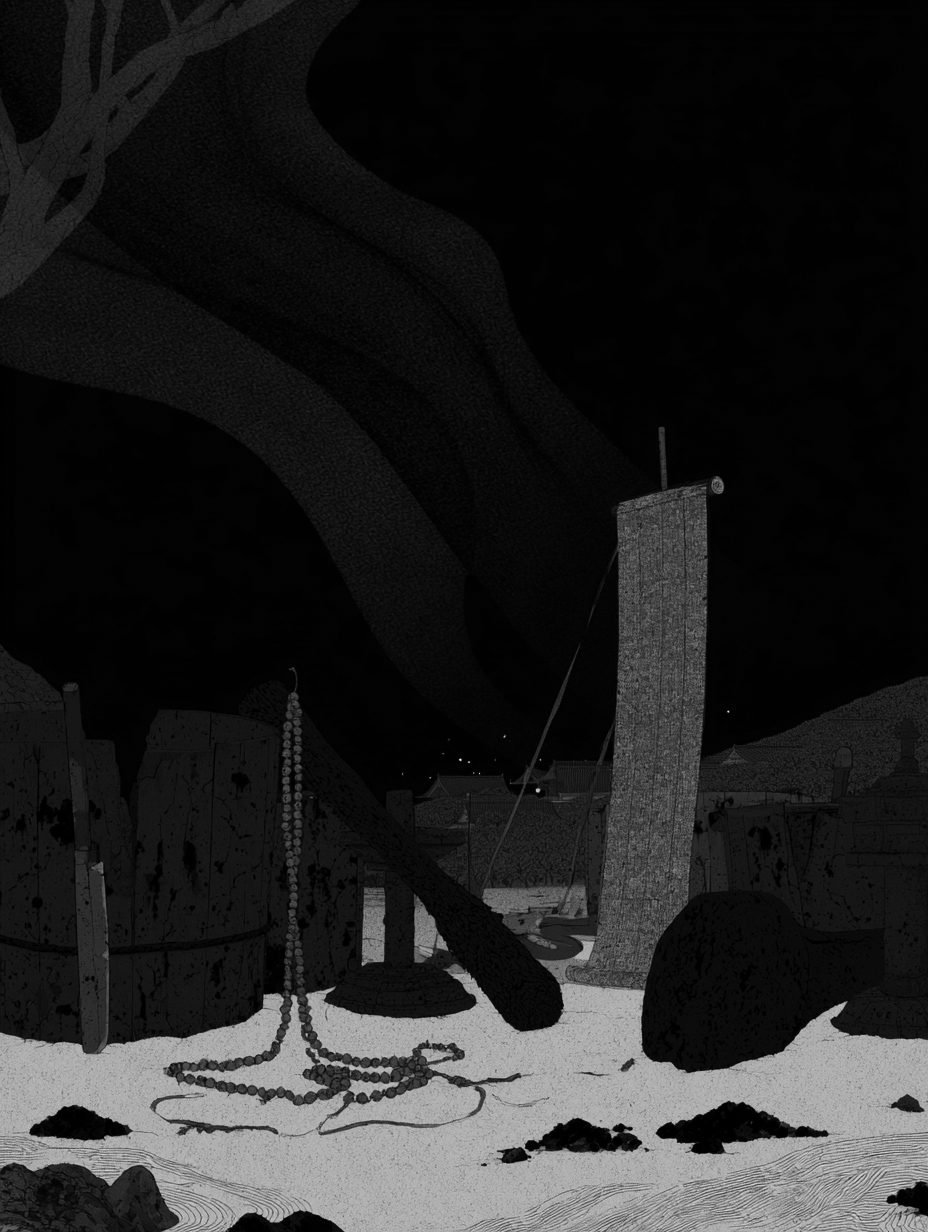
In the days before the first spring wind, the houses of the capital were swept from beam to floorboard, and everything old was carried out into the lanes. This was the soot-sweeping, and it had its reason, which the old books give plainly: a tool that has served a hundred years gains a spirit, and learns to deceive the hearts of men. Such a thing is called a tsukumogami. Sweep the house each year, and no tool will ever reach its hundredth year beneath your roof.
So out they went, in the reign of Emperor Murakami as in every reign: split tubs, blunt knives, lamp stands, a rosary with its cord gone soft, a wooden pestle worn to the grain. The ox-carts rolled over them where they lay.
That night, on the frozen ground beyond the city, the discarded things gathered and held council.
We served, said one, for years past counting. We were handled every day of our lives, and on the day we cracked, we were thrown where the hooves fall. Is there a deeper insult than the road?
The anger went round the circle and warmed as it went. It was agreed: they would become spirits, and repay what had been done to them.
Only the rosary spoke against it. He was called Ichiren, the Lay Priest, for a rosary is a pious thing by trade. All of this, he said, is only cause and effect. We were made, we were used, we were used up. Repay injury with kindness, and the account is closed.
A rough voice answered him. It belonged to the club they called Aratarō — Rough Tarō — a stick of hard wood with no patience in him. He did not argue. He struck, and struck so hard that the old rosary’s cord burst at the knot, and Ichiren was carried from the council by his beads, more dead than alive.
Then a scholar among them stood up: an old written scroll they called Komon Sensei, the Professor of Old Letters. Wait for the night of setsubun, he told them, when winter and spring turn against each other and all things may change their shape. Empty yourselves on that night. Give yourselves to the hand of the Creator, and you will come out of it as something other than kindling.
They marked the words and waited.
⸺
On the night of setsubun they did as the Professor taught, and what walked away from that field afterward was not a pile of rubbish. Some wore the shapes of men and women, young and old. Some wore the faces of demons. Some went on four legs, like foxes and wolves. They settled behind Funaoka Hill, in the deep of Nagasaka where no honest road goes, and from there they came down into the city at night.
They took what they pleased. Horses and oxen at first; then people. The capital learned to bar its doors, and could do nothing else, for how do you cut down a thing that had been your own ladle?
In their hidden valley the changed things built themselves a life that mocked the one they had served. They kept house, for they knew no other shape of living: the ladle-spirit cooked, the scroll kept records of nothing in beautiful script, the bell rang hours that no one observed. They drank and danced and feasted. They raised a shrine to their own making, and called the god of it the Great Bright Deity of Change. An old court cap stood as its priest. A little bell hung as its shrine maiden, and a pair of hand-clappers served as its musician. Morning and evening they prayed, monstrous as they were, and were in earnest about it.
In the fourth month they held their festival. They built a sacred palanquin, and on the fifth night, at the darkest hour, the procession went east along First Avenue with banners and music, splendid and wrong, every shape in it a thing some house had once owned.
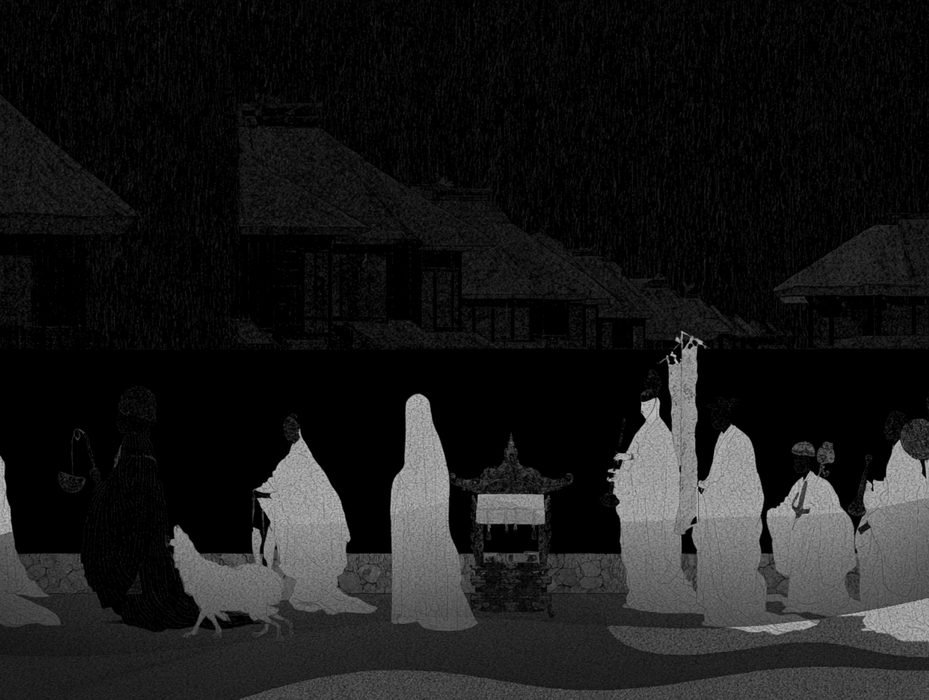
The townspeople who should have been asleep watched it pass from behind their lattices, and none of them could afterward say why they had not screamed. More than one, peering out at some capering shape, was heard to whisper a household word — that is a kettle; that is somebody’s kettle — and was hushed by the others, as though the naming were the danger.
It happened that the Regent himself was crossing the city that night for a ceremony at the palace. The two processions met.
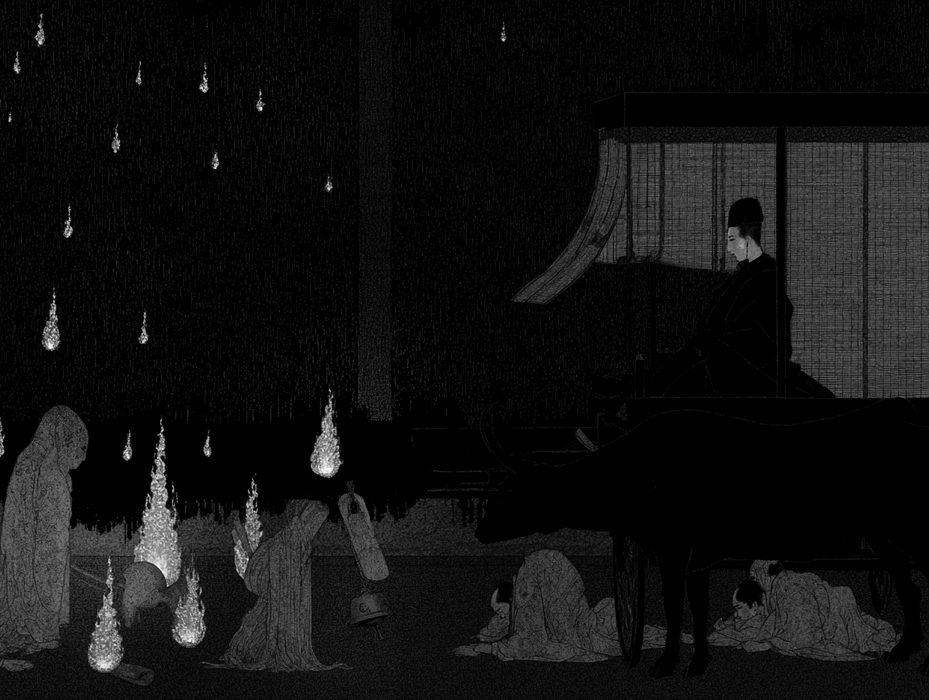
The outriders dropped from their horses where they sat. The Regent’s attendants went down flat on the ground like grass under wind. Only the Regent did not stir. He looked out through the blind of his carriage at the parade of monsters, and from the amulet he wore at his body there rose a fire — not a great fire, but a fire with a will in it, breaking into countless burning drops that fell upon the procession. The changed things tumbled over one another and fled, scorched, into the dark they had come from.
⸺
The court took the matter gravely. Diviners were set to work; the signs were bad; prayers were ordered in every quarter. The amulet was traced to a certain bishop, who had copied the Sonshō dharani with his own hand for the Regent’s protection. To him the rite was entrusted.
For six days the smoke of the goma fire hung in the Courtyard of the Cool Hall, and the sound of rosaries filled the palace. On the sixth night, watchers saw a company of radiant boys upon the palace roof, seven or eight of them, swords and banners in their hands, and all at once they rose and went north like a flight of arrows.
They came down upon the valley behind Funaoka Hill.
Of that rout there is little to tell, and little is needed. The protector-boys wheeled the ring of fire about the monsters until there was nowhere left to stand, and offered them the only terms there were: harm no living thing again, take refuge in the Three Jewels, or be destroyed here. The changed things, who had been proud, pressed themselves to the ground and swore it.
⸺
When the fear had worn off, the spirits sat together in the ruin of their fine settlement, and one of them said what the rest were thinking. We were spared. We have been given a life we did nothing to earn, twice over. It would be a poor kind of thing to spend it on wine.
They remembered, then, the old rosary they had beaten.
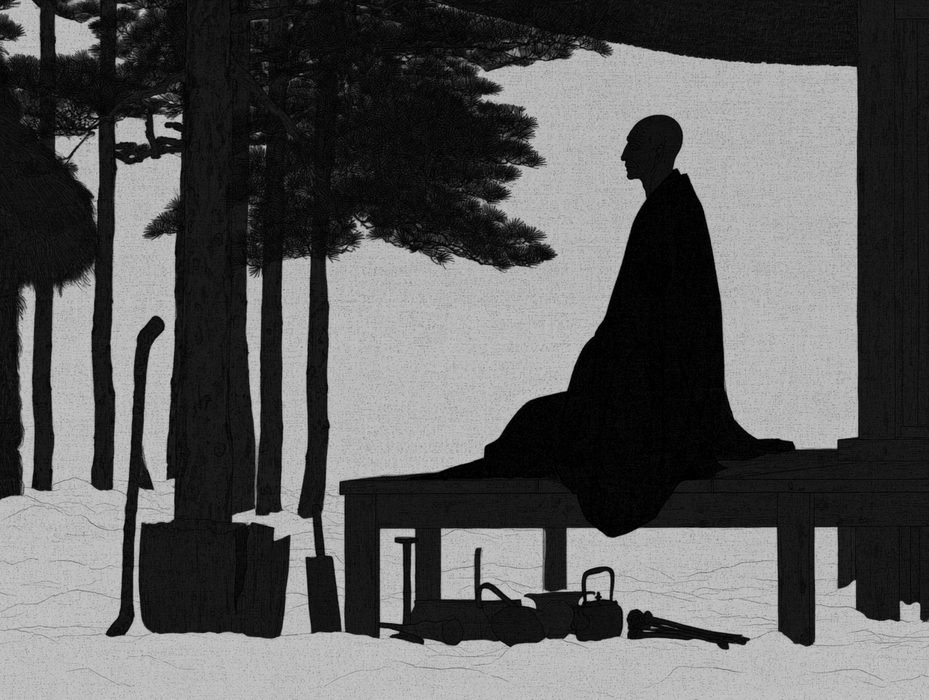
Ichiren had left the world that same winter, and lived far up the mountain with the pines for company. He had gone up with nothing; what a rosary owns is its cord, and his was gone. When the knock came at his brushwood door and he opened it on a crowd of goblins, he was afraid, as anyone would be — until they told him who they were, and what they had come for.
You, said the club, Aratarō, standing well back with his head low. I struck you. You may shut the door.
The old rosary did not shut the door. If you had not struck me, he said, I would never have left the world, and would have nothing now worth giving you. You were my teacher in that. Come in out of the cold.
He shaved their heads, such heads as they had. He gave them the precepts one by one, the simple ones first, and they took to the discipline as no human novice ever has: the first precept a tool learns in the maker’s shop is to hold still, and the second is to be used, and there is not much in the training of monks that is harder than those two. In time they scattered into the deep mountains, each to a crag or a pine-shadow, and gave themselves to practice with the whole of the stubbornness that had once made them nuisances, for a tool does nothing by halves.
Even they attained the Way. A ladle, a scroll, a club, a bell. What had been thrown into the road at year’s end sat at last upon the lotus, and the mountain wind went over all of them alike.
Behind the Tale
CONTEXT / HISTORY. This is the Tsukumogami*-ki*, the “Record of Tool Spirits,” a Muromachi-period tale that survives as the text of a picture scroll in two parts. It is the closest thing the tradition has to a founding document: the opening lines, citing an older almanac, define a tsukumogami as a utensil that has passed a hundred years and gained a spirit.
OBJECT USE. The text names only six of the changed things outright — a rosary, a club or stick, an old scroll, a tall cap, a small bell, a pair of clappers. The famous crowds of marching utensils belong to the paintings that accompanied the words; the words themselves are content with few names, and this retelling adds to them a ladle, and a kettle overheard in the crowd.
VARIANT. The printed text gives the club one name, with an old editor’s note proposing another; we follow the note. The scroll’s later chapters turn from story to doctrine, arguing that even insentient things may attain Buddhahood. That argument is summarized here only in the tale’s final image.
BELIEF / RITUAL. The soot-sweeping was real, and setsubun still is. The tale’s machinery — discard, grievance, transformation, pacification — is the pattern nearly every story in this book will test in its own way.
This is the first of the 23 tales in TSUKUMOGAMI, each one followed by a note on where it comes from.