In the Oldest Account, Oiwa Had Smallpox
The Play Everyone Means
Tōkaidō Yotsuya kaidan was written by the fourth Tsuruya Nanboku and first staged at the Nakamura theatre in Edo in the seventh month of 1825. It is the most famous ghost story Japan has produced, and almost everything an English-speaking reader knows about Oiwa comes from it: the poison given to her disguised as medicine, the moment at the mirror when her hair comes away in her hand, the face that will not go back, and the two corpses nailed to opposite sides of a single door and floated down a ditch.
One detail of that first run is worth keeping, because it says something about what the play was for. It was not performed on its own. It was staged interleaved with Kanadehon Chūshingura, the loyal-retainers play, across two days, the acts of the two works alternating — the ghost story running inside the most respectable plot in the repertoire.
What the Older Account Says
Roughly a century before Nanboku, the story existed in prose. Yotsuya zōdanshū is dated by its colophon to 1727. It does not present itself as a ghost collection; it is a jitsuroku, a “true record,” the genre that claims to report real events in a real district.
Its Oiwa is the eldest daughter of a low-ranking officer of the watch named Tamiya. Her husband is a masterless man from Settsu, taken into the household as an adopted son-in-law. A senior officer and his concubine work to break the marriage, and it is broken; she goes out of her mind and disappears; and afterwards the household is destroyed — a snake, an apparition, rats, the deaths of a daughter and finally of the husband.
And her face is ruined at twenty by smallpox.
There is no poison in it. There is no scene at the mirror. There is no man named Kohei, and no door with a body nailed to each side.
A caveat about the reading is owed here. The text consulted for this note is the version printed in a 1928 anthology of early-modern jitsuroku, edited by Kawatake Shigetoshi, and not the 1727 manuscript itself; the two have not been compared. What can be said is that the version in general circulation before the play does not contain the play’s famous scenes.
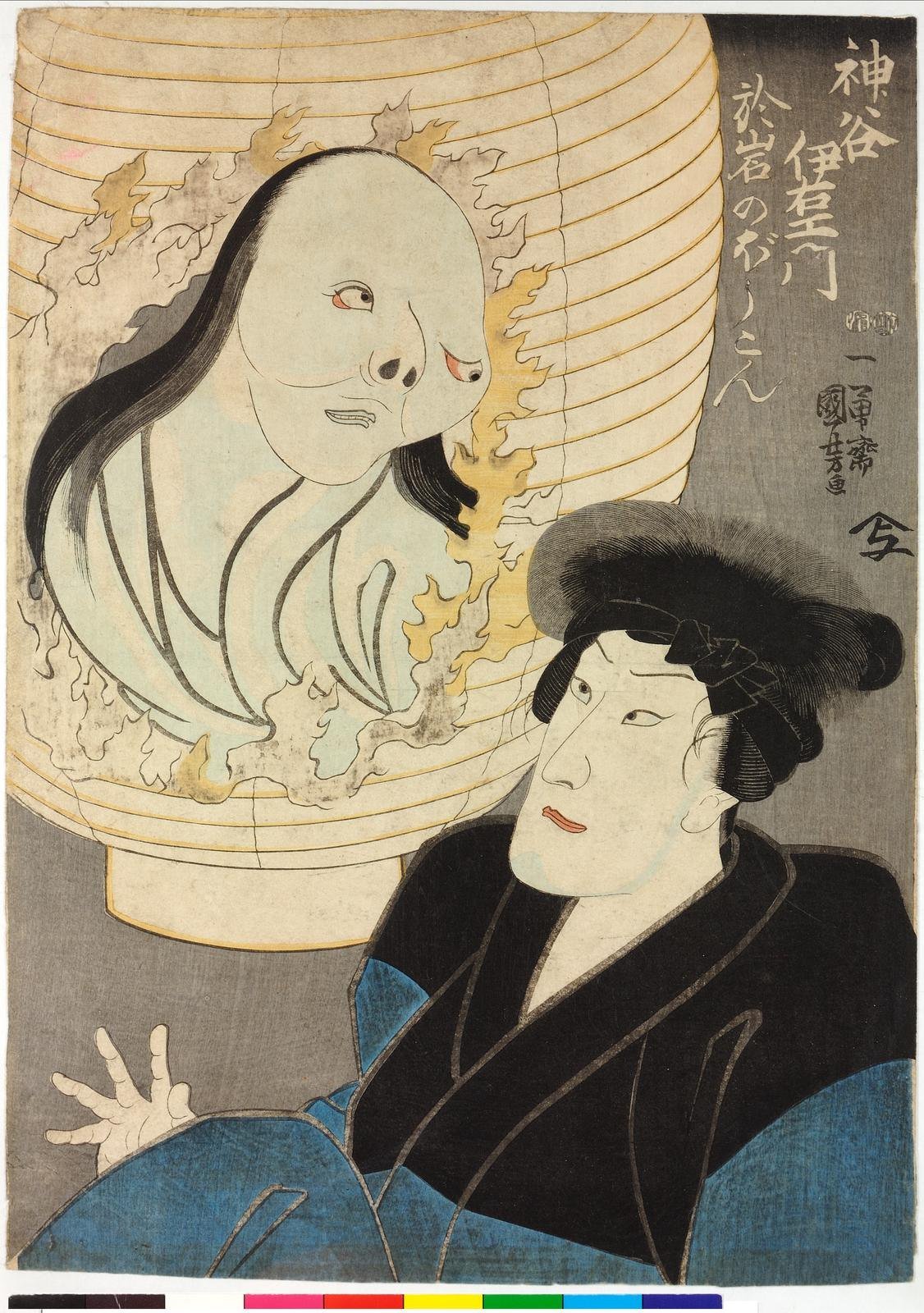
Utagawa Kuniyoshi, 1848: Iemon and the ghost. Twenty-three years after the first performance. Public domain, via Wikimedia Commons.
What the Play Put In
The substitution is the interesting part. Disease is replaced by poison, which means the disfigurement stops being misfortune and becomes a crime, with somebody to blame and somebody to revenge herself on. The mirror scene exists so that the audience watches it happen. The nailed door exists so that one actor can play both victims and switch between them in view of the house.
Every one of the images that made the story famous is a thing that works on a stage and does not work on a page. The play did not dramatise the story; it rebuilt it to be performed.
Two Shrines, and Which Way They Moved
There are two places in Tokyo associated with Oiwa, and their history runs opposite to the way people assume.
A shrine to Oiwa stood at Yotsuya as a household shrine of the Tamiya. In 1879 it was moved across the city to the district of the theatres, with the help of kabuki people; a shrine remains at the original Yotsuya site as well, so there are now two. The shrine followed the stage, not the other way round.
Facing the Yotsuya site there is also a temple, founded in the early Shōwa period around a hall that dates from 1757. Its own account of itself, published on its own website, says that when there is a kabuki run the actors and those involved always come to pray for safety and success. That is the temple’s own wording, and it does not use the word curse.
One more thing belongs here. The tradition preserved on the Tamiya side holds that Oiwa was a devoted wife and that the marriage was a good one — which is the reverse of what the 1727 record says about the same woman. Both accounts cannot be right, and this note is not in a position to decide between them.
The Curse
Now the part that every English-language page states with confidence: that the play is cursed, that productions suffer accidents, and that companies must visit the shrine before opening.
I have not been able to date this belief. Pretending otherwise would be easy, and this note is not going to. The one specific attribution that turned up is a museum’s reference answer pointing to the reminiscences of an actor born in 1915 — a source given without a journal or a year, which by our own standard is not a citation. No evidence has turned up that the practice goes back to 1825, or to the nineteenth century at all.
There is also a silence worth recording. Orikuchi Shinobu, one of the major figures of Japanese folklore studies, wrote three short pieces in this territory in 1948 and 1949 — a comparison of how the Osaka and Edo versions were staged, an essay on summer theatre and ghost plays, and a memorial notice for the actor most associated with the role. He was writing for theatre publications, for readers who would have known. None of the three mentions the shrine visit or the curse.
That is not proof of absence. It is the kind of absence that ought to be reported before a date is invented.
What a Folklorist Said in 1949
The same essay on summer theatre contains a judgement that has aged extremely well, and it is worth translating closely.
Oiwa, Orikuchi writes, is a character built up entirely out of Nanboku’s imagination. There are several so-called true accounts of her in circulation; they contradict one another; and many of them appear to have been made after the play became famous, so that none of them can be believed.
A Japanese folklorist said that in a theatre magazine in 1949. The English-language material has been travelling in the other direction ever since, treating the play as the dramatisation of a real haunting and the shrine as older than the script.
Why the Order Matters
Set the layers out and the shape is plain. A record of 1727 describes a household destroyed and a woman whose face was ruined by illness. A play of 1825 exchanges the illness for poison, supplies the mirror and the door, and is performed inside another play. A shrine moves toward the theatres in 1879. A temple that says actors always come to pray is founded in the twentieth century. And the curse, the part everyone is surest of, has no witness earlier than an actor born in 1915.
Each layer explains the one before it, and the explanations get more confident as they get younger. That is usually the direction of travel, and it is worth noticing when a ghost story is the thing being explained.
Sources
- Yotsuya zōdanshū 四谷雑談集, jitsuroku account, colophon dated 1727; consulted in the version printed in the collected early-modern jitsuroku edited by Kawatake Shigetoshi 河竹繁俊, 1928, and not in the original manuscript.
- Tōkaidō Yotsuya kaidan 東海道四谷怪談, by Tsuruya Nanboku IV 四世鶴屋南北, first staged at the Nakamura-za, seventh month of 1825. Wikipedia
- Orikuchi Shinobu 折口信夫, “Oiwa and Yomoshichi,” in the bulletin accompanying the Tsuruya Nanboku volume of a collected Japanese literature series, July 1948.
- Orikuchi Shinobu, writing as Shaku Chōkū 釈迢空, “Summer theatre and ghost plays,” Shinbashi Enbujō, 5 July 1949; the passage on the “true accounts” of Oiwa.
- Orikuchi Shinobu, writing as Shaku Chōkū, “The scientific quality of Kikugorō,” Makuai supplement 45, 1 August 1949.
- The temple facing the Yotsuya site, for its own account of itself and of the visits by kabuki companies, as published by the temple.
Further Reading
- Michael Dylan Foster, The Book of Yōkai: Mysterious Creatures of Japanese Folklore, 2015
The reading in “Why the Order Matters” is KWAIDANOTE’s own.
Found an error? Write to kwaidanote@gmail.com — corrections are made on this page and dated.