The Tsuchigumo Never Spun the Web
Three Things Under One Name
The two characters written tsuchigumo mean earth-spider. Over about twelve hundred years they name three different things: people the court could not govern, a monster a warrior kills in a hole, and — loosely, and much later — a spider-woman who turns out to have almost no story behind her.
Only the middle one is a yōkai. The English-language material is almost entirely about that one, which is the least interesting of the three.
The Oldest Layer Is About People
In the Nihon shoki, completed in 720, the word belongs to the chapters on the first emperor’s campaigns. At three named places there were tsuchigumo who, trusting in their own strength, would not come to court.
At one village the chronicle is more specific, and the sentence is worth having in full. Their bodies were short and their arms and legs long, it says, so that they resembled dwarfs; the imperial army wove a net of kudzu vine, threw it over them, and killed them, and for that reason the name of the village was changed to Kazuraki — kudzu-castle. It is still the name of that district in Nara.
The web in the oldest tsuchigumo story is woven by the army.
The pattern repeats in the reign of the twelfth emperor, where tsuchigumo hold stone caves in Kyushu and are killed with mallets cut from camellia wood, and the blood is said to have run to the ankles of the men doing it; two local place names are explained by the slaughter. The provincial gazetteers compiled in the same period list them by name. Bungo has a woman of Itsuma-yama and five more in two places. Hitachi applies a different term to a group and notes that tsuchigumo is what people commonly call them. A fragment of the Mutsu gazetteer names eight, each with a household, holding eight stone chambers at defensible points, and explains that this was why they did not obey the command from above.
These are the records of the side that won, written by it, and they are the only records there are. The people described in them left nothing, and this note is not going to repeat the court’s characterisation of them as though it were a description.
A Scholar Reversed the Arrow in 1919
The historian Tsuda Sōkichi devoted an appendix of his study of the two chronicles to the word, and what he did with it has not been improved on.
His first point is grammatical and easy to miss: the term means one who does not obey the imperial command, and it is a designation for an individual, not the name of a people. It is applied to chiefs, one at a time, by a court that had not subdued them.
His second point is the one that matters. The long limbs, the cave-dwelling, the spider-like look — these were reasoned backwards from the name, not the other way round. The word contained a spider, so the descriptions grew spidery. The appearance did not produce the name; the name produced the appearance.
His evidence is an absence, and he states it as one. The word is never used of rebels in periods the chronicles treat as historical. It appears only in passages set long ago. That makes it a habit of the compilers of old lore rather than a term anyone was using.
He is also careful in a way worth copying. Noticing how many of the named tsuchigumo are women, he declines to build anything on it, and writes that this is probably mere chance.
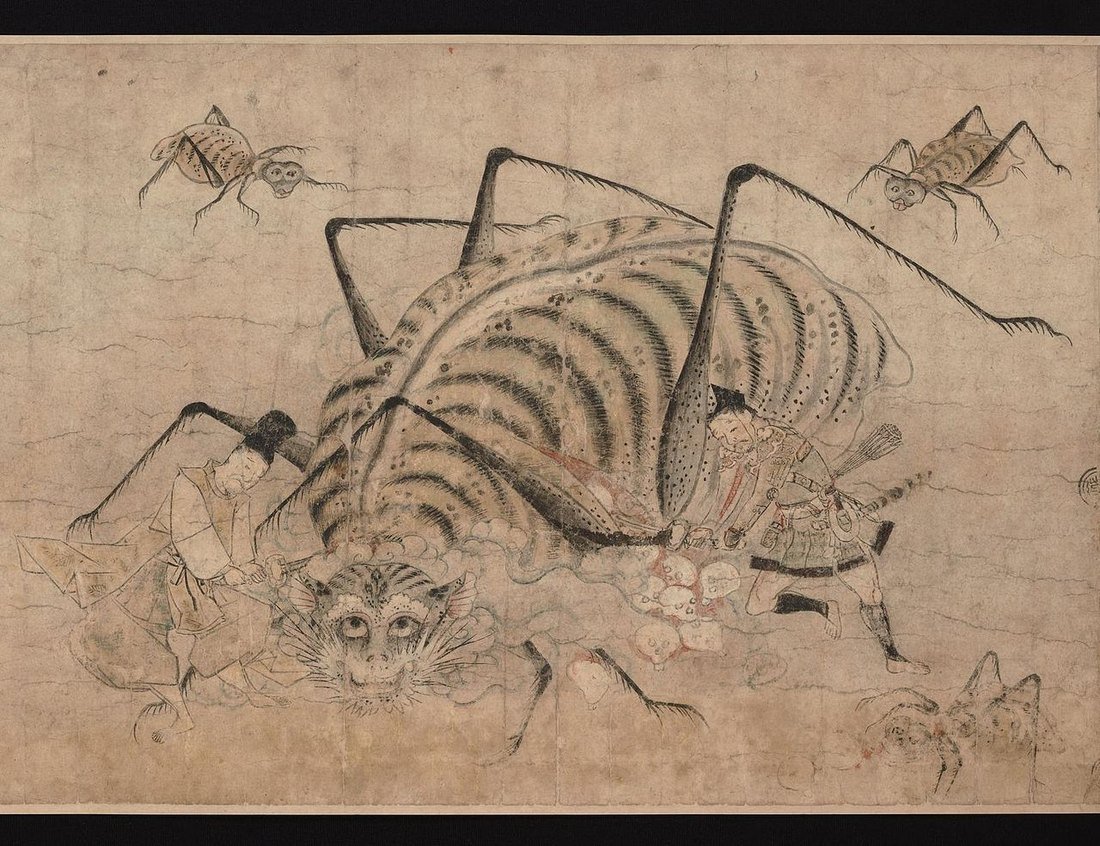
The picture scroll of the early fourteenth century, in the Tokyo National Museum. Public domain, via Wikimedia Commons.
Then It Became an Animal
Centuries later the word attaches to a creature, in the cycle of tales around Minamoto no Raikō. Our notes on Shuten-dōji and on the severed arm at the Rashōmon deal with that cycle and with the texts behind it, so the point here is narrow.
The earliest telling of Raikō and the spider is in the Tsurugi no maki, the chapter appended to popular copies of the Tale of the Heike that our note on Ibaraki-dōji sets out. Raikō, worn down by a recurring fever, is approached at night by a figure in the shape of a priest seven feet tall, and cuts at it with the sword Hizamaru. A blood trail leads to an old mound, where a mountain spider four feet across is found and killed. And the sword is given a new name: Kumogiri, spider-cutter. I should say that I have not read that passage in the original — the text service that carries it was unavailable — and that this account follows consistent modern summaries.
That last detail is the useful one. A study of Japanese heroic tale-types published in 1935 sorts the tsuchigumo killing in with the other demon-quellings, and then notes that it is also a treasure-sword tale. The episode partly exists in order to explain a name on a blade.
After that the material multiplies without arranging itself. There is a picture scroll in the Tokyo National Museum from the early fourteenth century, nine passages of text and thirteen paintings, whose setting and course differ from the Tsurugi no maki. There is a Noh play, author unknown, of the Muromachi period, which takes its bones from the Tsurugi no maki. The strict order of descent among these has not been settled, and accounts that present one are tidier than the evidence.
One correction while we are here. The tsuchigumo is not in the Taiheiki. The text people mean is the Zen taiheiki, a popular chronicle of the Edo period, and the two are confused constantly.
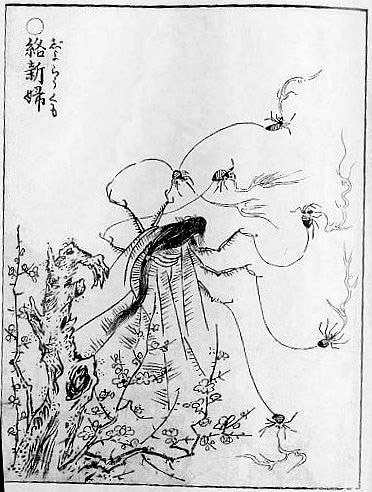
Sekien’s plate of 1776, printed with no text beside it. Public domain, via Wikimedia Commons.
The Third Name Has Almost Nothing Behind It
The jorōgumo is the spider-woman of modern retellings, and the writing usually given for her, 絡新婦, is a set of characters chosen for the sound. The plain writing is 女郎蜘蛛, which is the ordinary Japanese name of a large and common orb-weaver that anyone in Japan has seen in a garden.
Toriyama Sekien drew her for his picture-book of monsters in 1776 — a woman with spiderlings about her — and gave her no accompanying text at all.
Spider-women do appear in Edo collections: there is one in a book of a hundred tales of 1732, one in a collection of 1677, one in Asai Ryōi’s book of 1666. But the story everybody now tells — the woman who plays a biwa to a traveller and then eats him — cannot be traced to any of them. A university library’s reference desk went looking for a text matching it, and recorded in the shared reference database the national library runs that it had found none.
That is worth saying plainly rather than filling in. A creature with a famous story and no text behind it is a more interesting object than one with neither.
What Actually Connects Them
One reading is that a real insect gave its shape to a slander and then to a demon. The records suggest the traffic ran the other way each time.
The first use names people who would not come when they were called, and the spider is in the word before it is in anything else. The second names a thing killed in a hole, which also, conveniently, names a sword. The third names a picture that was never given a caption.
What holds the three together is not an animal. It is a way of naming, and in the oldest case the net belonged to the people doing the naming. A much later record does the same thing to households rather than to chiefs, and our note on the dog-god follows it: The Inugami Was Made of Quotations.
Sources
- Nihon shoki 日本書紀, 720; the campaigns of Jinmu, including the village renamed Kazuraki, and the twelfth reign in Kyushu. Commons
- The provincial gazetteers of Bungo, Hitachi and Mutsu, 8th century. Wikipedia
- Tōyō kōhi taizen 東洋口碑大全, volume one, compiled by Iwaya Sazanami 巖谷小波, 1913; the gazetteer passages quoted with their sources named.
- Tsuda Sōkichi 津田左右吉, Kojiki oyobi Nihon shoki no shin kenkyū 古事記及び日本書紀の新研究, 1919; appendix two, on the tsuchigumo.
- Tsurugi no maki 剣巻, chapter appended to popular recensions of the Heike monogatari; the naming of the sword Kumogiri. Not consulted in the original for this note.
- Tsuchigumo sōshi 土蜘蛛草紙, picture scroll, early 14th century, Tokyo National Museum. Wikipedia
- Tsuchigumo 土蜘蛛, Noh play, author unknown, Muromachi period. Wikipedia
- Shimazu Hisamoto 島津久基, Yoshitsune densetsu to bungaku 義経伝説と文学, 1935; the classification of heroic tale-types.
- Gazu hyakki yagyō 画図百鬼夜行, by Toriyama Sekien 鳥山石燕, 1776; the jorōgumo plate. Commons
Further Reading
- Michael Dylan Foster, The Book of Yōkai: Mysterious Creatures of Japanese Folklore, 2015
The reading in “What Actually Connects Them” is KWAIDANOTE’s own.
Found an error? Write to kwaidanote@gmail.com — corrections are made on this page and dated.