Okiku Broke the Plates Herself
The Ghost Everyone Pictures
A woman rises out of a well and counts: one, two, three, up to nine, and then stops, or wails, or begins again. There were ten plates in a set belonging to the household. One is missing, and she was killed over it.
The counting is very nearly the whole of her. She does not address anyone, ask for anything, or explain herself. She reaches nine, fails to arrive at ten, and starts over, and the horror is entirely in the arithmetic — a task that cannot be completed, performed by someone who cannot stop.
After Oiwa, she is the most reproduced ghost in Japanese art. And the version of her that English-language readers meet is usually credited to a particular modern play, which is the one thing about her that is definitely wrong.
What Is Actually in the Play
Okamoto Kidō’s Banchō Sarayashiki is dated January 1916 and is the text that English reference works cite.
Read it and the story is not the one they describe. Okiku breaks the first of the household’s heirloom plates herself, in secret, against a pillar. Later, with the thing confessed, she takes the rest out of their box one at a time and hands them to Harima, who breaks them against the guard of his sword while the two of them count. She is not clumsy and she is not being framed. She destroyed an irreplaceable thing belonging to the man she lives with, on purpose, to find out whether he loved her enough to forgive it.
He does not forgive it. What he says is that it is not the plates Harima grudges; it is that a woman doubted the heart of an honest man, and that is the heavy crime. He cuts her down himself, in the garden, in one stroke, and orders the body thrown into the well.
Then the play ends. There is no ghost in it. The counting is done by the living, in that room, as the plates go; nobody counts at a well and nobody comes back. Harima does not kill himself; he picks up a spear and goes out to fight with the local toughs, and the curtain comes down.
The English summary in wide circulation describes a play in which Harima forgives her, later discovers the breakage was deliberate, is visited by a serene and beautiful apparition, and commits suicide. None of those four things is in the text.
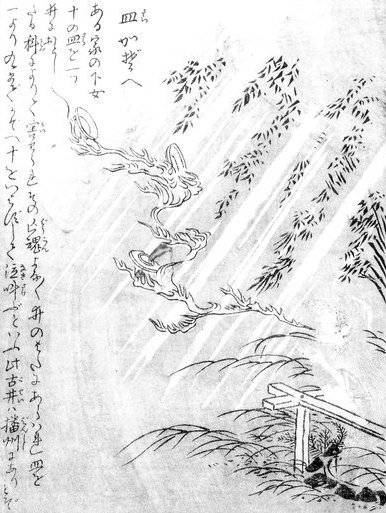
Toriyama Sekien, 1779. He titled the plate not with her name but with what she does: plate-counting. Public domain, via Wikimedia Commons.
So the Ghost Is Older, Not Newer
Once that is cleared away the sequence runs the other way from what one expects.
A puppet play called Banshū Sarayashiki opened in Osaka, at Dōtonbori, in the seventh month of 1741. It sets the household in Harima province, in the west.
In 1758 a prose “true record,” attributed to Baba Bunkō, moves the household to Banchō in Edo, and there it stays; the Edo version is the one that becomes standard. A study published in a Japanese literary journal in 1987 treats that text as a central case in the formation of the whole jitsuroku genre — the class of book that claims to report real events, which is also where Oiwa’s oldest account sits.
In 1779 Toriyama Sekien drew her for the second of his monster picture-books, and titled the plate simply Sarakazoe: plate-counting.
That title is worth a moment. He does not call the picture Okiku. He names the action and not the woman, which is how this ghost has usually been identified — by the thing she repeats. Around 1831 Hokusai did the same in the print series he named after the hundred-tale game, and more drastically: he replaced her body with the objects, running the neck out into a chain of dishes, so that the counter and the counted are one animal.
By the time Kidō wrote, the counting ghost had been in print for a hundred and sixty years and in pictures for well over a century. He did not invent her. He removed her.
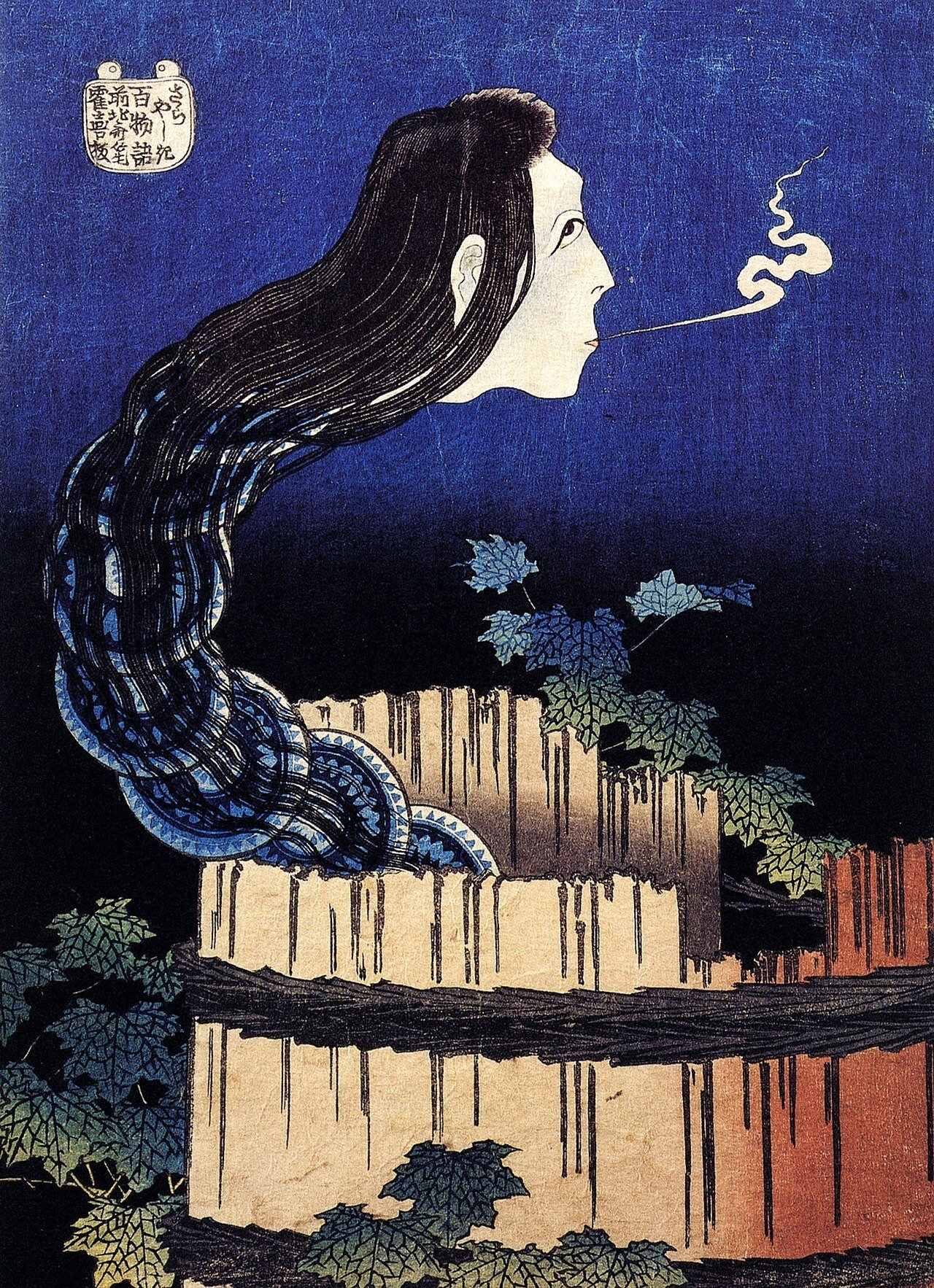
Katsushika Hokusai, about 1831 — eighty-five years before the play that is said to have made her. Public domain, via Wikimedia Commons.
The Oldest Layer Is Thinner Than It Looks
The origin usually offered is a collection said to date from 1577, containing a Harima version of the story.
What is reported of it does not match the familiar tale at any of the points that matter. The woman in it is not called Okiku. The objects are not plates but cups made from abalone shell, and there are five. There is no well.
I was not able to confirm that text in the standard bibliographic catalogues, and this note is not going to build on it. What can be said is that the elements everyone thinks are ancient — the name, the plates, the counting, the well — are not all present in the earliest thing usually cited.
The Same Story With Different Addresses
Yanagita Kunio, in a book on legends published in 1940, makes the point in passing and from the inside. What Edo calls the Banchō plate mansion, he writes, is called the Banshū plate mansion where he comes from.
That is the useful description. It is not one household’s tragedy that spread; it is a form with a blank in it where the district name goes, and each district fills in its own. It is also why the long-running argument about which town the real one happened in cannot be settled: a form with a blank does not have an original address. Counts of how many such places exist are repeated everywhere and I could not find a source for any of them.
The Well at Himeji
Himeji Castle shows visitors a well identified as Okiku’s, and it is the single most photographed piece of evidence for the story being real.
The city’s own pages about the castle do not mention it. The well’s older name was the bucket well, and the identification with Okiku appears to have taken hold only after the castle was opened to the public in the Taishō period — within about a century, and within living memory of the generation that followed. The English encyclopaedia entry on the castle already marks the identification as disputed.
A place attached itself to the story, and it did so recently. Visitors have been shown that well for roughly a century, which is long enough for the identification to feel immemorial and short enough for it to be checked. That is a common enough thing; what is unusual is being able to watch it happen.
What the Sequence Shows
Put the layers in order and the direction of manufacture is plain, and it is the opposite of the usual assumption.
The ghost was in prose by 1758 and in pictures by 1779. A playwright in 1916 took her out and wrote something harder and more modern in her place — a woman who destroys a precious thing to make a man prove himself, and a man who kills her for the insult rather than the loss. Then the reference literature described his play as though the ghost were still standing in it.
Nobody put her back into the play. They only put her back into the descriptions of it, which is easier and which nobody checks.
Sources
- Okamoto Kidō 岡本綺堂, Banchō Sarayashiki 番町皿屋敷, dated January 1916.
- Banshū Sarayashiki 播州皿屋敷, puppet play, first staged at the Toyotake theatre, Dōtonbori, Osaka, seventh month of 1741.
- Sarayashiki benpiroku 皿屋舗辨疑録, prose record attributed to Baba Bunkō 馬場文耕, 1758.
- Konita Seiji 小二田誠二, “The original form of the jitsuroku novel: on Sarayashiki benpiroku,” Nihon bungaku 36:12, December 1987.
- Konjaku gazu zoku hyakki 今昔画図続百鬼, by Toriyama Sekien 鳥山石燕, 1779; the plate titled Sarakazoe. Commons
- Hyakumonogatari 百物語, print series by Katsushika Hokusai 葛飾北斎, c. 1831; the Sarayashiki design. Commons
- Yanagita Kunio 柳田國男, Densetsu 伝説, 1940; the passage on the regional names.
Further Reading
- Michael Dylan Foster, The Book of Yōkai: Mysterious Creatures of Japanese Folklore, 2015
The reading in “What the Sequence Shows” is KWAIDANOTE’s own.
Found an error? Write to kwaidanote@gmail.com — corrections are made on this page and dated.