The Hamaya Was Already an Argument
An Arrow Nobody Shoots
At New Year, Japanese shrines hand out an arrow. It has no point and no bow to go with it, it is decorated, and it is taken home and stood somewhere for the year. The name is hamaya, written with characters that read as the demon-breaking arrow.
It is a small subject, and unusually well documented, and what the documents show is that the people who were buying these things were already arguing about what the word meant.
It Was a Market Good
A district gazetteer of Asakusa published in 1914, describing commerce in the Edo period, lists what was sold at the year-end market. Among the goods: rice bins, images of Daikoku, hemp tea-bags, demon-breaking bows, papier-mâché Daruma, buckets, poles, battledores, shuttlecocks.
That is the company it kept. Not a sacred implement issued by a shrine, but a seasonal line of stock, sold beside kitchenware and children’s toys at a temple market in the weeks before the New Year.
The caveat belongs here rather than in a footnote: the gazetteer was compiled in 1914 and is describing an earlier period in retrospect. It does not say which year, and it does not cite the source it is drawing on.
It Was a Bow
There is something else in that list, and in the verse-book quoted below, and it is easy to read past.
The Edo sources are not selling an arrow. They are selling a bow — the demon-breaking bow, hama-yumi. The thing given to the baby, the thing stacked at the market beside the buckets, is the bow, and the arrow is what goes with it.
The object handed over a shrine counter today is the arrow, on its own, with no bow anywhere. Somewhere between the Edo market and the modern shrine the set came apart and the smaller half survived, which is the sort of change that happens to objects when they stop being used for anything and start being displayed.
This note cannot date that either. What it can say is that the Edo documents and the modern counter are not describing the same object, and that the name we use now is the name of the part.
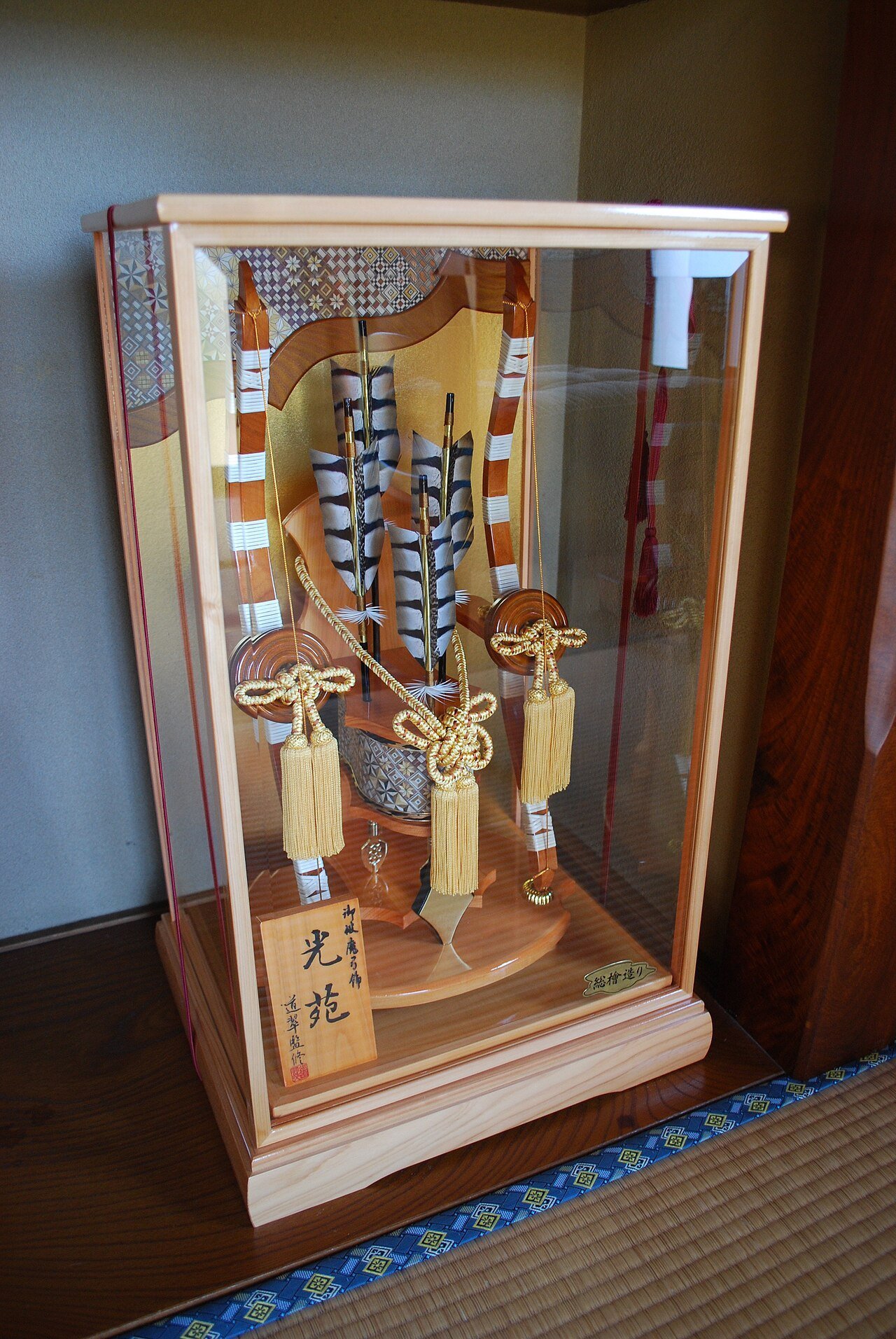
The bow and the arrow together, as the Edo records have them. Photograph by katorisi, CC BY-SA 3.0, via Wikimedia Commons.
And a Present for a First New Year
A miscellany of Edo customs quotes a verse-book on the same object in a different setting: the wet nurse sends a demon-breaking bow as a congratulatory gift for the young master.
So it also belonged to the life cycle — the thing given for a boy’s first New Year, from a woman in the household who would have had reason to mark it.
The Edo Period Argued About the Name
Now the part that makes this worth a note.
A collection of Edo writings reprinted in 1908 sets out two explanations of the word, and both of them come from Edo books.
The first, quoted from a work of 1688, derives it from an archery rite: in the reign of Emperor Kōtoku, it says, archery was performed at the New Year, and the custom descends from that. This is the pious version, and it gives the object an imperial pedigree in the seventh century.
The second, quoted from another Edo miscellany, says something quite different. The characters for demon-breaking, it argues, are a corruption. The original word was about breaking the target — the mark shot at in the New Year game was itself called a hama, and the arrow was simply the arrow you shot at it. The demons came later, supplied by writers who preferred the other characters.
The reverent etymology and the sceptical one are both three hundred years old. This is not a case of modern scholarship deflating a tradition. The deflation is already inside the tradition, in print, in the period when the objects were being sold at the market.
The Game Behind the Second Explanation
That second reading has a practice attached to it. The same source describes children shooting at the target and calling out as they shoot, which is a game with a name for the target and a name for the arrow.
Set the two explanations against that and the direction of travel is visible. A game has equipment. The equipment acquires a written form. The written form is chosen, among the available characters, by people with a reason to prefer demons to targets.
What Happened Afterwards
Yanagita Kunio, in a book on how to do fieldwork published in 1942, lists the word among the vocabulary that by his time survived only in certain parts of the countryside.
That is a striking place to find it, because it is the same period in which the shrine version — a New Year arrow, received over a counter, nationally, by everybody — was becoming the ordinary thing. A word receding in the villages and an object spreading through the shrines, at the same moment.
When that shift happened is the one thing this note could not establish — and it is worth saying who else cannot establish it.
The national association of Shinto shrines publishes a page on the hamaya. On the question of how the object came to be handed out at New Year in the form it now has, its wording is that the set is thought to have been simplified to the arrow alone, which then came to be given as a protective charm. Thought by whom, and from when, it does not say. The Japanese reference article on the subject hedges in the same way.
That is the institution that issues these things, declining to date its own practice. It is a more useful sentence than any confident chronology would have been, and it is the reason this note does not supply one either.
What the Object Actually Is
One reading is that the hamaya is an ancient apotropaic implement, and the market stalls and the children’s game are late vulgarisations of it.
The documents read the other way round. What can be shown is a game with a target, a seasonal commodity sold beside buckets and battledores, a gift given to a baby boy, and two competing accounts of the name, one of which says plainly that the demons were never in the word to begin with.
The arrow on the shelf in a Japanese house this January is the end of that, not the beginning of it. And the people who would have been least surprised to hear the etymology questioned are the ones who were buying it in Asakusa in the seventeen-hundreds.
None of which makes it less of a thing to have in the house. A boy was given one at his first New Year by a woman who had looked after him; children shot at a mark with it and shouted; it was sold in the cold beside the shuttlecocks. Whether the demons were in the word or were put there later, the object has been in Japanese Januaries for a very long time, and knowing that its name is contested is a better piece of knowledge than believing it is ancient and being wrong about which part is.
Sources
- Asakusa-ku shi 浅草区誌, lower volume, compiled by the ward office, 1914; the list of goods sold at the year-end market, in its account of commerce in the Edo period.
- Enseki jisshu 燕石十種, third volume, in the 1908 reprint; quoting Segen mondō 世諺問答, 1688, for the derivation from an imperial archery rite, and a further Edo miscellany for the argument that the characters for demon-breaking are a corruption of those for breaking the target, together with the description of the children’s shooting game.
- Kiyū shōran 嬉遊笑覧, by Kitamura Nobuyo 喜多村信節, c. 1830; quoting a verse-book on the wet nurse’s New Year gift. Commons
- Yanagita Kunio 柳田國男, a study of methods for the fieldwork of everyday life, 1942; the word listed among vocabulary surviving only in some districts.
Further Reading
- Michael Dylan Foster, The Book of Yōkai: Mysterious Creatures of Japanese Folklore, 2015
The reading in “What the Object Actually Is” is KWAIDANOTE’s own.
Found an error? Write to kwaidanote@gmail.com — corrections are made on this page and dated.