Shinigami Was a Figure of Speech
A Word Without an Address
In English the shinigami is introduced as the Japanese god of death, a figure of old belief who comes for the dying.
The word is genuinely old. What is missing is the god. There is no shrine to point at, no rite, no body of myth, and — as will become clear — no shortage of Japanese writers who noticed this and went looking abroad for something to compare it with.
1709, in a Play About a Double Suicide
The earliest citation in the standard historical dictionary of Japanese is a puppet play of 1709, and the line is worth having in full, because everything about the word’s later career is already in it.
It speaks of the frailty of a life that the shinigami calls away — the shinigami that lures, and the brevity of the life it lures. Nobody worships it. Nobody describes it. It has no shape and does not appear. It is a way of saying that two people are about to die together and that something is pulling them.
The author of that play is not identified in this note; the attribution was not confirmed.
The Same Register, the Same Genre
A study of Chikamatsu published in 1922 quotes a michiyuki — the journey passage in which a pair of lovers walk to the place where they will die — in which the shinigami leads the way along the road.
A caution: that is a quotation inside a study, and the play text itself was not read for this note. What it establishes is register rather than fact. The earliest written life of this word is in the theatre, in one genre, doing one job.
The shinigami begins as a stage device for explaining why two people walked to the same place.
What Japanese Scholars Reached For
Here is the diagnostic, and it is more persuasive than any absence of shrines could be.
A history of popular belief published in 1925 has a section on the shinigami. What is in the section is Yama of India, Osiris of Egypt, and Hela of the north. A volume of legend studies from the same period mentions the word, and the context is a summary of the Nibelungenlied.
Two Japanese scholars writing about a Japanese word illustrate it with material from three other continents. That is what a writer does when the domestic examples are not there to be used.
The One Attestation from a Village
There is an exception, and it is late.
A collection of legends and folktales from Shizuoka published in 1934 records a belief in plain terms: at sea, in the hills, or on the railway line, if you go to the place where someone has died, a shinigami attaches itself to you. And there is a thing called the death-turn, which afterwards calls people to die in their order.
That is a folk belief, in Japanese, recorded in the field, and it is nearly the only one this note found. It was written down in 1934.
Where the Familiar Figure Comes From
The shinigami that English readers actually picture — the one who can be spoken to and bargained with, who stands at the head or the foot of a sickbed, whose candles are the lives of the living — comes from a single rakugo piece called “Shinigami,” associated with Sanyūtei Enchō and the Meiji period.
And that piece is an adaptation of a European story. Two candidate originals have been argued in print, by named scholars in named places: an Italian opera of 1850, proposed in 1956, and the Grimm tale of Godfather Death, argued in 2000. The two are not level. The later paper is generally taken to have settled it in favour of the Grimm tale, and the opera reading is now the older position rather than the rival one.
Our note on the peony lantern deals with the same performer and the same decades, when his storytelling was being taken down in shorthand and printed. The most famous Japanese death spirit arrives in the same room as the technology that recorded him, and it arrives from abroad.
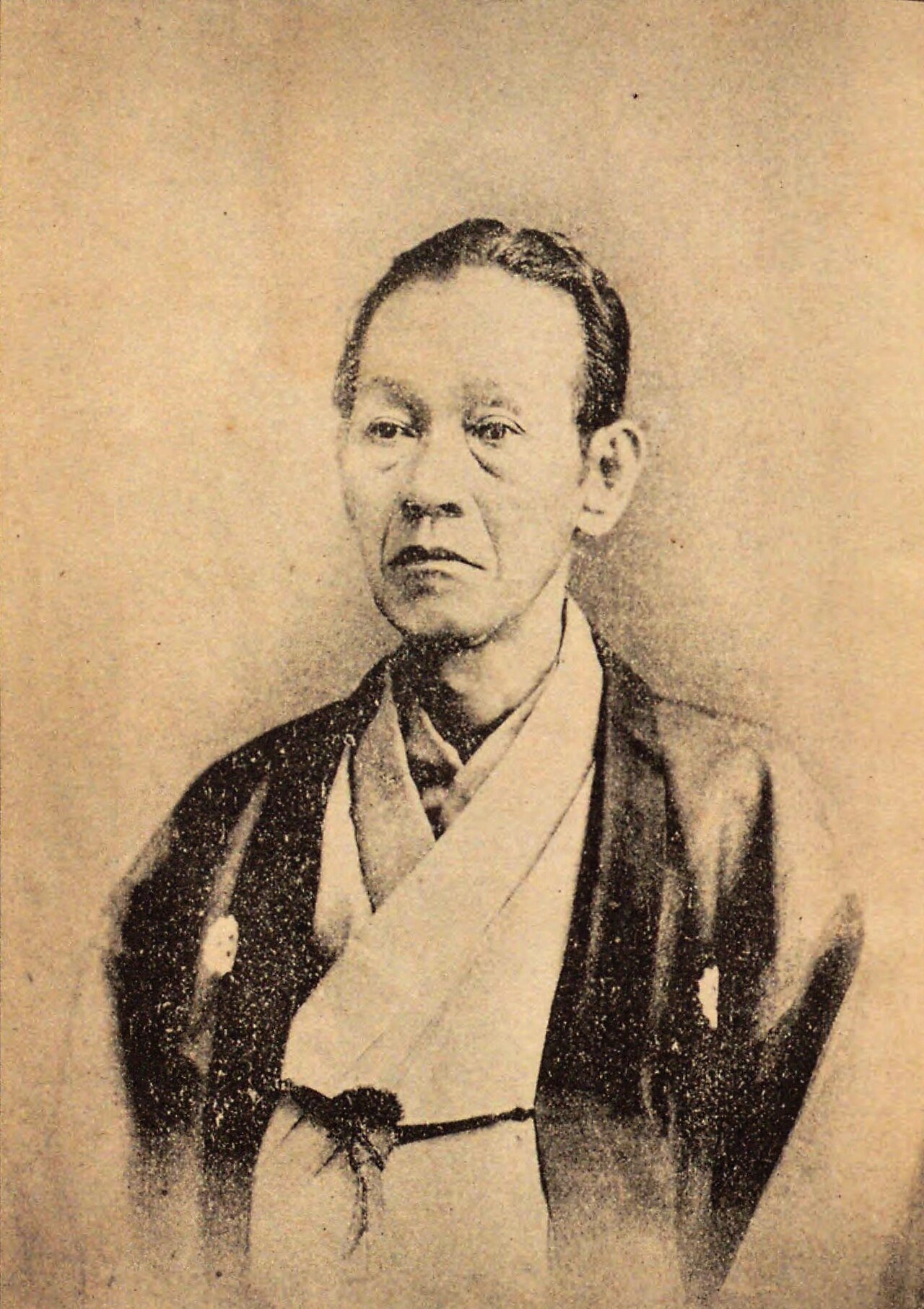
San’yūtei Enchō, who put the figure on a stage. Public domain, via Wikimedia Commons.
Then It Became an Everyday Phrase
Between the plays and the rakugo, something happens to the word that is easy to miss because it is so ordinary.
It turns into an idiom. In the fiction of the Meiji and Taishō periods — Izumi Kyōka’s novels are full of it — people are possessed by a shinigami, and charms are used to drive a shinigami off, in sentences where nobody believes a being is present. It is the way English says a person has a death wish, or that something is hanging over them.
A word that names a pull is exactly the kind of word that becomes a figure of speech, and once it is one, it can be used by writers who would deny the existence of anything behind it. That is the state the word was in when Enchō put a character on stage with the name — which is part of why the character worked. The audience already used the word every week and had never pictured anybody.
Two Things That Do Not Fit Neatly
Two earlier appearances resist the tidy account, and both are reported here at second hand.
A study of 1933 quotes an illustrated book of a hundred tales dated 1841, which lists the shinigami among its creatures. The original was not available, so what this note has is a quotation of a list.
And in 1886 a kabuki play gave an actor a shinigami to perform, with the print designer Tsukioka Yoshitoshi reported to have sketched the figure to help him find it. Whatever the word had been before, by the late nineteenth century it had a face on a stage.
What the Word Was Actually For
One reading is that Japan had a death god all along and simply did not build him anything.
The record suggests the opposite and something more useful. The shinigami is not a being with a habitat. It is a name for a pull, applied wherever a pull needs naming. In the plays it accounts for two people arriving at the same place on the same night. In the village record it accounts for a second death following a first. In the rakugo it becomes, for the first time, a character — and the thing that makes it a character is that it can be cheated, which is precisely what a real god of death cannot be.
That is why the borrowing from Europe went in so easily and left no seam. There was no established figure for the imported one to displace, no iconography to argue with, and no institution with an interest in how it was drawn. A word that had spent two centuries meaning an inclination had a vacancy where the body should be, and a storyteller filled it.
Sources
- Shinjū yaiba wa kōri no tsuitachi 心中刃は氷の朔日, puppet play, 1709; cited in the standard historical dictionary of Japanese as the earliest attestation of shinigami.
- Katō Junzō 加藤順三, a study of Chikamatsu’s plays, 1922; quoting a michiyuki passage in which the shinigami leads the way.
- Katō Totsudō 加藤咄堂, a history of popular belief, 1925; the section on the shinigami, treating Yama, Osiris and Hela.
- Shizuoka-ken densetsu mukashibanashi shū 静岡県伝説昔話集, 1934; the belief that a shinigami attaches at the site of a death, and the shiniban.
- Kurihara Seiichi 栗原清一, a study of mental illness in old Japanese documents, 1933; quoting a picture-book of a hundred tales dated 1841 that lists the shinigami.
- Noguchi Yonejirō 野口米次郎, on six ukiyo-e masters, 1919; the shinigami role in a kabuki play of 1886 and Yoshitoshi’s sketch.
- On the foreign origin of the rakugo piece: Imamura Nobuo 今村信雄, “Enchō’s Shinigami,” in Rakugo no sekai, 1956, for the Italian opera argument; Kitamura Masahiro 北村正裕, “The fairy tale of death: Grimm and Japanese rakugo,” Sundai Forum 18, 2000; Umeuchi Yukinobu 梅内幸信, a motif analysis of the classical rakugo “Shinigami,” Chiiki seisaku kagaku kenkyū, 2013.
Further Reading
- Nishimoto Kōji 西本晃二, The world of the rakugo “Shinigami,” 2002
The reading in “What the Word Was Actually For” is KWAIDANOTE’s own.
Found an error? Write to kwaidanote@gmail.com — corrections are made on this page and dated.