The Zashiki-warashi Appears Twice
Two Items, and No More
The zashiki-warashi, the child that lives in the good room of an old house, is the best-known thing to come out of Tōno, and the book that made it known is the collection of local traditions published in 1910.
In that book it occupies two numbered items: the seventeenth and the eighteenth. A search of the whole text finds the word three times — once in the table of contents and once in each of those two entries. There is no third appearance.
Our notes on the book itself and on the man who supplied its contents deal with how it was made. This one is about what those two items say, and what they do not.
The First One Ends in Wealth
Item seventeen opens by saying that there are not a few old houses in which this god lives, that it is mostly a child of twelve or thirteen, and that now and then it lets itself be seen.
Then two households. In the first, a daughter home from girls’ high school for the holidays came face to face with one in the corridor and was badly frightened — and the text says, flatly, that this one was a boy. In the second, a woman sewing alone heard the sound of paper rustling in the next room, and understood what it was.
The item closes with a statement of consequence: the house in which this god lodges is prosperous without effort.
That is the law the first tale gives. Not ruin. Wealth.
A short note is appended to the entry, and it is the compiler speaking rather than the informant. It explains that the name is written with the characters for the child of the good room, and refers the reader to an earlier book of his own in which the same being is discussed. The category is already established for him before the two tales arrive — he is filing them, not discovering something. That is a small thing and it colours everything after it, because a collector who already has a folder will tend to receive what fits in it.
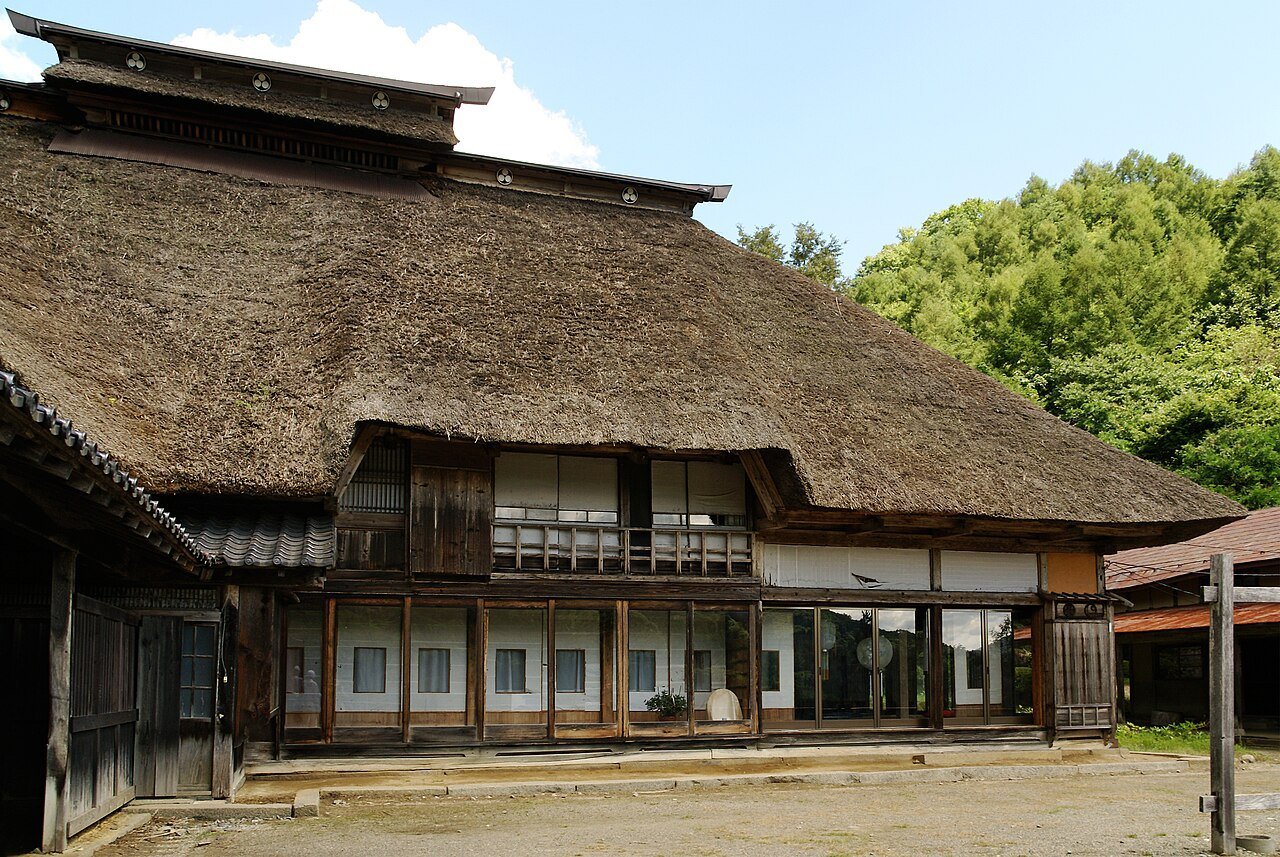
A farmhouse of the Tōno kind, with the stable under the same roof. Photograph by 663highland, CC BY-SA 4.0, via Wikimedia Commons.
The Second One Ends in Mushrooms
Item eighteen opens by saying that the zashiki-warashi is sometimes a girl, and that a certain old house had long been said to have two of them.
A man of the village, coming back from town, met two unfamiliar and well-dressed girls at a bridge. He asked where they had come from and they said from that house. He asked where they were going and they named another house in another village. He thought to himself that the first family’s time must be at an end.
That exchange is the only dialogue this creature is given in the entire book, and it is worth noticing how ordinary it is. He asks two direct questions and gets two direct answers, and neither side does anything strange. Nobody vanishes, nobody threatens, nobody is coy. The catastrophe is already fixed by the time the conversation happens and the conversation does not affect it; the man simply works out what he has just been told. The most frightening item in the collection turns on a piece of polite road-side small talk, and on a listener who is quick enough to do the arithmetic.
And not long after, the text says, the master and servants of that house, twenty-odd people, died in a single day of poisonous mushrooms, leaving one seven-year-old girl, who also grew old without children and died a short while ago.
What That Is Not
The modern statement of the rule is that when the zashiki-warashi leaves, the house falls. That is not what item eighteen is.
It is one house, one departure, one specific catastrophe — a meal — and a survivor whose entire subsequent life is disposed of in a subordinate clause. There is no general principle offered, and nothing to suggest the compiler thought he was recording one.
And it is contradicted by the item immediately before it, where the presence of the same being means prosperity without effort. Two consecutive entries, two opposite outcomes, no attempt to reconcile them, and no comment.
What Is Not in the Book at All
The zashiki-warashi that now appears in guidebooks and games has a bobbed haircut, a red face, and a taste for mischief — footsteps in an empty corridor, pillows turned in the night, objects moved.
None of that is in the 1910 text. The two items were searched for it and it is absent.
What is present is an age, a corridor, the sound of paper, a sex that changes between one entry and the next, and two economic outcomes that point in opposite directions. That is the whole of it.
Where the Rest Came From
This note does not know, and is not going to guess. The supplement of 1935 added a great many further items and does contain at least one more on this subject; it was not examined for this note, so whether the familiar details enter there is a question this note leaves open rather than an answer it supplies.
One fact is worth adding. The man who told these stories to the compiler went on to write on this subject himself, and the book of his that carries the zashiki-warashi in its title was published in 1974 — forty-one years after his death.
Why the Thinness Is the Point
One reading is that the 1910 book is simply an early and sketchy record, later filled in by better collecting.
The other reading is the one the book invites. Its preface makes a famous promise about having altered nothing, a promise our note on it examines and finds it did not keep in every particular. But the two zashiki-warashi items read exactly like what that promise would produce if it were kept: they stop where the person talking stopped. No description beyond what was seen, no rule beyond what happened to one family, and two accounts side by side that do not agree.
Everything that has been added since — the haircut, the pranks, the tidy law about houses falling — was added after the only source that claimed to be adding nothing.
That is not an argument for going back to the two items and treating them as the true version. They are two things two households said about themselves to one visitor in one district, and they disagree. It is an argument for knowing which parts of a familiar figure can be traced to them and which parts arrived later by routes nobody has written down, which is a different and more useful kind of knowledge than authenticity.
Sources
- Tōno monogatari 遠野物語, by Yanagita Kunio 柳田國男, privately printed 1910; items seventeen and eighteen, the only appearances of the zashiki-warashi in the collection. Commons
- The supplement of 1935, not consulted for this note.
- Sasaki Kizen 佐々木喜善 (1886–1933), the compiler’s informant; his own volume on the zashiki-warashi and the Oshira deity was published in 1974. Wikipedia
Further Reading
- Ronald A. Morse, translator, The Legends of Tono, 1975; centenary edition 2008
The reading in “Why the Thinness Is the Point” is KWAIDANOTE’s own.
Found an error? Write to kwaidanote@gmail.com — corrections are made on this page and dated.