Kūkai and the Daishi
A man and a title
Kūkai was born in 774 in Sanuki, on the island of Shikoku, and died on Mount Kōya in 835 — or, as the lives written about him prefer to say, entered meditation there and did not come out. Eighty-six years later, in 921, the court of Emperor Daigo gave him a title: Kōbō Daishi, “Great Teacher Who Spread the Dharma” [1]. Most of Japan has known him by it ever since. In English writing about the Shikoku pilgrimage or Mount Kōya, “the Daishi” usually means Kūkai, and “Kūkai” usually means the man.
The two are not quite the same figure, and the difference is recorded in the books themselves. The Japanese lives of Kūkai printed between 1894 and 1922 — devotional biographies, an illustrated life, a district gazetteer and a few critical histories — carry both at once [1–11]. They set down dates, letters and appointments, and on the same page they tell of dragons, of a star entering a young monk’s mouth, of a body whose colour did not change after death. Read together, they make the question less who was Kūkai than how a monk became a presence that villages still expect at the door.
What the records hold
The firmest parts of Kūkai’s life come from his own writing. In 804 he sailed with the embassy of Fujiwara no Kadonomaro to Tang China. The ambassador’s ship was driven far south to the coast of Fuzhou, where local officials sealed the ship and kept the party on the beach, and Kūkai wrote a letter in the ambassador’s name that won them a hearing. That letter survives in the Shōryōshū, the collection of his writings made by his disciple Shinzei; one phrase in it gives the length of the drift: “two months and more on the waves” [2].
In Chang’an in 805 he was received by the master Huiguo at Qinglong Temple and given the full transmission of the esoteric teaching within a few months. The dates of those ceremonies, and Huiguo’s words of greeting, come from the Shōrai mokuroku, the catalogue Kūkai himself presented to the court on his return, listing the texts, paintings and ritual implements he had brought back [2][3]. He came home in 806. He opened Mount Kōya as a training ground in 816, and the lives agree that his end came on the mountain in the third month of 835 [1][4].
Even here the lives do not agree on everything. They give his age at death as sixty-two, while a later study notes that the court histories say sixty-three [8]. They differ on the year of his great debate at court, and on the order of the ordeals he passed through as a young ascetic on Shikoku [1][5]. The books of this period rarely hide such disagreements; they simply print their own version and move on.
The second figure
The Daishi is made of another kind of material. Take the entry into meditation. In the tellings, Kūkai announces the day and hour months in advance, stops eating grain, and on the appointed morning sits in the lotus position and closes his eyes; the witnesses, in an older text quoted by a 1921 life, say that only the closed eyes and the silence showed he had gone [4][5][11]. Whether this was death or something else is argued in the lives themselves — some insist on one word, some on the other [4].
Then the story continues past the man. The 1909 life of Kūkai by Yamagata Genjō tells how, in 921, the envoy Kangen opened the cave on Kōya to deliver the emperor’s new robe and title, found the master’s hair grown long and his robe worn to threads, shaved him, and dressed him in the new robe [1]. The older Kōbō Daishi gyōjōki ends one of its books with a lay-monk regent, identified with Fujiwara no Michinaga, climbing Kōya in 1023 one step and three bows at a time, and seeing, faintly, the Daishi’s face in a light like the morning sun [5]. These are not presented as symbols. They are told as events, with dates, envoys and witnesses, in the same register as the embassy of 804.
The critical historians of the same years read them differently. Ono Tōta, in his 1904 life, called the star that entered the young monk’s mouth “a later embellishment” [3]. Adachi Ritsuen’s history of Japanese Buddhism (1899) treated several of the wonders as illusionism [6]. Miura Hiroyuki (1914) judged that none of the stories of magical contests between Kūkai and his rival Shubin rests on a certain record [7], and Makino Shinnosuke’s 1921 study of the lives called the famous scene of Kūkai transforming before the emperor’s court a legend that cannot be credited [8]. Reverence and doubt were printed side by side, in the same decades.
The monk at the door
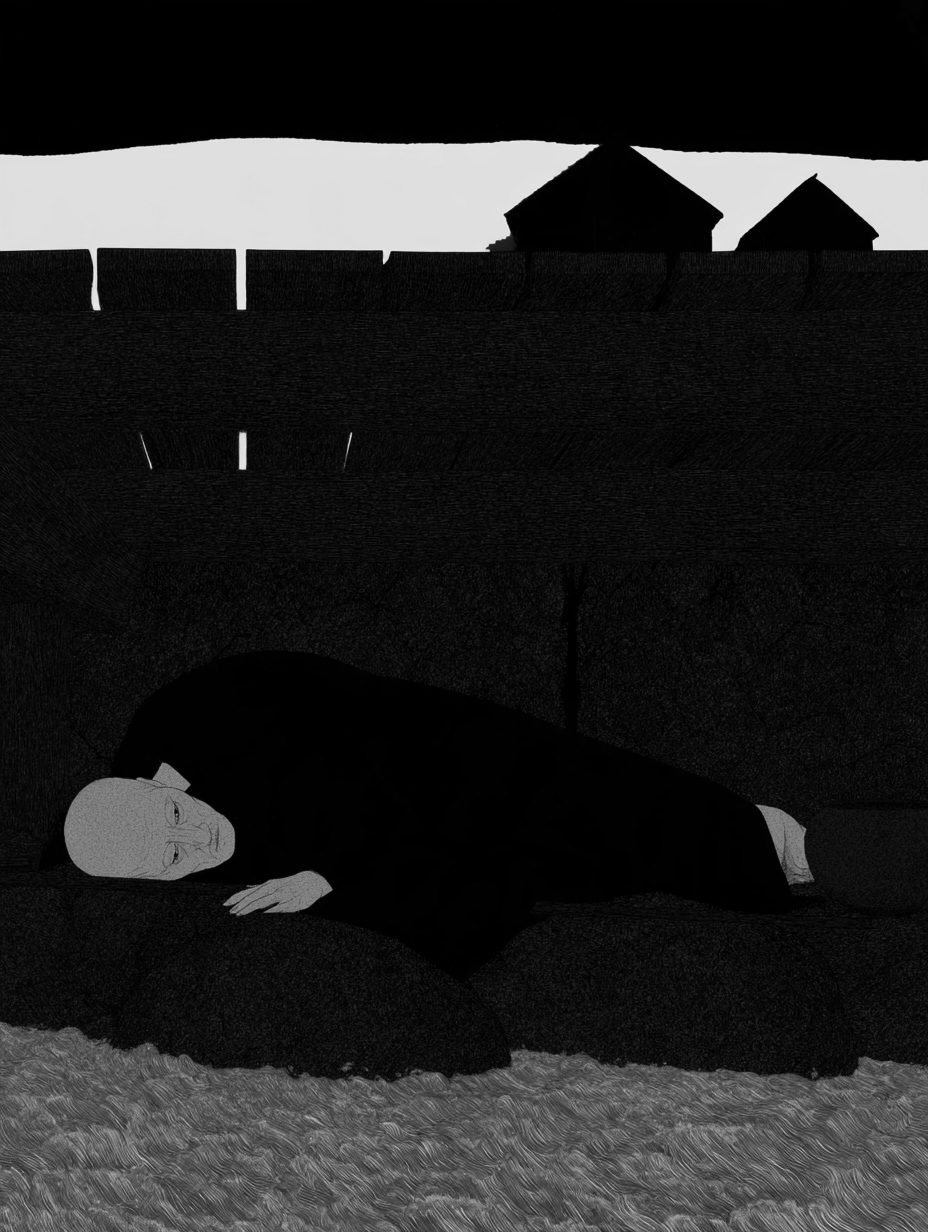
The Daishi is at his most recognizable, though, not on the mountain but on the road. Across Japan, springs, wells, trees and stones carry the explanation that the Daishi passed this way. The pattern is simple: a traveling monk asks for something small, usually water, and what follows depends on the answer.
Yokoyama Kendō’s Daishō Kūkai (1918) records that in a drought in Awa province a woman who had carried clear water from a distant valley gave it gladly to a passing monk, on the day of her mother’s death [10]. The same book records a village in Iyo where the Daishi was turned away with polite excuses at every house, and spent the night under the planks of a bridge [10]. The district gazetteer of Nishishirakawa, in Fukushima, printed in 1915, records two such tales from its own villages. In one, an old woman refuses the Daishi a single cane from her bamboo grove, and he vows that no bamboo will grow there; the gazetteer offers this as the reason those hamlets do not plant bamboo. In the other, quoting an older topography, an old woman tells him there is no water, and from then on the wells there yield water too astringent to drink [9].
The second of these is worth reading closely. It does not say that the Daishi cursed anyone, or that the old woman had water and lied. It says only what she said, that he went on, and what the wells were like afterward. The connection is left to the reader — or, more exactly, to the village, which had kept the story as the reason for a daily walk to the spring by the highway [9]. One reading is that such tales are less about the monk than about the household: they record what a place remembered about its own hospitality.
What interests me most in these village tellings is how little the Daishi does in them. He asks, he blesses or he leaves. The consequence arrives afterward, in the landscape, and it is the people who carry it.
Where the two meet
The Shikoku pilgrimage, the circuit of temples associated with Kūkai around his home island, sits on exactly this seam. One of its origin legends, told in the 1909 life, concerns a rich man of Iyo named Emon Saburō who struck a begging monk’s bowl and spent the rest of his life walking the island in search of him [1]. The tale gives dates in the 820s and 830s, yet the numbered round of eighty-eight temples and the white clothing of the pilgrims that it describes belong to the world in which the legend took shape, centuries later. The legend is not less valuable for that. It records what pilgrims believed they were doing when they walked.
The Shingon school that Kūkai founded, and the pilgrimage associated with him, are living practices. The wonders in the old books can be read as records of belief — careful, specific, often dated — without being taken as reports of fact, and without being dismissed. In our book KŪKAI: Tales of the Monk Who Became a Legend, the tales keep the lives’ own words where they exist, and a short note after each one says which telling it follows and where the others part. Where the tellings disagree, they are left disagreeing. That seems the only honest way to follow a man who was, from the start, being written into two lives at once.
Sources
- Yamagata Genjō 山県玄浄, Kōbō Daishi goichidaiki 弘法大師御一代記, 1909.
- Mihashi Tokugen 御橋悳言, ed., Kōbō Daishi godenki 弘法大師御伝記, 1915. Quotes Kūkai’s letters from the Shōryōshū 性霊集 and passages of the Shōrai mokuroku 請来目録.
- Ono Tōta 小野藤太, Kōbō Daishi den 弘法大師伝, 1904.
- Saeki Yūsan 佐伯宥粲, Kōbō Daishi goden 弘法大師御伝, 1922.
- Ichion 一音, Kōbō Daishi gyōjōki 弘法大師行状記.
- Adachi Ritsuen 足立栗園, Hihanteki Nihon bukkyōshi 批判的日本仏教史, 1899.
- Miura Hiroyuki 三浦周行, Kōbō Daishi 弘法大師, 1914.
- Makino Shinnosuke 牧野信之助, Kōbō Daishi den no kenkyū 弘法大師伝の研究, 1921.
- Nishishirakawa District, Fukushima Prefecture 西白河郡, ed., Nishishirakawa gunshi 西白河郡誌, 1915. Entries for the villages of Kamanoko and Kayane; the second quotes the Shirakawa fudoki 白河風土記.
- Yokoyama Kendō 横山健堂, Daishō Kūkai 大聖空海, 1918.
- Hasuo Kanzen 蓮生観善, Kōbō Daishi godenki 弘法大師御伝記, 1921. Quotes an older account of the entry into meditation.
Further Reading
- The tales and notes in KŪKAI: Tales of the Monk Who Became a Legend (Mystics of Old Japan, 2026) follow these same books; each tale’s Behind the Tale note names the telling it follows.
Found an error? Write to kwaidanote@gmail.com — corrections are made on this page and dated.