Seimei and Dōman: The Making of a Rival
A Rival Without Dates
Abe no Seimei died in 1005. He was an onmyōji, a diviner of the Heian court, and his profession was the calendar, the sky and the reading of omens. The man remembered as his great rival, Ashiya Dōman, has no dates at all. Asked who Abe no Seimei was, the old books answer in two registers: a court specialist in a handful of dry entries, and a wonder-worker with a fox for a mother and an enemy who would not stay beaten. The rivalry lives almost entirely in the second register, and nearly every piece of it can be dated to the moment someone added it.
What the Record Keeps
The oldest stories about Seimei are short, and none of them is about a duel. The Konjaku monogatari shū, compiled early in the twelfth century, makes him a pupil of the diviner Kamo no Tadayuki and closes by calling him no ordinary man [1]. The Ōkagami, a late-Heian history of the court, places him in his house at the Tsuchimikado corner on the night in 986 when the young Emperor Kazan slipped out of the palace to take the tonsure; Seimei reads the event off the sky from behind his shutters and never sees the procession pass [2]. A thirteenth-century collection, the Zoku-kojidan, keeps the profession’s own notice of him — a man of technique; in learning, not exceptional — and a quarrel with Kamo no Mitsuyoshi over what a dead master had left behind, the learning on one side and the books on the other [3].
These are colleagues, clients and a teacher. The record gives Seimei no nemesis. The closest it comes is a hired hand.
The Monk from Harima
The one early figure who carries something like the rival’s name is not quite called Dōman. The Uji shūi monogatari, an early thirteenth-century collection, tells how Fujiwara no Michinaga’s white dog stopped its master at the gate of his temple, the Hōjō-ji, and how Seimei found a curse buried in the road: two clay dishes bound mouth to mouth with a yellow paper cord, holding nothing but a single stroke of red cinnabar [4]. The trail leads to an old monk of Harima province named Dōma, working for a great minister. The same story stands in the Kojidan [5].
This is the seed, and it is a thin one. Dōma is a practitioner for hire, working out of a shabby house. Seimei names him as the likely culprit, but the two men never meet. The entry’s chronology is loose as well. The Hōjō-ji was begun in 1019, fourteen years after Seimei’s death, and the minister it names held the post of Minister of the Left only from 1017. One reading is that the compilers kept better sources than clocks: they knew who was said to have done what, and cared less about when.
The Storytellers’ Doctor
Some nine hundred years after Seimei, the name came back as a career. In the printed kōdan books of late Meiji and Taishō Japan — stage storytelling taken down in shorthand from the platform, or written for a pocket-book series — Ashiya Dōman is Doctor of the Heavens, a senior post in Seimei’s own profession, a diviner from the western provinces and, in one telling, sworn brother to the Great Counselor Fujiwara no Motokata. Three of these tellings, printed in 1902, 1912 and 1914, are followed here [6][7][8].
They give the two men what the record never did: a meeting. It is a public disputation before the court, and it turns on what a diviner is. Dōman holds that the master of prayer stands above Heaven and Earth and commands the five elements as a lord commands his servants. The young Seimei answers that a practitioner fits himself to the world so exactly that when he moves, the world is moving — and that a man standing above Heaven has nothing left to pray to [7][8].
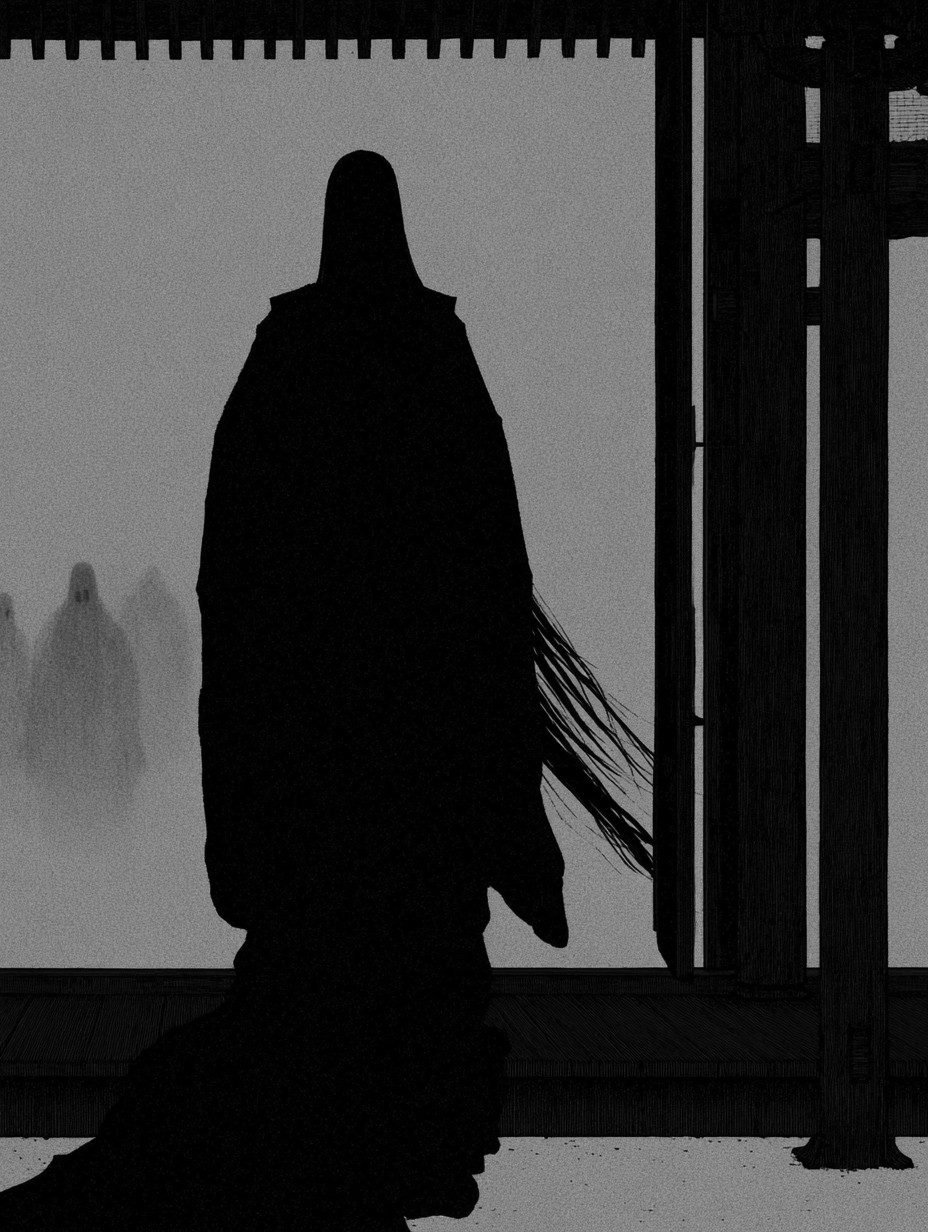
From there the storytellers build a conspiracy in the grammar of a court case: a frame-up by arson, a prayer-monk engaged to pray a man to death, a thief on the Modoribashi bridge at night with Seimei’s books on his back, and a forged finding filed against a true one. The tellers move real names and real era dates wherever they need them. The Motokata of the record died in 953, a dozen years before the storm night they date so exactly, and the capital of that century carried out no death sentences. The bridge had older associations of its own. The war chronicle Genpei seisuiki notes in passing that Seimei kept his shikigami, his served spirits, beneath it, because his wife could not bear them in the house [9]; one line of the storytellers puts Dōman’s own house at the foot of the same bridge. The three printed tellings cannot agree on how his story ends.
A Storybook, a Stage and a Skeptic
Between the monk of Harima and the storytellers’ Doctor stand three Edo-period shelves. Abe no Seimei monogatari, a printed life of Seimei published in 1662, sets the two men a contest over a sealed chest — each must divine what is inside — in an entry titled “Dōman and Seimei match wits” [10]. It is the one version here in which the rivalry is given an ending.
In 1734 the playwright Takeda Izumo put Dōman’s name into the title of a puppet play, Ashiya Dōman Ōuchi Kagami, although the line most people remember from it is not Dōman’s at all. It belongs to Seimei’s fox mother, the close of her farewell poem about the kudzu leaf [11].
The skeptic is Hayashi Razan, a Confucian scholar of the early Edo period, who distrusted wonders on principle. Surveying the country’s shrines in his Honchō jinja kō, he came to Seimei, called a Seimei-and-Dōman tale preposterous, and copied it out at length anyway, because common speech had been telling it for so long [12]. That is how a legend of this kind survives: despised and preserved in the same motion.
One Name, Several Men
Set side by side, these figures do not add up to a single life. The record’s Dōma is a hired monk from Harima. The storybook’s Dōman is a rival across a sealed chest. The storytellers’ Dōman is a court official and a conspirator, with three different fates. Harima runs through several of these tellings — the record’s monk comes from there, at least one storyteller makes his Dōman a Harima man as well, and one of them names Seimei governor of the same province [6] — but no source joins the men, and the resemblance of the names is as far as the evidence goes.
What interests me most is the place where the rivalry is missing. The record had every opportunity to set two masters against each other and did not take it; what it kept instead was Seimei’s quarrel with a colleague over a dead master’s books. The storytellers gave Seimei a rival with a curse-altar. The record gave him a colleague with a bookshelf — and in the one entry that names them together, Seimei and Dōma never exchange a word.
Sources
- Konjaku Monogatarishū 今昔物語集, early 12th c., book 24, tale 16. Wikimedia Commons
- Ōkagami 大鏡, late Heian period, chapter on the sixty-fifth sovereign (Kazan). Wikipedia
- Zoku Kojidan 続古事談, compiled 1219, book 5, “The Ways,” entry on Seimei. Wikipedia (ja)
- Uji Shūi Monogatari 宇治拾遺物語, early 13th c., book 14, tale 10, “The wonders worked by the Midō Chancellor’s dog and by Seimei.” Wikimedia Commons
- Kojidan 古事談, compiled c. 1215, book 6. Wikipedia
- Momokawa Minoru (performer), Abe no Seimei, kōdan in two volumes (1902).
- Tamada Gyokurin (performer), Kōdan Abe no Seimei (1912).
- Sekka Sanjin, Abe no Seimei: Bushidō seika (1914).
- Genpei Seisuiki 源平盛衰記, Kamakura period, book 10. Wikipedia
- Abe no Seimei monogatari 安倍晴明物語, kana-zōshi (1662), book 2, entry 7, “Dōman and Seimei match wits.” Wikipedia (ja)
- Takeda Izumo 竹田出雲, Ashiya Dōman Ōuchi Kagami 蘆屋道満大内鑑, puppet play (1734). Wikimedia Commons
- Hayashi Razan 林羅山, Honchō jinja kō 本朝神社考, early Edo period, book 6, entry on Abe no Seimei. Wikipedia (ja)
Found an error? Write to kwaidanote@gmail.com — corrections are made on this page and dated.