The Fox Next Door
A Grievance Carried to Fushimi
A fox living under Sanada-yama, on the Osaka side, had the mouth of its den fouled by a sightseer who relieved himself under the trees there, and it followed the man all the way to Fushimi to settle the matter. The tale is from the Taihei Hyaku Monogatari, a hundred-tales book of the Edo popular press, and what stayed with me is not the grievance but the procedure. Fushimi was another fox’s ground. The visitor, by its own account at the confrontation, got into the offender’s house with leave asked of, and good offices from, the fox of Momoyama, who held that side; and what it demanded in settlement was a penance, assessed and to be paid on a schedule — red rice and fried things carried to the den, morning and evening, for three days. [1] The affair runs, as KITSUNE — the book this note accompanies — puts it, like a suit at law conducted in wonders.
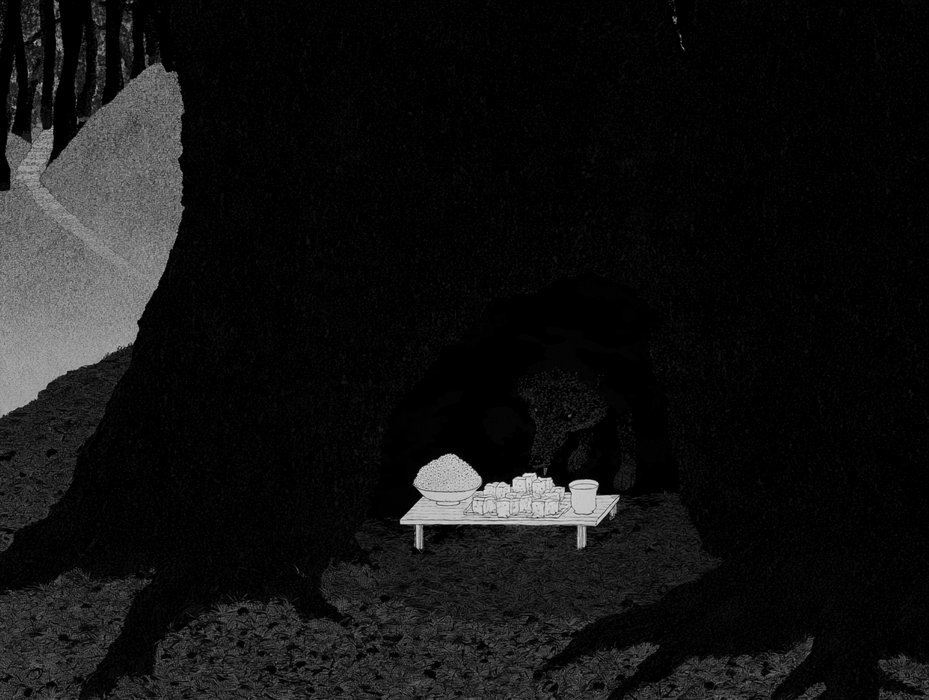
In English the kitsune is often called a Japanese fox spirit, or a fox demon. The second word is the one the old records resist. Of Japan’s uncanny beings, the fox lives closest to people — it dens under the storehouse floor and crosses the road in daylight — and the records treat it accordingly: not as a marvel from somewhere else but as a neighbor, with ground of its own, grievances of its own, and standing business with human beings that both parties are assumed to understand.
The Forms of Business
In the tales the book gathers, the fox conducts a remarkable share of its business in the forms its human neighbors used on one another.
It petitions. The Kokon chomonjū, an anthology of tales completed in 1254, tells of the Major Counselor Fujiwara no Yasumichi, whose house at Gojō Bōmon and Takakura had never in two generations been free of foxes. When the mischief grew past bearing and he ordered every fox on the property clubbed to death, a petition arrived the night before the hunt — in a dream, from an aged suppliant who confessed the mischief, pleaded that one night’s remaining life was dear, and offered terms in return for pardon. [2]
It is petitioned against. In the spring of 1803, by the dating of the Mimibukuro — the private notebook of Negishi Yasumori, a magistrate of the shogunate — a seller of rat poison in Yotsuya lost his infant child and blamed foxes. He went to the Inari shrine and argued his case aloud, point by point, like a plaintiff who believes the court can hear him. [3] In the Edo understanding, fox affairs had an address. That is the book’s reading.
It swears. The Tamahahaki, an Edo collection of strange tales, places in the Kyōroku years (1528 to 1532) an affair in the house of the Kōno, lords of Iyo, that turns on an oath — written fair, with the divine names of the five shrines of Inari copied in as witnesses — presented at the gate by a deputation speaking for the foxes of all Shikoku. [4]
It comes when called. At the Inari shrine of Massaki, on the Sumida bank above Asakusa, a teahouse woman could call a fox out of a hole with fried tofu. The Mimibukuro takes that much from an earlier miscellany, the Wagakoromo, which places the calling in the Tenmei years, the 1780s; the rest of the entry, the story told there of the fox itself, is undated talk heard at the spot. [5]
And it signs. Another Mimibukuro entry, set among the yeoman-samurai of Hachiōji, has a husband reason with the thing that has taken hold of his wife — an argument about the reputation of two houses — and then demand a written account, so that the story would not drift into rumor. [6] How the paper was signed gives the tale its title in this book.
Where the Records Disagree
What the fox is, the sources decline to settle among themselves, and the disagreement is old enough to be part of the record.
The Zoku Kojidan, a collection of court anecdotes finished in 1219, records that in the reign of Go-Sanjō (1068 to 1073) a man shot a fox near a provincial shrine that held the fox to be the very body of its god, and that the question of his guilt was referred to the council of senior nobles at a guard post of the inner palace. [7] That council, the book explains, was the highest deliberative organ of the state; whether the fox was god or beast was not a village puzzle but state business.
Long after, an old fox in the Sanshū kidan kōhen, the continuation of Hori Bakusui’s collection of strange tales from the three provinces, visits a village man at night — neither as dream nor as waking, the text says — and gives a frank account of the trade. The foxes of that country, it says, have grown clumsy at changing, and the foxes said to punish and to bless are not doing it themselves; something else stands behind such a fox and works through it. [8] The book prints that testimony beside tales that dispute it at every point, and does not adjudicate.
The shelving has something to say too. The Konjaku monogatarishū, the early-twelfth-century collection, files by doctrine: Kaya no Yoshifuji of Bitchū, who in the autumn of 896 walked out of a prosperous house and could not be found, stands not among its tales of spirits but in its sixteenth book, the miracles of Kannon, because — as KITSUNE explains the collection’s habit — what is being recorded is the miracle and not the fox. [9]
What the Name Says
The Mizukagami, a chronicle composed at the end of the twelfth century or the beginning of the thirteenth, pauses in the reign of Emperor Kinmei to explain how the beast called yakan came to be called kitsune. A man of Mino goes out across the open country to find a wife, meets a woman in the fields, and marries her; a son is born. The chronicle derives the word from a phrase spoken near the story’s end — kitsu, ne: come always, and sleep — and presents that as the origin of the name. [10] The Nihon ryōiki, some four centuries older, carries the same story, agreeing even in small details, though the older text presses one scene more closely. [11]
It is a beautiful derivation, and the book is careful to call it what it is: the chronicle’s claim, an etymology of affection rather than of language. The chronicle says that this is where the name came from. That is a fact about the chronicle. It is not a fact about the word.
Inari, Briefly
Inari is the deity of rice and increase, whose shrines stand throughout Japan, and the fox is Inari’s messenger, holding an office at those shrines. In common speech shrine, god, and fox shade into one another; the Yotsuya poison-seller argues before the Inari shrine, and the penance the Sanada-yama fox assessed is, as the book notes, precisely what Edo left at Inari altars. Inari worship is a living religion, and the tales that touch it are best read as evidence of how Edo people understood the fox’s standing, not as a description of the faith.
Possession presses in at the edges too. The Mimibukuro has an innkeeper beg two passing retainers for the warrior rite of the bowstring and the humming arrow against a fox that has ridden his daughter for two or three years, and a miscellany from Aizu describes the art of Izuna, the keeping of an unseen fox-servant. [12][13] That subject belongs to another volume in this series, TSUKIMONO, and is left there.
Counting Tails
In popular culture the fox is often drawn with nine tails. The Killing Stone of Nasuno — the stone left where the court lady Tamamo-no-mae, revealed as a white fox in the reign of Konoe, was run down by archers — is told in this book from a temple record of 1429, preserved whole inside a county gazetteer of 1915. [14] The text gives the fox no particular number of tails. The many-tailed figure belongs to other branches of the tradition; the temple’s page, kept because it explains the temple’s name, does not count.
What the Compilers Would Not Say
The dry habit of these records is what I have come to value most in them. A Mimibukuro entry of 1795 records the disappearance of a serving woman from a walled compound, and its strange sequel. [15] The heading attributes the affair to fox and tanuki; the animals of the heading appear nowhere in the entry beneath it, and the magistrate lets the heading and the silence stand together.
That restraint is the records’ last lesson. The people in these records petitioned foxes and were petitioned by them, took oaths from them, argued with them before the shrine; the men who wrote the records down set all of that on the page. And at the point where a modern reader most wants a diagnosis, many of them set down the heading, set down the report, and left the space between unfilled.
Sources
- Taihei Hyaku Monogatari 太平百物語, compiled by the writer signing himself Yūsa 祐佐, Edo period, book 1, tale 3.
- Tachibana no Narisue, Kokon chomonjū 古今著聞集, completed 1254, book 17, section of henge, the tale of Fujiwara no Yasumichi’s house. Wikipedia
- Negishi Yasumori, Mimibukuro 耳嚢, book 5, the entry dated Kyōwa 3 (1803). Wikipedia (ja)
- Hayashi Jiken 林自見, Tamahahaki 玉箒木, Edo period, book 1, the entry set in the house of the Kōno of Iyo.
- Negishi Yasumori, Mimibukuro 耳嚢, book 4, the entry of the Oide fox, quoting book 2 of Wagakoromo 我衣 by Katō Eibian 加藤曳尾庵. Wikipedia (ja)
- Negishi Yasumori, Mimibukuro 耳嚢, book 5, the Hachiōji entry. Wikipedia (ja)
- Zoku Kojidan 続古事談, compiler unnamed, finished 1219, book 2, the council held over the man who shot a fox beside a shrine. Wikipedia (ja)
- Hori Bakusui, Sanshū kidan kōhen 三州奇談後編, the continuation of the Sanshū kidan 三州奇談, book 7, the old fox of Tako.
- Konjaku monogatarishū 今昔物語集, compiled early 12th c., book 16, tale 17. Wikimedia Commons
- Mizukagami 水鏡, composed late 12th or early 13th c., upper book, reign of Emperor Kinmei. Wikipedia
- Kyōkai, Nihon ryōiki 日本霊異記, early 9th c., book 1, tale 2. Wikimedia Commons
- Negishi Yasumori, Mimibukuro 耳嚢, book 2, the entry on Ogasawara Yakatajirō and Kandabashi. Wikipedia (ja)
- Misaka Haruyoshi, Rōō sawa 老媼茶話, Edo period, the entry on the Izuna rite.
- Nishi-Shirakawa gunshi 西白河郡誌, gazetteer of Nishi-Shirakawa district, Fukushima (1915), entries for Yashiro village and Hossekizan Jōzai-in, quoting the record of the acts of Gennō Nōshō 源翁能照大和尚行状記 (1429).
- Negishi Yasumori, Mimibukuro 耳嚢, book 4, the entry dated Kansei 7 (1795). Wikipedia (ja)
Found an error? Write to kwaidanote@gmail.com — corrections are made on this page and dated.