She Was Named for Her Own Poem
The Scene
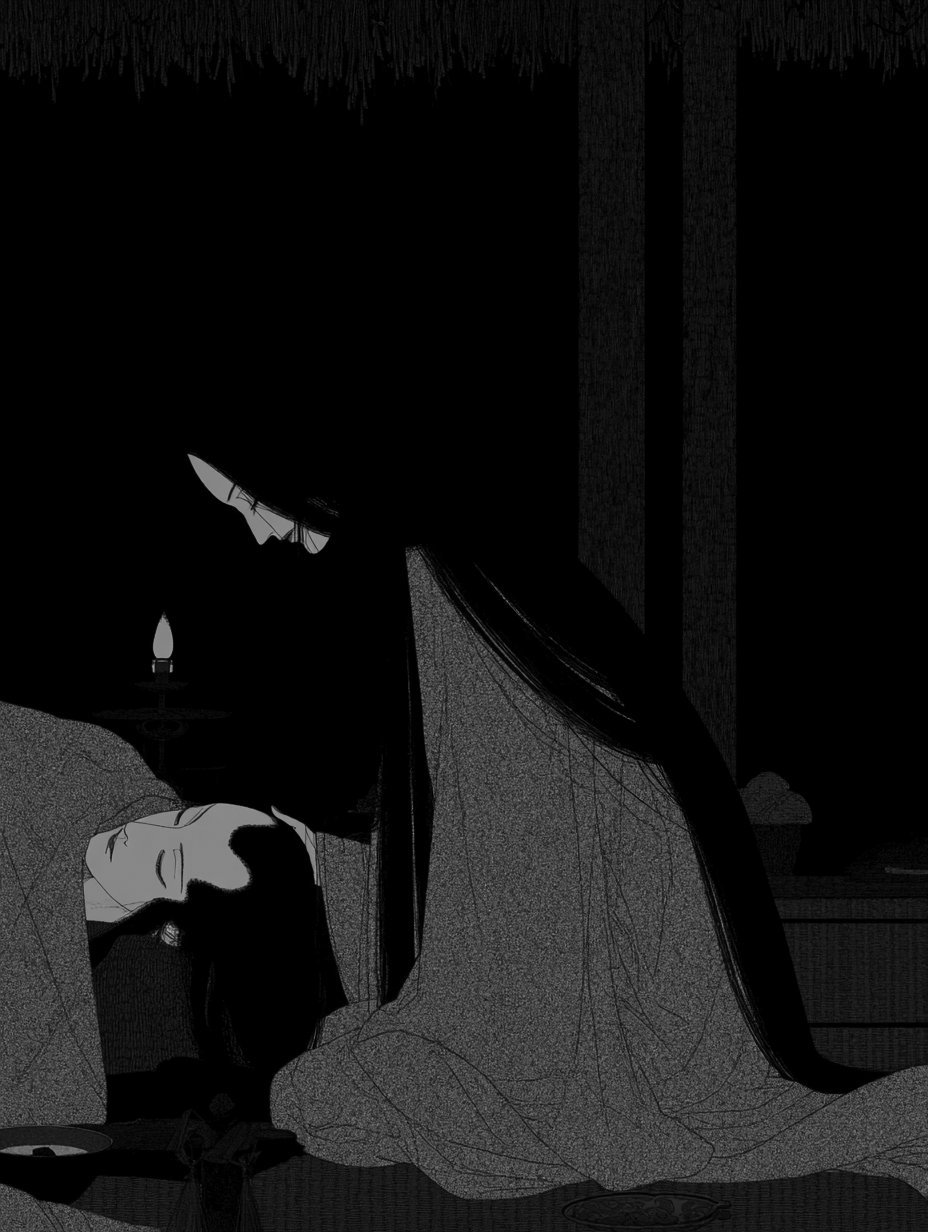
A man’s wife is discovered, by her small son or by her own carelessness, to be a fox. She cannot stay. Before she goes she writes a poem on the paper door of the room where the child is sleeping, and in the best-known staging of the scene she writes it with the child on her back and the brush held in her mouth.
The poem tells him where to find her. In English it runs roughly: if you long for me, come and look for me, in Izumi, in the forest of Shinoda — and then the last five syllables, which are the whole difficulty.
Urami kuzunoha. The resentful kudzu leaf. Or: the kudzu leaf showing its underside.
The Pun
Kudzu is a vine with broad three-part leaves, pale on the reverse. In wind a hillside of it turns over and goes silver, and classical poets had used this for centuries as a figure for a turned heart: ura-mi, to see the underside, is written differently from urami, resentment, but sounds the same. A poem that ends on a kudzu leaf ends on a reproach that has not quite been said out loud.
Our earlier note on Seimei and his rival mentioned that the line everybody remembers from an eighteenth-century puppet play is not the magician’s or his rival’s but his fox mother’s. This is that line. What it does not tell you is that the woman is named after it, rather than the other way round.
The Oldest Version Has Almost Nothing In It
The story that Abe no Seimei’s mother was a fox is not from his lifetime. The historical Seimei died in 1005, served the court as a diviner, and appears in official records; his parentage is simply not recorded.
The earliest text that gives him a fox mother is the Hoki shō, a Muromachi-period commentary on a pseudo-historical divination manual.[1] What it contains is a skeleton. A man takes a wife; the wife is a fox; a child is born who becomes the great diviner. The father in it has no name at all — he is “a certain person.” There is no Shinoda forest yet, no rescued animal, no door. The poem, though, is already there — set down in the same commentary not as a wife’s farewell but as a verse spoken by a god.
Everything else arrives in the seventeenth century, and it arrives in pieces.
The father is given the name Yasuna in a printed storybook of 1662.[2] And the wife is not called Kuzunoha until a kabuki play of 1699, more than two centuries after the fox mother first appears in writing.[3]
The Leaf Was There First
Here is the part that gets the sequence backwards in almost every retelling.
The poem is oldest where the fox mother is oldest. The same Muromachi commentary carries it, kudzu-leaf ending and all, and the National Diet Library’s reference service, asked where the verse comes from, names that commentary as the earliest material in which it can be found.[1] A verse-and-tale collection of the first half of the seventeenth century carries it too.[4] The wording is not fixed — the opening varies between copies and between the collection and the shrine that keeps the site — but the last phrase is there before the woman has the name.
The kudzu leaf was a word in the poem before it was anybody’s name. The theatre took the final phrase of her goodbye and made it the woman herself, which is why she is known today by a pun on a vine.
Not every telling ends that way. Some versions close the poem instead on a phrase meaning that she keeps herself hidden, which turns a reproach into a plain statement of where she has gone. The two endings have coexisted for a long time, and the one that won is the one that sounds like a name.
The Play That Fixed the Scene
The version that became standard is the puppet play Ashiya Dōman Ōuchi Kagami, by Takeda Izumo, first performed at the Takemoto theatre in Osaka in the tenth month of 1734 and adapted for kabuki in Kyoto the following spring.[5] It is a five-act history piece, and its fourth act is the parting.
That act is still performed on its own, under the name by which audiences know it: Kuzunoha’s leave-taking of her child. The business of writing the poem with the brush in the mouth, or in reverse, or with the left hand, belongs to a category of stage display called kyokugaki — showing off with a brush. It is a performer’s feat before it is anything else.
The Shrine Tells the Stage’s Version
There is a shrine at Shinoda, in the city of Izumi in Osaka prefecture, on the site the poem names. It is a real and working shrine, associated with Inari since about the 1740s, when a local headman brought the deity into a small existing hall.
Its own account of itself, published on its own website, is worth reading to the end. It gives a traditional founding date in the early eighth century. It has Yasuna coming daily to pray for the restoration of his house, saving a white fox from hunters, receiving a visitor named Kuzunoha some days later, and losing her when their son is five. Then it says that she wrote her farewell with a brush held in her mouth, and that when Yasuna carried the child to the forest he found it grown thick with kudzu leaves that had not been there before.
I went to the shrine’s page expecting its version to be older than the play’s. That detail of the brush is a piece of eighteenth-century theatrical business. It has flowed back into the sacred history of the place the poem is about, and now stands in the shrine’s own telling as part of what happened.
What the Layers Look Like
A Muromachi commentator wanted a supernatural pedigree for a famous diviner, gave him a fox for a mother and a nameless man for a father, and set down a verse about a kudzu leaf. A storybook of 1662 named the man. A collection of the same century preserved a farewell poem ending on a leaf. A kabuki play of 1699 gave the woman the leaf’s name. A puppet play of 1734 built the parting scene that everyone now pictures, and a stage trick inside it became, in time, part of a shrine’s history.
The poem outlasted all of it. It is the only element of the story that has been in essentially the same shape since it first appears, and it works because it is not a curse or a revelation but a set of directions — come and look for me, here is the place — issued by someone who knows she cannot be followed.
Sources
- Hoki shō 簠簋抄, Muromachi-period commentary on the Hoki naiden 簠簋内伝 Wikipedia, a divination text falsely ascribed to Seimei himself; earliest surviving printing of the commentary, 1647.
- Abe no Seimei monogatari 安倍晴明物語, kana-zōshi, 1662; traditionally attributed to Asai Ryōi, though the attribution is not certain. Wikipedia
- Shinodazuma しのだづま, kabuki play, 1699.
- Tsukikarumoshū 月刈藻集, tale and verse collection compiled in the first half of the 17th century — one of the early witnesses to the poem. Its author and ultimate source remain unknown.
- Ashiya Dōman Ōuchi Kagami 蘆屋道満大内鑑, puppet play by Takeda Izumo, Takemoto-za, Osaka, tenth month 1734; kabuki adaptation, Kyoto, 1735. Wikipedia
Also used: the shrine’s own account of its founding and traditions, published on its website.
Further Reading
- Karen A. Smyers, The Fox and the Jewel: Shared and Private Meanings in Contemporary Japanese Inari Worship, University of Hawai’i Press, 1999
The reading in the final section is KWAIDANOTE’s own.
Found an error? Write to kwaidanote@gmail.com — corrections are made on this page and dated.