The Oldest Rokurokubi Story Is About a Head
Two Creatures Under One Name
Our note on the rokurokubi sets out the two forms it comes in: the neck that stretches across a room while the body sleeps, and the head that separates altogether and goes out. This note is about where the name came from, which turns out to be the second of the two, and about the oldest Japanese tale published under it.
Our volume of neck tales draws on an early eighteenth-century collection, so the story it carries is not repeated here.
The Oldest One Under the Name
Shokoku hyakumonogatari, printed in 1677, is the first collection of strange tales to take the hundred-tales title, and its second book contains a piece called, in the table of contents, the rokurokubi of Fuchū in Echizen.
A traveller is on the road at night and comes to a large stone pagoda. Beneath it there is a woman’s head, by itself, in the road, blocking his way and laughing at him. He draws to cut at it and it goes, and he follows it into the town, where it passes into a house. Inside that house a wife is telling her husband about being chased across the moor, in the manner of somebody describing a dream.
The story ends with a line of reported speech: there is such a thing, people said, as a head that travels the roads.
Nothing in it stretches. The title says rokurokubi and the tale is a detached head, in the road, at night, on its own.
One qualification belongs with that. The 1677 book took a good many of its tales from a collection of 1663, and this appears to be one of them — same stone pagoda, same head, same chase. What the older book does not do is call it a rokurokubi; its title for the piece is about a woman’s obsession walking about. So the claim here is narrow: 1677 is the oldest telling to carry the name, not the oldest telling.
Where “Rokuro” Came From
A collection of 1712 explains the word, and the explanation is not the one usually given.
In it a character cites Chinese books aloud — a treatise on natural curiosities, for a southern people whose heads leave their bodies at night and use their ears as wings, and an older collection of strange accounts, for flying heads in general. And he quotes a verse in which the flying head is described as being like a rokuro.
A rokuro is a windlass, a pulley, a potter’s wheel: the class of things that turn on an axis and pay out. The comparison is to how a severed head moves through the air — the turning of it, the unreeling.
On that reading the word was borrowed to describe a head in flight, and only afterwards attached to a neck getting longer. In English the stretching is almost always treated as the original image and the flying head as a variant of it. The 1712 quotation runs the other way.
Two cautions, because this is a single text carrying an argument. The verse it quotes is not from the old collection of strange accounts it cites in the same breath; it belongs to a much later Chinese poem, and the Edo author has compressed two sources into one citation. And the standard Japanese reference works do not settle the etymology at all — one of the competing explanations they list ties the windlass image to the stretching neck rather than the flying head, by way of the rope a well-pulley pays out. What can be said is that a premodern text compares a flying head to a rokuro. What cannot be said is that this settles where the word came from.
The Chinese Line, Openly Cited
The flying head is attested in Chinese writing many centuries before either Japanese book, under names of its own, and Japanese texts made no attempt to hide it: the 1712 collection has its character name the Chinese titles in dialogue, which is the eighteenth-century equivalent of a footnote.
An illustrated encyclopaedia published in the same year is said to have glossed the Chinese term with the Japanese reading rokurokubi, which would be the moment the two vocabularies were formally joined. That is reported here at second hand; the encyclopaedia itself was not consulted for this note.
The citing is worth as much as the content. A character in a popular collection of strange tales stops the story to name two Chinese books by title, and the author expects this to satisfy rather than bore the reader. That tells us what the audience for these books was like in 1712: people who wanted the pedigree, who took a foreign source as evidence of a thing’s reality rather than of its foreignness, and who would have found a wholly unsupported marvel less convincing, not more. The Edo strange tale is a genre with visible footnotes, which is one of the reasons it can be traced at all.
What Cannot Be Said
There is a tidy version of all this that circulates widely: the detaching head is Chinese, the stretching neck is Japanese, and the second grew out of the first on Japanese soil.
It could not be verified. What the standard reference works actually say is narrower and less satisfying — that both forms are present in Japanese sources from early on, that the names are used for one another, and that a major dictionary of yōkai treats them under a single entry with both shapes described. A developmental sequence has been proposed by at least one modern scholar, but this note has not read that argument in the original and will not summarise a summary of it.
There is also a third term in the 1712 book that resists the whole scheme. Rihonbyō, the detached-soul sickness, is glossed there as popularly called the shadow sickness, and it belongs to a young woman in the frame story who is simply ill. It has nothing to do with necks. Our note on the living spirit takes that word up.
A Household That Does Not Know
One detail of the 1677 tale is worth keeping, because it is not the detail the story is famous for.
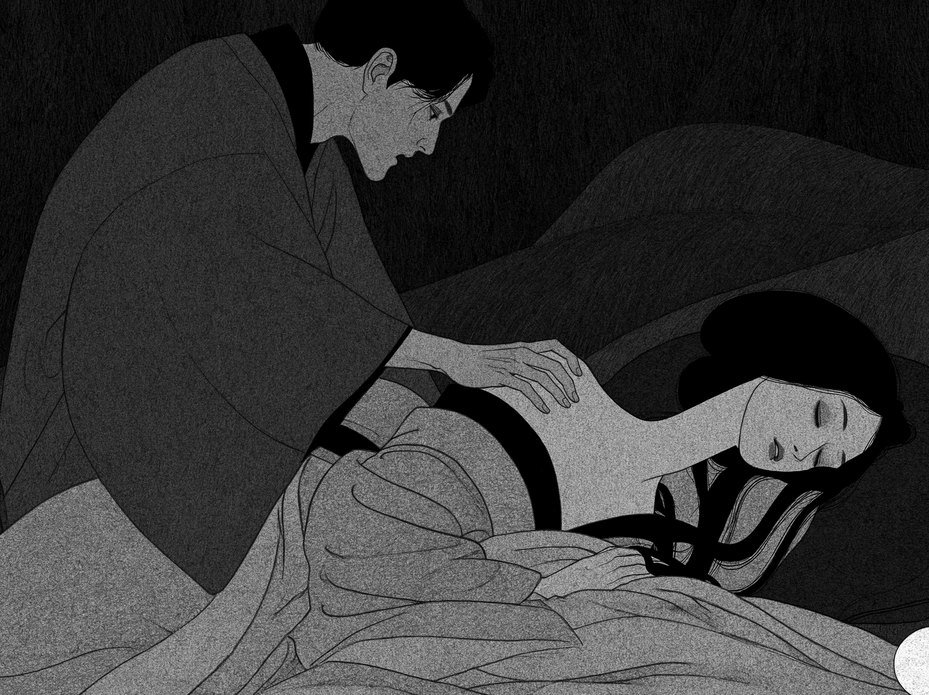
The head is not discovered in the woman’s own house by her own family. It is met on a road by a stranger, and traced home. And when the traveller gets there the woman is already talking about it — recounting being chased, as though she had dreamt it, to a husband who presumably says something reassuring.
That is a household that contains the thing and does not know it, which is the same arrangement as the fox-owning houses and the inherited familiars this site has written about elsewhere. The horror is not that a head comes off. It is that somebody has been out all night and come back and has an account of it that everybody can live with.
Why the Wrong Name Stuck
The likeliest reading is the dull one. A vivid word for a turning, unwinding motion got attached to a creature, the creature had two forms, and over time the word settled on the form that the word fits worse — because a neck that extends is easier to draw, easier to stage, and much easier to describe to somebody who has not seen the picture.
The English question about this creature is usually whether it is real. A better one is which of the two is meant, and the answer for the oldest Japanese text to carry the name is: the one with no neck in it at all.
Both forms have been in the language for as long as anyone can check, under names that were never kept apart. Asking which is the true rokurokubi is asking the word to have been tidier than the people who used it.
Sources
- Shokoku hyakumonogatari 諸国百物語, 1677, compiler unknown; second book, the tale titled as the rokurokubi of Fuchū in Echizen. Commons
- Ichiyabune 一夜船, 1712, reissued under a changed title in 1726; the passage quoting Chinese books on the flying head and the verse comparing it to a rokuro, and the frame-story gloss of rihonbyō as the shadow sickness.
- Chinese accounts of the detached flying head, cited within that Japanese text by title.
Further Reading
- Michael Dylan Foster, The Book of Yōkai: Mysterious Creatures of Japanese Folklore, 2015
The readings in “A Household That Does Not Know” and “Why the Wrong Name Stuck” are KWAIDANOTE’s own.
Found an error? Write to kwaidanote@gmail.com — corrections are made on this page and dated.