The Peony Lantern Passed Hand to Hand
A Story That Carries Its Own Receipts
Most of the tales on this site have to be traced. Somebody has to go and find out which book a story was in before it was in the book you are holding.
The peony lantern is the exception. It is the best-documented chain of quotation in Japanese supernatural fiction, and one of the tellers opens by naming the others — which is rarer than it sounds, and worth more than a scholar’s reconstruction, because it is a teller of the story saying where he had it.
Here is Okamoto Kidō, opening a story of his own in 1924: the peony lantern record from the Jiandeng xinhua, he writes, has been adapted by Santō Kyōden and by Sanyūtei Enchō, and everyone knows those; what follows is a little different. Three links of the chain, named in the first sentence, before the story has even started.
1378, China
The beginning is a collection of strange tales in classical Chinese by Qu You, put together around 1378. Four books of five tales each, with two more appended; the peony lantern is the fourth tale of the second book, ninth in the sequence.
A man meets a woman at the lantern festival, attended by a servant girl with a peony-shaped lantern. He takes her home. A neighbour looks through a gap in the wall and sees him embracing a painted skeleton.
That collection travelled. It was read in Korea and Vietnam, and in Japan it became the quarry from which a great deal of early Edo supernatural fiction was cut.
1666, Kyoto
The man who did the cutting was Asai Ryōi, a priest and prolific writer, whose Otogibōko of 1666 adapts a series of the Chinese tales into Japanese settings. Our note on the hundred-candle game deals with a different chapter of the same book.
The peony lantern is among them, and this is the version that made the story Japanese: the names, the district, the temple, the priest who gives the man a charm for his door.
What Ryōi was doing had a commercial shape as well as a literary one. Printing in Kyoto had reached the point where a writer could live by supplying books to a public that wanted them, and the stock of Chinese strange tales was a quarry that could be worked steadily: the plots were good, the originals were in a language most buyers could not read, and moving a story from Ningbo to a named Japanese district was a day’s work for a man who knew both. Our note on the hundred-candle game deals with a different chapter of the same volume, and the two together give a fair picture of what one industrious priest could put into circulation in a single year.
A caution belongs here. The identification of which chapter corresponds to which Chinese tale comes to this note from a secondary correspondence table, not from the 1666 text, which was not available for consultation. The attribution is standard and repeated everywhere; it has not been checked here against the original.
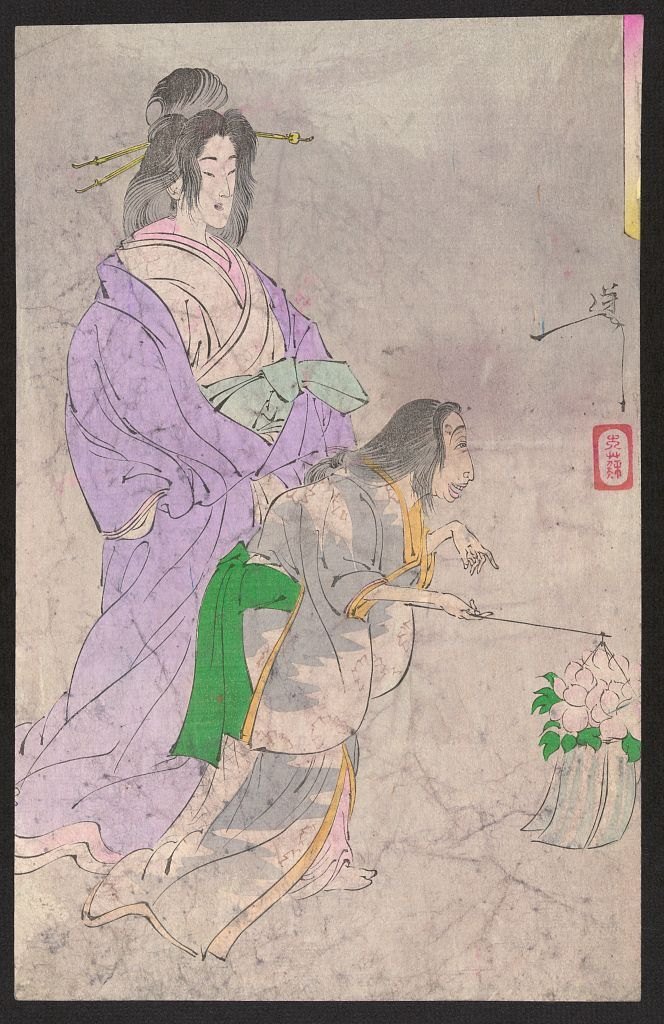
Tsukioka Yoshitoshi, 1880 — four years before the shorthand book. Public domain, via Wikimedia Commons.
1884, Tokyo, in Shorthand
Two centuries later the story belonged to the rakugo stage, and to one performer in particular: Sanyūtei Enchō, who told it over many nights.
In July 1884 it was published — and the interesting thing is how. It was not written by Enchō. It was taken down in shorthand as he performed it, by a stenographer named Wakabayashi Kanzō, and printed from the transcript.
That is a peculiar object: a book of a ghost story that is really a recording of a voice. The stenographer said as much in his preface, arguing that putting spoken Japanese onto the page would in time improve the written language.
It helps to know what was being transcribed. A rakugo performer of Enchō’s standing did not tell this story in an evening. He told it in instalments over many nights, to an audience that came back, which means the text that reached print has the shape of a serial — the recaps, the deliberate pauses at the end of a night’s portion, the small repetitions that a listener needs and a reader does not. The book preserves the joints. It is the earliest thing in this chain that records not just a story but a performance of one, including the parts that exist only because somebody had to make people return the following evening.
He was more right than a preface usually is. Written Japanese at that date was still a formal, classical instrument with its own grammar, quite unlike anything spoken aloud, and the movement to close that gap is conventionally said to have taken hints from exactly these stenographic transcripts of Enchō. A ghost story turns out to sit near the beginning of modern Japanese prose, not because of its plot but because somebody wrote down how a man actually talked.
I should mark that last point as received rather than checked: it is repeated consistently in the standard accounts, and this note has not traced it to a single identified study.
What Is Not Claimed Here
Two things that would round the story off nicely are absent, and they are absent because they could not be verified.
The first is a comparison of what changed between the Chinese tale and the Japanese one. Neither the 1378 text nor the 1666 text was available for this note, and a list of additions and deletions assembled from summaries would be worth nothing.
The second is the sound. Everyone who knows the story knows the karan-koron of wooden clogs approaching, and it is routinely credited to Enchō. The sourcing for that is thin and popular, and the detail may belong to the kabuki adaptation, or to the twentieth-century stage and screen. It is not in this note.
Why It Kept Being Retold
The chain runs 1378, 1666, an Edo novelist, 1884, then kabuki and film, and it has not stopped.
One reason is mechanical: the story is portable. It needs a festival, a lantern, a wall with a gap in it, and a charm on a door — no geography and no history. It can be moved from Ningbo to Kyoto to Edo without losing anything.
The other reason is the shape of the ending. The man is warned. He is given a means of protection, and it works. And then he takes it down himself, which is the part audiences remember, because it converts a ghost story into a study of a person who would rather be visited than be alone.
Every teller in the chain kept that. The settings moved, the names changed, the lantern stayed, and the decision at the door stayed, because it is the only part of the story that cannot be improved.
Sources
- Jiandeng xinhua 剪燈新話, by Qu You 瞿佑, c. 1378; four books of five tales with two appended, the peony lantern record being the fourth tale of the second book.
- Otogibōko 伽婢子, by Asai Ryōi 浅井了意, 1666; the peony lantern chapter. The correspondence with the Chinese tale is taken here from a secondary table and has not been checked against the 1666 text. Wikipedia
- Kaidan botan dōrō 怪談牡丹燈籠, told by Sanyūtei Enchō 三遊亭円朝, taken down in shorthand by Wakabayashi Kanzō 若林玵蔵 and published in July 1884.
- Okamoto Kidō 岡本綺堂, “Shin botan tōki” 新牡丹燈記, first published 1924; the opening sentence naming the earlier versions.
- Ukibotan zenden 浮牡丹全伝, by Santō Kyōden 山東京伝, named by Kidō as one of the adaptations.
Further Reading
- Michael Dylan Foster, The Book of Yōkai: Mysterious Creatures of Japanese Folklore, 2015
The reading in “Why It Kept Being Retold” is KWAIDANOTE’s own.
Found an error? Write to kwaidanote@gmail.com — corrections are made on this page and dated.