The Itako and the Three Kinds of Mouth
A Trade, Described as a Trade
The itako of the Japanese northeast are the blind women who call voices: the voice of someone who has died, at the request of a family who wants to hear it.
Our note on the miko sets out the wider category and gives the spirit-calling medium a line of its own, outside the institutional shrine system. This note is about the northern practice as one book recorded it, and what that book can and cannot establish.
The book is a history of Japanese female mediums published in 1930. What is striking about its account is how unmysterious it is. It reads like a description of a trade, because that is what it is describing.
Three Kinds of Mouth
The work divides into three. There is the dead mouth, calling the spirit of someone who has died; the living mouth, calling the spirit of someone alive but far away; and the god mouth, in which a deity speaks.
They are not interchangeable and the handling differs. The account specifies that the prayer beads are worked one way round for the dead and the other way for the living.
That detail is worth stopping on, because our note on the words ikiryō and shiryō shows how unstable that distinction is in the classical written record — the two terms arriving centuries apart and pairing late. Here it is not a literary category at all. It is a difference in which direction you rub the beads.
The Water and the Leaf
The procedure around the call is specific in the same way. The person making the request fills a vessel with water and stirs it three times with a leaf — an offering of water, made by the client rather than the medium, before anything is said.
“Almost Without Exception Blind”
On the point that English writing usually reaches for first, the book is blunt. The itako of the northeast, it says, are almost without exception blind women, and the author has never heard of a sighted one.
It then records an explanation that circulated for why this was so. In a time of famine, the story goes, the authorities gathered and killed blind infants; one blind girl saved herself in front of the lord by naming objects in the garden she could not see, and from then on blind women were permitted this work.
The author sets that down and calls it a pitiable legend. He does not present it as history, and neither does this note. But it is worth registering what kind of story it is: a profession accounting for its own existence by an escape from being killed.
The Initiation
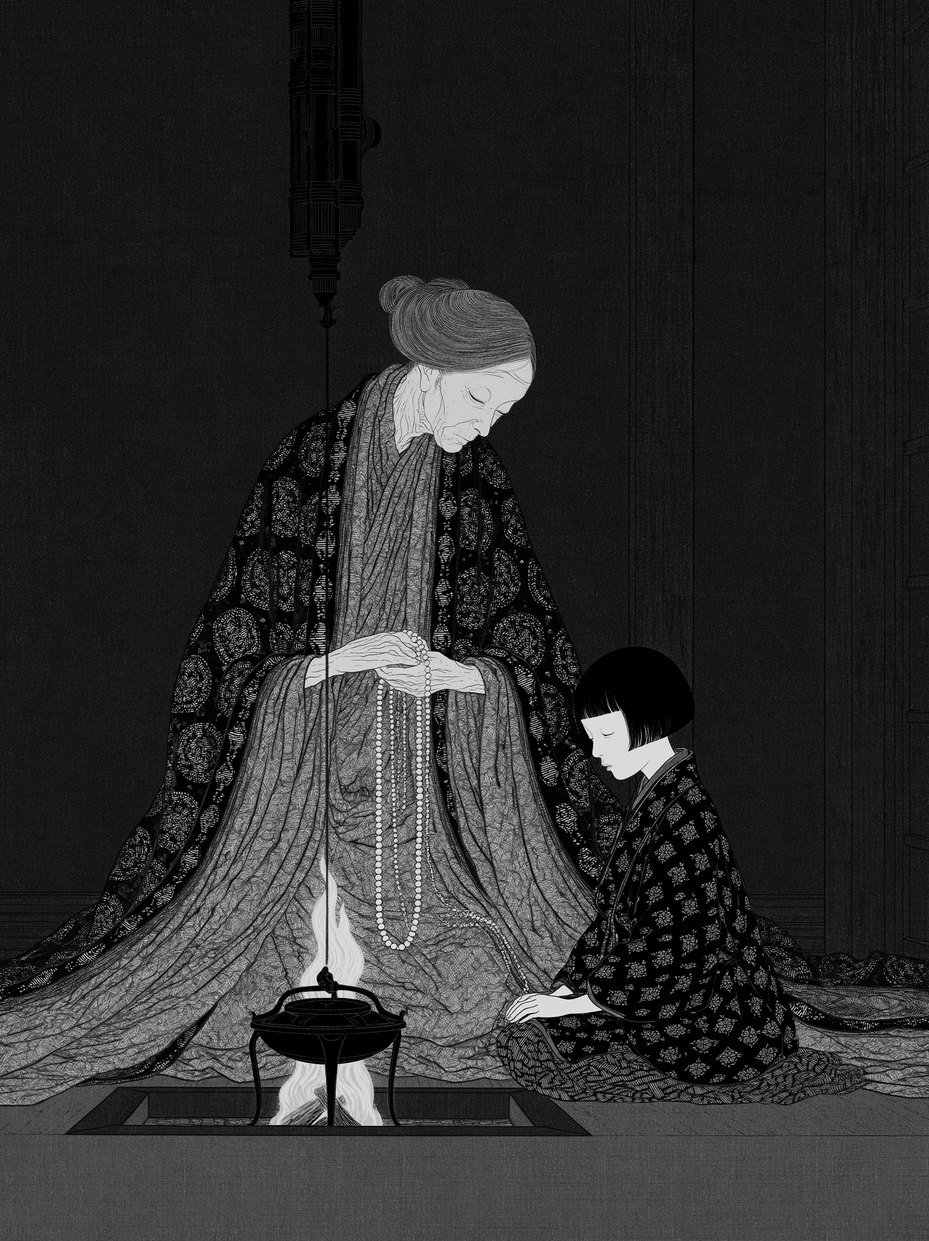
There is a ceremony for attaching a god to a new practitioner. She sits on rice bales with offerings set at her feet and recites, and at the end calls out which god has come. The book gives the names of women it is describing, as a book of 1930 would.
How the Book Knows What It Knows
The account of the Oshira rite that the itako perform comes from two fieldworkers who published their observations in 1928, and the circumstances are not what a reader expects.
They did not watch it in the northeast. They watched it in Tokyo, at the house of Yanagita Kunio, who had arranged for an itako to travel up to the capital so that the rite could be performed properly and seen.
The standard early record of a northern practice is an eyewitness account of it being staged in a scholar’s front room in the city. Our notes on the Tōno collection and on the man who supplied it deal with the same arrangement from the other end; here it is the practitioner rather than the story who makes the journey.
This is not a complaint about the record. It is the record, and knowing how it was made is the only way to use it properly. An observer in Tokyo in 1928 saw a complete performance under good conditions and wrote it down carefully, which is more than can be said for most descriptions of anything in this subject. What he could not see was the part that does not travel: who in the village had sent for her, what they wanted said, and whether they were satisfied.
How Old Is Any of It
The book is honest about the limit. There is no record, it says, that establishes precisely when the itako of the northeast began, and it points instead at two Edo-period local texts as grounds for thinking the practice old. It names them. It does not quote them, and this note has not read them.
Outside the book, the standard reference works give two eighteenth-century attestations of the word itself, in a domain diary of 1772 and in a travel record of 1788, where it appears as a reading attached to older words for a female medium. Those are reported here from dictionaries rather than from the texts.
The Part Everybody Photographs
Which leaves the most famous fact about the itako, and the one this note cannot support.
Osorezan, the volcanic mountain in the far north, with its sulphur and its stone cairns, is where the itako are photographed, and the mediums who gather at the summer festival are the image the subject has in every foreign publication.
The association is younger than it looks, and it cannot be dated to a year. Popular accounts place it anywhere from the late Meiji period to the early Shōwa, and they disagree with one another. The scholarship on it is better than the popular accounts and reaches the same limit: the work on the modernisation of the mountain puts the itako’s connection with it in the late Taishō or early Shōwa period, finds it in the records only from the late 1940s, and attributes its national fame to mass media in the 1950s and 1960s, with demand from the families of the war dead behind a good deal of it. The single most reproduced thing about this tradition is the part of it that is within living memory.
What Is Actually Documented
One reading of the itako is that they are a survival — an ancient shamanic layer of Japanese religion persisting in the poorest corner of the country.
What the 1930 account documents is narrower and more concrete: a trade with three named services, a direction for the beads in each, an offering of water stirred three times with a leaf, an initiation that ends by naming the god that arrives, and a body of chant long enough to be printed. It also documents a society that had decided which of its children could be trained for this and which could not, and a story told to explain that decision which the author of the book found difficult to repeat. Those two things — the procedure and the recruitment — are the parts that can be checked, and they are not the parts the photographs are of.
Sources
- Nakayama Tarō 中山太郎, history of Japanese female mediums, 1930; third part, second chapter, for the three kinds of calling, the handling of the beads, the water offering, the initiation, the statement that the itako are almost without exception blind women, and the legend of the famine.
- Field reports by two researchers published in 1928 in journals of folk art and of ethnology, recording an Oshira rite performed in Tokyo; quoted in the above.
- Tōno kojiki 遠野古事記 and Hirayama nikki 平山日記, named in the above as Edo-period evidence for the antiquity of the practice; not consulted for this note.
- Eighteenth-century attestations of the word, from a domain diary of 1772 and a travel record of 1788, as given in the standard historical dictionaries.
Further Reading
- Carmen Blacker, The Catalpa Bow: A Study of Shamanistic Practices in Japan, 1975
The reading in “What Is Actually Documented” is KWAIDANOTE’s own.
Found an error? Write to kwaidanote@gmail.com — corrections are made on this page and dated.