Rokujō and the Incense That Would Not Wash Out
The Case Everyone Cites
When the living spirit is explained in English, the example given is almost always the same one: the Lady of the Sixth Ward from The Tale of Genji, whose jealousy is said to leave her body and attack the women around the man she cannot have.
Our volume of living-spirit tales tells her story, so this note does not retell it. It is about the eleventh-century text behind it — what the chapter’s own vocabulary is, what it puts in her hands as proof, and what a Noh play did to all of it three or four hundred years later.
The Word Is Not in the Chapter
Start with the term, because the term is doing work that the text does not.
The word ikiryō does not appear in the chapter. A search of the whole of the relevant chapter, and of the later chapter where she returns, produces no instances of it. What the text writes is ikisudama — an older word, built differently — and where we would write mononoke in characters, the text has it in plain kana.
The neat modern pair, living spirit against dead spirit, is later than the scene that is always cited as its origin. That is a subject in itself and our next note takes it up. Here it is enough to say that the vocabulary we file her under was not available to the woman who wrote her.
What She Is Told, and What She Thinks
The rumour reaches her at second hand. People are saying that what is tormenting the sick woman is a living spirit — and, in the same breath, the spirit of a dead minister.
That pairing is easy to read past and worth stopping on. The household has not settled on one explanation either. It is running two at once, a living woman’s jealousy and a dead man’s grievance, and it does not choose between them. The scene that gets quoted as the classic diagnosis of a living spirit is in fact a scene of a household failing to diagnose anything, which is a good deal closer to how these episodes are recorded generally.
Then comes the sentence that the English summaries flatten. Beyond the grief of her own one body, the text says, she has no wish that anyone should suffer — and yet a soul that wanders out in brooding might indeed do such a thing. And there are times when she comes to know this of herself.
That is not a woman who is unaware. It is also not a woman who has decided anything. It is narrower and worse than either: she cannot rule herself out.
The Incense
Then the chapter hands her the one piece of physical evidence in the episode.
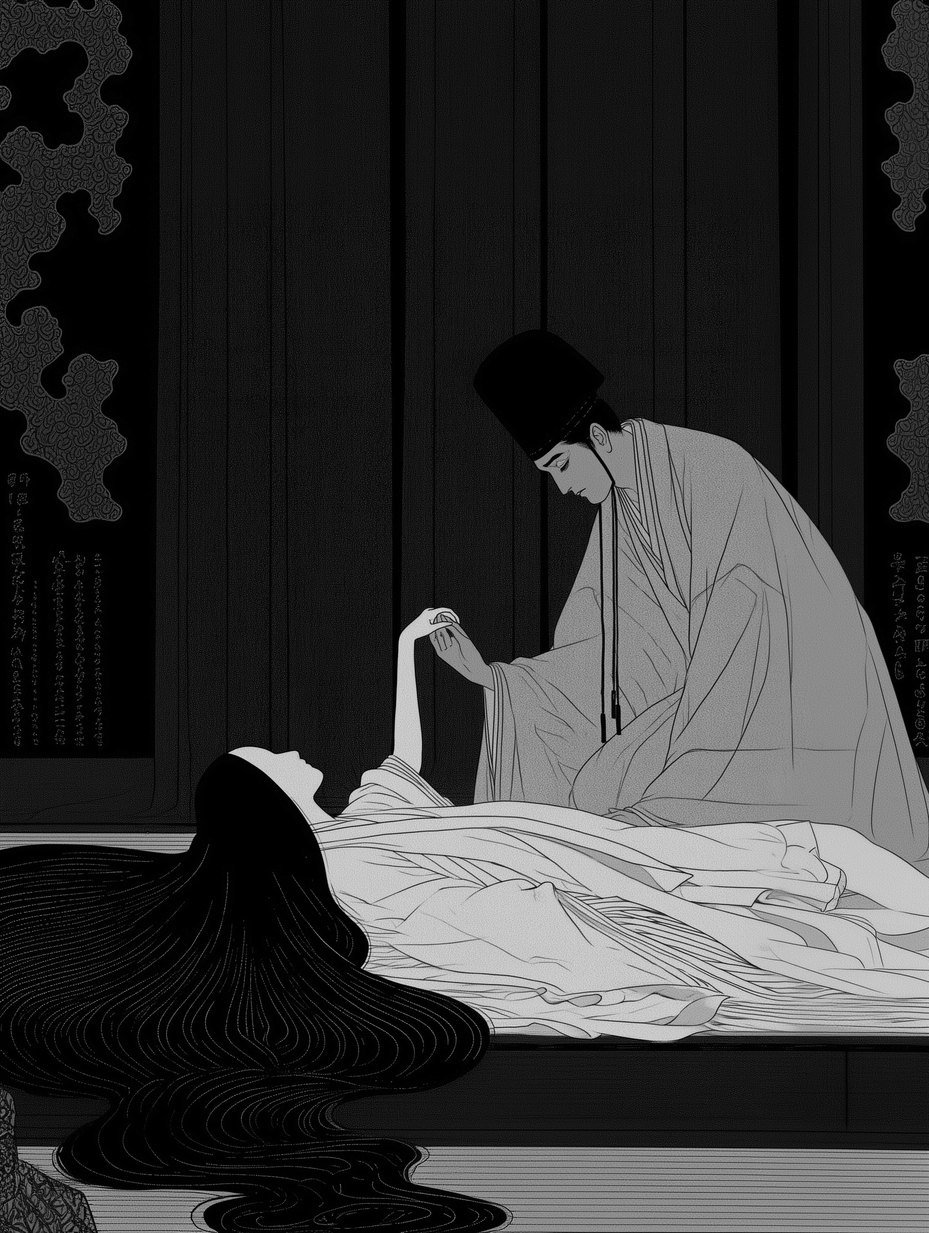
Rites have been performed over the sick woman, and mustard seed has been burned in them — the seed used in the rite for subduing a hostile spirit, as distinct from the seeds used in rites for peace or for increase. Afterwards Rokujō notices the smell in her own clothes. She has her hair washed and changes her robes and tries again, and it is the same. The text follows this with her reaction, and it is not fear: she finds her own body repellent to her.
Consider what that smell is. It is not a trace of anything she did. It is the smell of the countermeasure — of the rite performed to drive her off — and she is carrying it. The evidence against her is made of the effort to be rid of her.
The proof arrives as laundry. It is the only thing in the whole sequence that can be checked by anybody, and what it establishes is not intention but attendance. It says she was in the room. It says nothing at all about whether she meant to be.
One more thing about her, which the chapter arranges and nobody remarks on. She has no personal name in the text. She is called by a district of the capital and by a rank held at court, the way the women of this book generally are, and so the most famous individual spirit in Japanese literature is identified throughout by an address. The thing that is said to leave her body and travel is the only part of her the story gives a clear outline to.
What the Play Added
The Noh play built on this — author unknown, possibly reworked by Zeami, and in any case several centuries younger — supplies a great deal that the chapter does not have.
It has a medium who summons the spirit by plucking a catalpa bow. It has the spirit announcing who she is. It has the mask, the horned face that English readers now attach to her automatically. And it has a mountain ascetic who fights her and subdues her at the end.
None of those things is in the chapter. There is no summoner, no duel, no mask, and above all no confrontation: nobody ever accuses her, and nobody asks her. A later chapter, after she is dead, does contain a spirit that answers a demand to name itself. The chapter everyone cites does not.
The mask deserves a moment of its own, and our note on it goes into what it is and is not. What matters here is what it does to her. A Noh mask is a fixed face, carved once and worn by everybody who plays the part, and putting one on this character settles by carpentry a question the chapter keeps open. In the prose nobody sees her do anything. On stage there is a face to look at, and it is the same face every time.
The play gives her an interrogation. The chapter gives her a smell.
Why the Difference Is the Whole Thing
One reading is that the stage coarsened her — that a subtle psychological portrait became a horned demon to be beaten by a priest.
The more exact thing to say is that the play answers the question the chapter refuses to answer. On stage she is identified, named, engaged and defeated, and by the final scene there is no doubt left anywhere in the theatre about what she was or what she did. The chapter arranges matters so that the doubt cannot be resolved by anyone, least of all by her. She is never told. She is only left with the evidence of her own hair.
That is why the flat summary — that her spirit goes out without her knowledge — misses what the chapter is for. She is not spared the knowledge. She is denied the certainty, which is the more punishing arrangement of the two, and it is the reason this episode has outlasted every other possession story of its century.
Sources
- Genji monogatari 源氏物語, by Murasaki Shikibu 紫式部, early 11th century; the “Aoi” chapter, third section, for the report of the rumour and for Rokujō’s own reflection, and the later passage on the scent of the burned mustard seed. Consulted in the Japanese text. Commons
- The same work, “Wakana ge” chapter, for the spirit that answers a demand to name itself after her death.
- Aoi no Ue 葵上, Noh play, author unknown, with a tradition that Zeami reworked it; Muromachi period. Wikipedia
Further Reading
- Royall Tyler, translator, The Tale of Genji, 2001
- Edward G. Seidensticker, translator, The Tale of Genji, 1976
The reading in “Why the Difference Is the Whole Thing” is KWAIDANOTE’s own.
Found an error? Write to kwaidanote@gmail.com — corrections are made on this page and dated.