Three Names for the Dead
Six Altars in a Garden
In the fifth month of 863, the court held a ceremony in the Shinsen’en, the walled garden that lay south of the palace in the capital. The official history of the reign records the occasion and its reason: an epidemic had been killing people, and the deaths were understood to have a cause that could be addressed.[1]
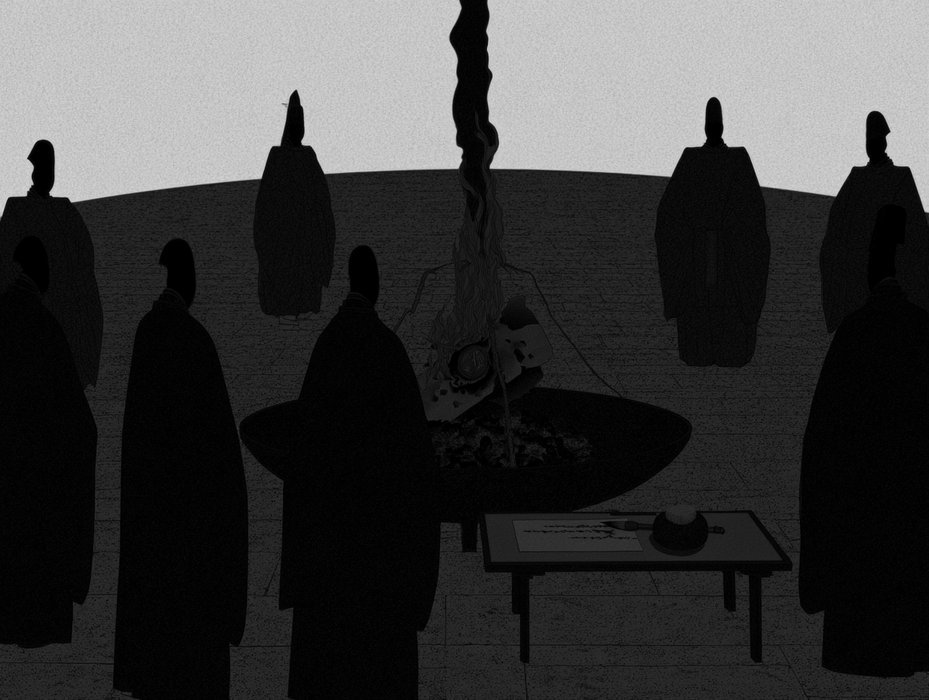
Six altars were set out. Sutras were read, dancers performed, and the gates were opened so that the townspeople could come in and watch. The six for whom the altars were built were named, and they had one thing in common: every one of them had died in disgrace. Among them were Prince Sawara, who had been accused of murder and sent into exile and was by then known by the posthumous title of an emperor; Prince Iyo and his mother, who had died under a charge of rebellion; and Tachibana no Hayanari, exiled after a conspiracy. One of the six the record identifies by office rather than by name, and modern accounts differ slightly on who is meant.
The word the occasion uses for these six is goryō 御霊.
What the Honorific Is Doing
The second character of goryō is the ordinary word for a spirit. The first is an honorific — the prefix you attach to something you intend to address with care. The compound means, near enough, the honoured spirits, and the honour is not decoration. It is the whole content of the term.
What the honour consisted of is legible in the record itself: posthumous rank restored, an altar, offerings, a rite performed on the state’s account and in public. A goryō is not a kind of dead person. It is a dead person the living have decided to treat as a guest.
This is worth pausing on, because it is the opposite of what the English word exorcism suggests. Nobody at the Shinsen’en was trying to drive these six away. The court had concluded that the dead were owed something, and was paying.
The Same Person, One Step Earlier
The word for that dead person before the decision is onryō 怨霊. Its first character is grievance — a wrong held onto. An onryō is a dead person named as the cause of present harm: a fire, a plague, a death at court. It is an accusation, and it is made by the living about someone who can no longer answer.
The best-documented passage from the one word to the other belongs to Sugawara no Michizane, a scholar and minister who was sent from the capital to Kyushu in 901 and died there in 903. In 930, lightning struck the Seiryōden, the emperor’s residential hall, and killed courtiers inside it; the emperor died within months. A shrine was raised at Kitano in 947. In 993 the court promoted the dead man twice in one year, to the first rank and then to chancellor, and somewhere in those decades he acquired the name Tenman Tenjin. He became, and remains, the deity of scholarship, prayed to by students before examinations.
Nothing about Michizane changed across those decades. What changed was what the living built. He is the clearest case, and this site has a separate note on the grouping of the three great vengeful spirits that places him beside Emperor Sutoku.
The Widest Word
Yūrei 幽霊 is not a rank in this system at all. It is the general word for the dead who appear — the one an English reader is likeliest to meet first, usually translated simply as ghost.
The difference is one of grammar more than of menace. Onryō is an accusation and goryō is a settlement; both are things the living say about a dead person. Yūrei describes what the dead person does. In the older Japanese records the two are not the same subject at all: a yūrei tends to come back for something specific and unfinished — a debt, a burial, a message — and to be recognised as one particular person rather than as a type. That is the subject of another note here, and it is a quieter business than the word ghost usually promises.
So the three words do not stack neatly into small, medium and large. They answer different questions. What is it doing? Who is to blame? And what, if anything, are we going to do about it?
Where the Living Stand
There is a fourth word that sits outside the whole arrangement. An ikiryō 生霊 is a spirit that leaves a body which is still breathing, and it belongs to none of these categories, because the question the other three answer is what to do about someone who has died. Ikiryō is not a stage on the way to becoming an onryō; it is a different situation, and the tradition treats it as one. Three notes on this site already take it up.
Worth noticing, though, is that the ikiryō makes the same point from the other side. What qualifies a spirit for attention in these records is rarely death itself. It is the intensity of an unfinished claim.
Three Positions, Not Three Species
The useful way to hold these words is not as a bestiary. None of them names a creature with fixed properties, and none of them is simply a stronger version of the one before it.
They are three positions in a relationship between the living and one dead person. The dead person can move between them, and does. A courtier dies far from the capital and is forgotten. A generation later a plague arrives, and someone remembers his name and says it aloud in the wrong tone: now he is an onryō. A generation after that, a shrine goes up and a festival is scheduled: now he is a goryō, and eventually a god with a shrine full of examination candidates.
At no point in that sequence does anyone consult the dead man. Each step is taken by people who are still alive, and the vocabulary records their decisions with some precision. The words are less about what the dead are than about what the living have agreed to owe them.
Sources
- Nihon sandai jitsuroku 日本三代実録, compiled 901. Jōgan 5 (863), fifth month, twentieth day — the goryō-e held in the Shinsen’en. Wikimedia Commons
Further Reading
- Neil McMullin, “On Placating the Gods and Pacifying the Populace: The Case of the Gion ‘Goryō’ Cult,” History of Religions 27, no. 3, 1988
- Jonathan Stockdale, Imagining Exile in Heian Japan: Banishment in Law, Literature, and Cult, 2015
- Michiko Iwasaka and Barre Toelken, Ghosts and the Japanese: Cultural Experience in Japanese Death Legends, 1994
The reading in “Three Positions, Not Three Species” is KWAIDANOTE’s own.
Found an error? Write to kwaidanote@gmail.com — corrections are made on this page and dated.