The Hannya Mask Is a Woman's Face
What Is Actually Carved
The mask has two horns, gilded, set well back on the skull. The eyes are gold leaf with only the pupils pierced through, so that the actor can see out and the audience cannot see in. The mouth is open from ear to ear, and the teeth inside it are metal, with two pairs of fangs.
That is the half of the mask that reproduces well on a poster. The other half is above it, and it is doing something different. The brows are drawn together and the forehead is furrowed, and the muscles around the eyes are pulled the way a face pulls when it is about to weep. The lower half of the mask is rage and the upper half is grief, and they were carved at the same time by the same hand.
Made to Be Tilted
Noh masks are not carved to be looked at straight on. They are carved to be worn by an actor who will move his head very slightly, and the carving is cut so that the light falls differently as he does.
When the actor lowers his face, the brow comes forward and the shadowed eyes read as sorrow. When he raises it, the light catches the mouth and the teeth and the horns, and the same object reads as fury. The technique has names in the profession, and in the prayer scene of the play Dōjōji it is used at length: the audience watches a single carved face move between two states without anything about it changing.
A photograph of the mask, taken from the front, is the one view in which it has only one expression. That is the view on most of the merchandise.
Who Wears It
Three plays account for most of the mask’s appearances, and they are sometimes grouped together for that reason: Dōjōji, Aoi no Ue, and Kurozuka — the last also performed as Adachigahara.
In all three, the figure wearing the mask is a woman, or was one. In Dōjōji she is a woman who followed a priest to a temple and coiled around the bell he was hiding under; that story is the one our Hebionna volume retells, and it is older than the play by four centuries. In Aoi no Ue she is the jealous spirit of a noblewoman who is, at the time, still alive — a case this site takes up in its notes on the ikiryō.
Aoi no Ue also shows how precisely the mask is used. The spirit first appears in a different mask, deigan, whose gilded eyes are the only sign of what is coming; the hannya is put on later, offstage, once the transformation is complete. And because the woman in that play is of high rank, the hannya used for her is conventionally a pale one. The mask is graded to the social standing of the woman underneath it.
A Stage, Not a Species
The hannya is one mask in a sequence, and the sequence is the point.
It begins with deigan, a woman’s face with gold in the eyes and nothing else wrong. Then namanari, where short horns have started and the face is still recognisably a person’s. Then the hannya. Then shinja, in which very little of the woman is left and the face is closer to a snake’s.
Read in order, these are not four monsters. They are one person at four moments, and a company chooses among them to say how far along the story has got. A mask-maker carving a hannya is carving the middle of a process, which is why leaving the grief in the upper face is not a flourish. Without it the sequence has no middle.
The Name Is Not Settled
Hannya 般若 is the Japanese reading of the Sanskrit prajñā, wisdom — the word in the title of the Heart Sutra, one of the most widely recited texts in Japanese Buddhism. Why it is also the name of this face is a question with several old answers and no agreed one.
The most repeated account credits a mask carver known as Hannya-bō. Against it, the Noh scholar Nogami Toyoichirō pointed out that masks of this type are attributed to carvers working before Hannya-bō’s time, and that the workmanship does not separate them. Another account traces the name to a line in Aoi no Ue. An actor of the Kanze line has called the naming an irony: horns of attachment, carrying the name of the wisdom that would have cut attachment away.
I am inclined to that last reading, but it is a reading, and the tradition has not chosen. It is worth saying plainly that the connection between this mask and the Buddhist term is unexplained rather than absent.
Older Than the Mask
The Dōjōji story reaches print long before anyone carved a face for it. Its oldest surviving form is in an eleventh-century collection of Lotus Sutra miracle tales, and it appears again in the Konjaku monogatarishū, in the fourteenth book, as the tale of the priest of Dōjōji in Kii province who copied the sutra and saved a serpent.[1][2]
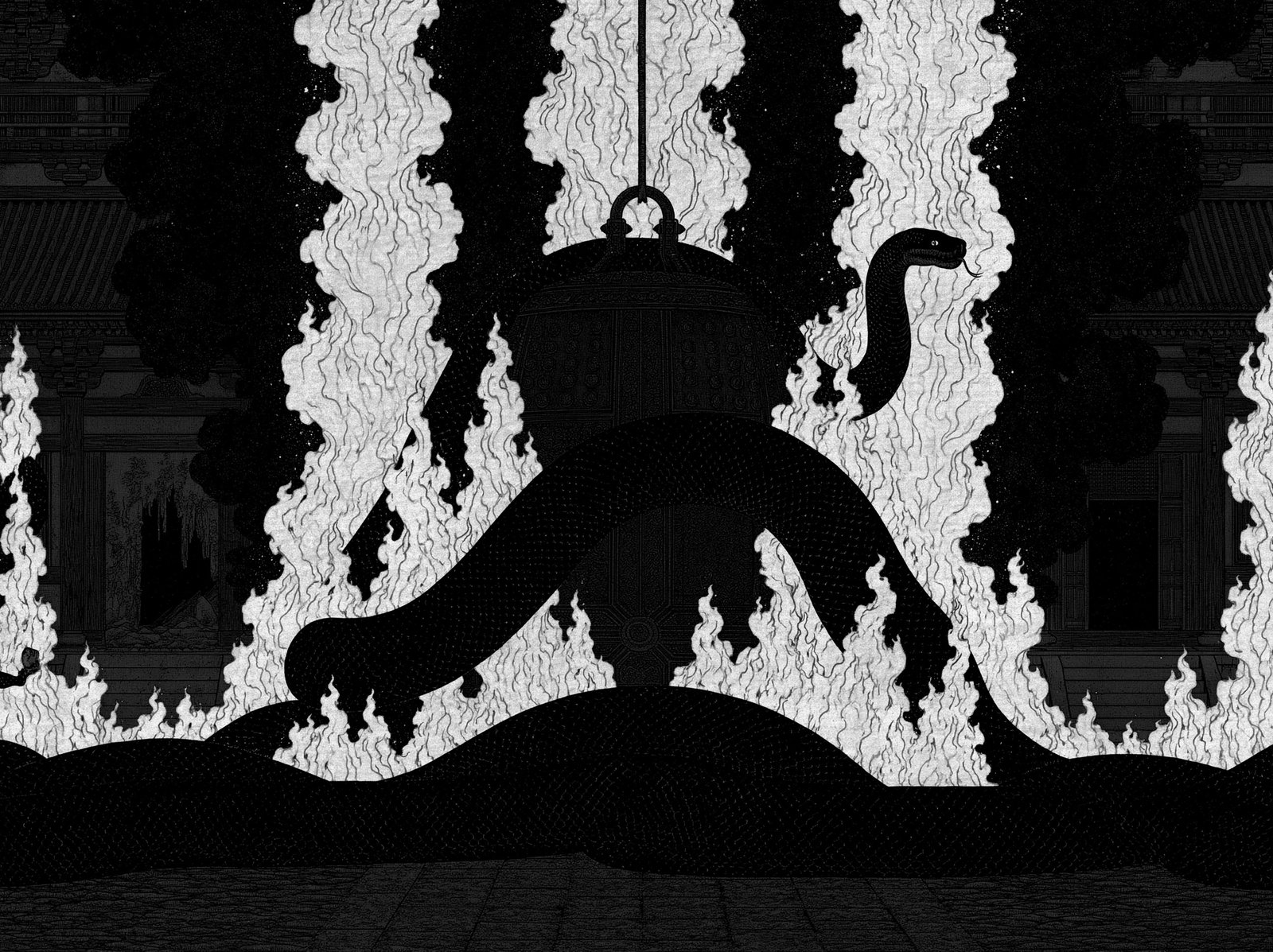
In those versions there is no mask, because there is no stage. There is a woman, a priest who breaks his word, a serpent, a bronze bell, and a great deal of heat. The face arrived around 1500, when the tale was made into the Noh play, itself adapted from an earlier one called Kanemaki.[3] The hannya is not a creature from folklore. It is a piece of theatrical equipment, made five hundred years ago to solve a staging problem: how to show a woman and what she has turned into at the same time.
Why the Usual Caption Misses It
Called a demon mask, the object becomes simple, and its whole construction argues against being simple. The horns are the end of something. The brow is the beginning of it, and both are present in one piece of wood because the drama requires the audience to keep the woman in view while watching what happens to her.
If the mask were only a demon’s face, the upper half would be wasted work. It is not wasted. It is what the actor shows you when he lowers his head.
Sources
- Dainihonkoku hokke genki 大日本国法華験記, 11th century — the oldest surviving form of the Dōjōji tale. Wikipedia
- Konjaku monogatarishū 今昔物語集, early 12th century, book 14, tale 3, “Kii no kuni Dōjōji no sō Hokke o utsushite hebi o sukuu koto” 紀伊国道成寺僧写法花救蛇語. Wikimedia Commons
- Dōjōji 道成寺, Noh play, c. 1500, adapted from the earlier Kanemaki 鐘巻; authorship not settled. Wikipedia
- Aoi no Ue 葵上, Noh play. Wikipedia
Further Reading
- Susan Blakeley Klein, “When the Moon Strikes the Bell: Desire and Enlightenment in the Noh Play Dōjōji,” The Journal of Japanese Studies 17, no. 2, 1991
- Michishige Udaka, The Secrets of Noh Masks
- Eric C. Rath, The Ethos of Noh: Actors and Their Art, 2004
The reading in “The Name Is Not Settled” and in “Why the Usual Caption Misses It” is KWAIDANOTE’s own.
Found an error? Write to kwaidanote@gmail.com — corrections are made on this page and dated.