The Giant Salamander That Got a Shrine
An Animal That Is Actually There
Almost everything on this site is a text about a text. This one begins with a living animal that can be photographed.
The Japanese giant salamander is among the largest amphibians in the world, and it lives in the clear, cold rivers of western Japan — nocturnal, slow, flattened, patterned like the stones it lies among. In the mountains of Okayama it is called hanzaki. (There is a popular explanation of that name which this note has not checked and does not repeat.)
It is a protected species. People go out at night to see them. And in one village there is a shrine to one.
The Paragraph
The record is short, and it sits inside a folklore work as a piece of supporting evidence for something else, which is often where the best things are.
In the province of Mimasaka, it says — in Maniwa district, in the village of Yubara — there is a shrine of the giant salamander, which people commonly call the sanshōuo. In the Genroku era a boy of that village, Mitsui Hikoshirō, killed a great salamander. Its length is given as three jō five shaku, and its girth as one jō three shaku. By the curse of it his entire household died, and so a shrine was raised and the creature was worshipped as a god.
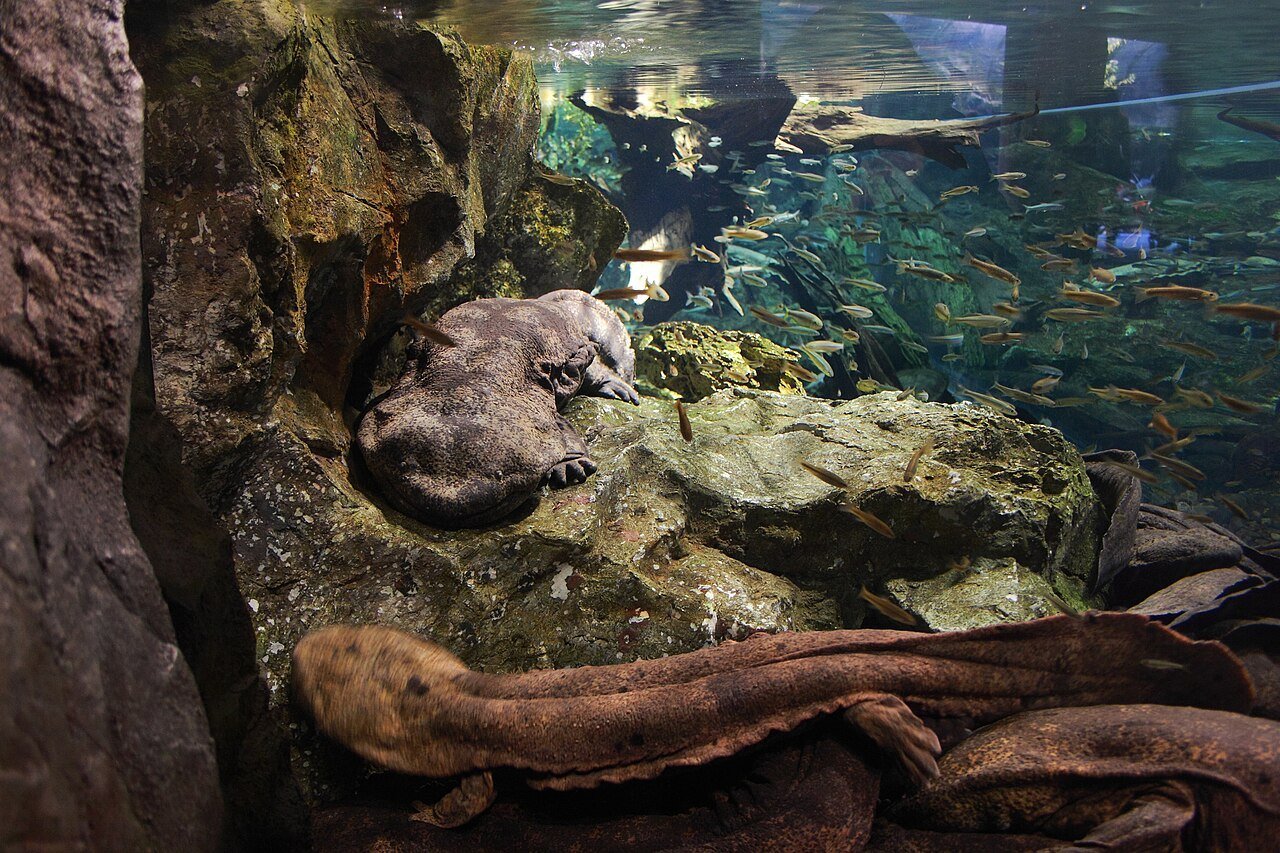
The animal itself. Photograph by V31S70, CC BY 2.0, via Wikimedia Commons.
The Measurement Is the Joint
Convert those figures and the animal in the record is something over ten metres long and nearly four metres around.
No salamander is that size. The species reaches about a metre and a half at the very largest, which is already extraordinary and quite large enough to frighten a boy in a river at night. The animal in the story is roughly seven times the length of the animal in the river.
That multiplication is where the whole thing turns. A boy killing a large amphibian is a day’s work. A boy killing a ten-metre creature is a transgression, and a transgression is a thing that can take a household with it and end in a shrine. The figures are not an error. They are the part of the record that does the work.
Four Names for One Animal
One sentence of the record carries three different words for the creature, and the report at the end of it adds a fourth.
The shrine is called by the literary graph for the giant salamander, borrowed from Chinese. The writer then stops to gloss it for his reader with the standard Japanese word, sanshōuo — literally the pepper fish, after the smell the animal is said to give off. The shrine itself, as the local people call it, is Hanzaki Daimyōjin. And the zoologist’s report puts the vernacular hanzaki in the title, in phonetic script, with the Chinese graph after it in brackets, and then a German subtitle giving the binomial.
That is the whole vertical range of Japanese naming in the space of two lines: the classical graph, the national vernacular, the village word, the international scientific name. Each of the four belongs to a different set of people who had a reason to talk about this animal, and all four are pointing at the same thing lying under a stone in a river.
Killed, Then Enshrined
The sequence in the record is one of the most familiar in the whole subject: a thing is killed, the killing brings ruin on the household, and the remedy is to build the thing a shrine and give it the rank of a god.
That is exactly the logic this site’s notes on Sugawara no Michizane and on the head of Taira no Masakado set out — a dangerous death answered with worship, enshrinement used not as honour but as containment. What is unusual here is only the occupant. The thing being raised to a deity is not a minister who died in exile or a rebel’s severed head. It is an amphibian.
I find that the most interesting sentence in the paragraph, and it is the one nobody quotes. The machinery Japanese religion built for handling wronged human dead was available, and a village in Mimasaka simply used it on a river animal, and the shrine took, and it was still receiving visitors two centuries later when a scientist came to photograph it.
Two Footnotes, Both Slightly Wrong
The paragraph carries citations, which is what makes it worth writing about, and both of them turn out to be imprecise in the ordinary way.
The first names a gazetteer of the province as its source for the killing. The title as printed does not resolve in the national catalogue, though the work behind it is real enough: the gazetteer of Mimasaka whose western portion was completed in 1691, with a collated edition published in 1894 and modern editions after it. The two ways of writing its name differ by one character, which is the ordinary reason a citation fails to resolve.
And the date moves. The folklore paragraph puts the killing in the Genroku era — the years around 1690, which is to say within a year or two of the gazetteer’s own compilation. Accounts that work from the gazetteer put it a century earlier, in the Bunroku era of the 1590s, and describe it as something that had happened about a hundred years before the book was written. The measurements shift between retellings too. This note has read neither the gazetteer nor the accounts that quote it directly, so it does not adjudicate; what it can say is that the era, the size and the source title all wobble in the space of one short paragraph, which is the condition this material is actually in.
The second names a university science-faculty bulletin as the source for the shrine still standing. The report is real and the man is real, but the publisher named does not match what the catalogue holds. Ishikawa Chiyomatsu published a monograph on the hanzaki — twenty-seven pages, issued in 1903 and 1904, carrying a German subtitle that names the species in the scientific manner of the period. It was issued by the Imperial Museum in Tokyo, not by a university faculty. Whether he also published something on the same animal in the bulletin the folklore writer names is a further question this note did not settle; what stands under his name for those years is the museum monograph.
So a folklore writer reached for two authorities, and in both cases the reference as printed does not lead where it says, and in both cases something real is standing behind it. That is completely ordinary scholarship and it is worth showing rather than tidying, because the alternative is to print the citations as given and let a reader who checks them conclude the paragraph was invented.
The Zoologist
What the folklore paragraph says about the report is the part that makes the case unusual.
According to it, Ishikawa’s report notes that there is in that district a shrine called Hanzaki Daimyōjin, that people go there to worship, and that photographs are appended.
This note could not verify that the shrine and the photographs are in fact inside that monograph; its contents were not examined. What can be said is that the claim being made is a specific and checkable one — that a professional zoologist, publishing a species monograph in the formal scientific apparatus of 1903, went to the trouble of recording a local shrine to the animal, and photographed it.
It is the only case on this site so far in which the folklore and the science are reported to be between the same covers.
What Makes This One Different
Elsewhere on these pages the chain runs from a book to a book to a book. Here it runs from a river to a shrine to a gazetteer to a museum monograph, and at the far end somebody with a camera stands in front of a small wooden building in the mountains of Okayama and takes a photograph of it.
Everything in that chain is checkable except the part everybody tells. The animal is real and can be measured. The shrine is reported by a scientist. The gazetteer family exists. The monograph exists, with its page count and its dates.
The boy, the curse, and the household that died are in one sentence in one gazetteer, and this note has not read it.
Sources
- A study of Japanese folklore, ritual volume; the paragraph on the shrine of the giant salamander at Yubara in Mimasaka, giving the Genroku killing, the name of the boy, the measurements, the curse and the founding of the shrine, and citing a provincial gazetteer and a report by Ishikawa Chiyomatsu.
- Ishikawa Chiyomatsu 石川千代松, Report on an investigation of the hanzaki はんざき(鯢魚)調査報告, with a German subtitle naming the species; issued by the Imperial Museum, Tokyo, 1903–1904, twenty-seven pages. Existence, issuing body, dates and extent verified in the national bibliographic catalogue; the contents were not examined for this note, and no search was made for other publications by the same author on the same animal.
- On the provincial gazetteer cited: the title as printed could not be matched in the national catalogue. The gazetteer of Mimasaka, whose western portion was completed in 1691, exists in a collated edition of 1894 and in later editions; the name is written two ways, differing by one character. Accounts working from it date the killing to the Bunroku era rather than the Genroku era given in the folklore paragraph. Neither the gazetteer nor those accounts was read for this note.
The readings in “The Measurement Is the Joint”, “Killed, Then Enshrined” and “What Makes This One Different” are KWAIDANOTE’s own.
Found an error? Write to kwaidanote@gmail.com — corrections are made on this page and dated.