Masakado's Head in the Financial District
A Fenced Plot in Ōtemachi
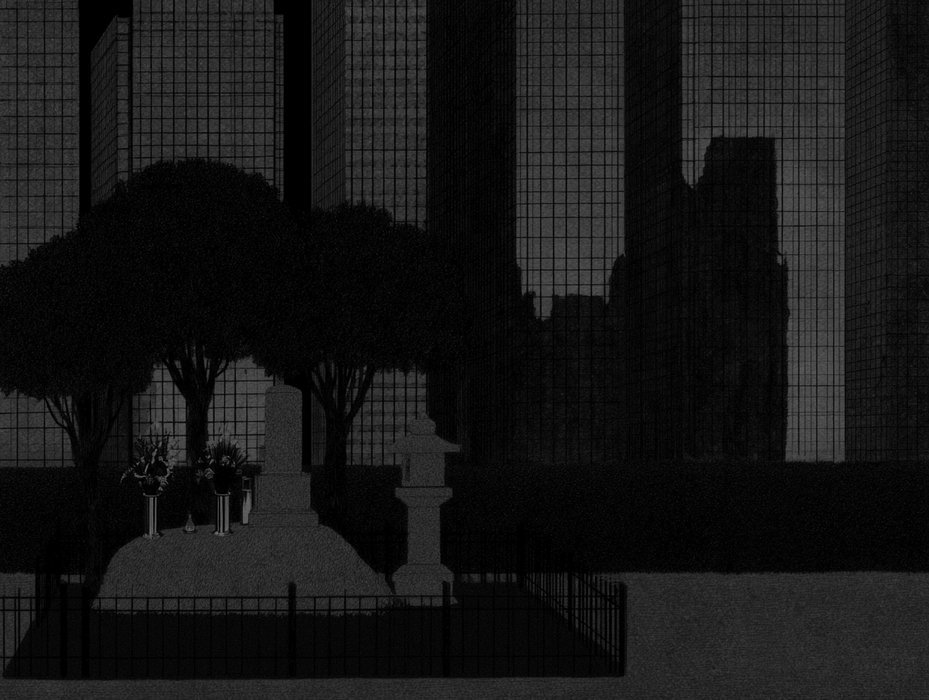
There is a small walled enclosure in Ōtemachi, a district of Tokyo given over almost entirely to banking and trade. It has a stone marker, a few trees, offerings, and a gate. Towers stand on every side of it, and the land under it is among the most valuable in the country.
It is said to hold the head of a man who died in 940.
What the Oldest Account Says
The earliest source is the Shōmonki, a military account written soon enough after the rebellion that its author is still arguing with the dead man’s motives.[1] Taira no Masakado, a provincial warrior, had taken control of eight eastern provinces and declared himself New Emperor. In the second month of 940 he was killed in battle, and the chronicle treats this as heaven’s own verdict on a man who reached above his station.
In the fourth month his head was sent to the capital with an official covering document and exposed at the prison gate beside the East Market. That market was a real institution on the eastern side of the city, the busier of the capital’s two official markets, and the choice of site was not incidental: a head displayed there was displayed where the most people would pass it. The exposure was an administrative act, recorded alongside the paperwork that accompanied it.
The oldest record does not say the head did anything. It stops.
Each Century Adds the Part the Last One Lacked
The head acquires its behaviour slowly, and the additions can be dated.
The Taiheiki, the great war chronicle of the fourteenth century, gives it three months without decay, eyes that will not close, teeth that go on grinding, and a voice that calls at night for the body it was cut from.[2] It also supplies a passer-by who mocks the head in a punning verse — and then has the head laugh, close its eyes at last, and fall silent.
The Tale of Tawara Tōda, a storybook of the Muromachi period named for Masakado’s killer, retells that scene and works it up further.[3] The laugh is not its invention; what the storybook adds is elaboration, and a wider audience.[3]
The flight east — the head leaving the prison gate and travelling to the plain where Tokyo now stands — is younger still. It belongs to Edo-period print and to a shrine’s founding tradition in the old province of Mino, which holds that the head was shot down there and pacified. It appears in a late chronicle of the Masakado wars and in a guidebook to the sights of Edo published in 1662.[4]
The most famous part of this story is the newest part of it, and it is roughly seven hundred years younger than the events.
The Layer Nobody Calls a Legend
There is one more layer, and it is the only one that keeps minutes.
In 1874 Masakado was removed from the main enshrinement at Kanda Shrine on the grounds that an enemy of the court could not be worshipped where the emperor might visit; another deity was installed in his place. He was restored to the main enshrinement in 1984.
The mound itself is looked after by a preservation society formed by the neighbouring firms in July 1960 and incorporated as a legal body in November 2023. Its members are the corporations whose buildings surround the site — a trading house, an estate company, a bank, a construction firm, a hotel. The society ran the sixth renovation of the plot from November 2020 to April 2021, and held a dedication on 26 April 2021 with a Buddhist observance by the priest of the nearby temple and a Shinto rite by the Kanda clergy. A memorial service is held each September, as the society’s own rules require, and something over a hundred people attend it.
That is the layer visible today: not a curse but a maintenance schedule, a membership list, and two liturgies at the same ceremony.
It is also the layer least likely to appear in an English account of the site, which tends to move from the tenth century to the ghost stories and stop. The society, the renovation dates and the annual service are all a matter of public record, and they describe a relationship with the dead that has outlasted every version of the legend attached to it.
Which Modern Stories Hold Up
The mound is also the subject of a set of twentieth-century stories about what happens to people who disturb it, and these need separating.
The most-repeated concerns the aftermath of the 1923 earthquake, when the mound was cleared for a temporary Finance Ministry building. The story is not fringe: Japan’s own National Tax Agency tells it on its website, which is a striking thing for a revenue service to publish about its predecessor’s premises.[5] Its account is specific. The mound was destroyed in 1924; the finance minister of the day died suddenly in 1926; the engineer who had headed the works died the year after; and in 1927 a stone was raised to quiet the spirit. The minister had taken office two years after the building was finished and had no part in putting it up. The same page records that lightning burned the ministry’s building in June 1940. And then the agency says, in its own words, that whether any of this was a curse cannot be established.
A second story, that an American bulldozer was stopped by accidents during the occupation, is repeated both by the shrine and by the tax agency. No contemporary record for it has turned up either.
Neither story is a rumour in the ordinary sense — institutions tell them, in public, on their own pages — and neither has a source from the time. That combination is unusual, and it is a better description of the situation than either believing or debunking.
What Is Actually Continuous
One reading is that the mound has survived because it frightens people. The documented record suggests something duller and more durable.
What is continuous here is attention. A chronicler used the head to make an argument about heaven and rank. A war chronicle gave it a voice because a silent head is no use in a story. A storybook gave it a punchline so that it could stop. A shrine in Mino needed a founding event and the head supplied one. And a group of companies in the most expensive square kilometre in Japan has decided, and re-decided for more than sixty years, that the plot stays where it is.
None of that requires a curse. It requires only that each generation found the head useful, which is a thing the record shows plainly and which the head itself, if the Taiheiki is any guide, would probably have enjoyed.
Sources
-
Shōmonki 将門記, account of Masakado’s rebellion, composed shortly after 940; author unknown. Wikipedia
-
Taiheiki 太平記, war chronicle, 14th century; book sixteen. Wikipedia
-
Tawara Tōda monogatari 俵藤太物語, Muromachi-period tale of Fujiwara no Hidesato.
-
Edo meishoki 江戸名所記, guide to the sights of Edo, by Asai Ryōi, 1662 Wikipedia; and Zen taiheiki 前太平記, later chronicle of the Masakado wars.
-
The National Tax Agency of Japan, “The head mound at Otemachi,” in its public series on the history of taxation.
Further Reading
- Karl F. Friday, The First Samurai: The Life and Legend of the Warrior Rebel, Taira Masakado, 2008
- Judith N. Rabinovitch, translator, Shōmonki: The Story of Masakado’s Rebellion, 1986
The reading in “What Is Actually Continuous” is KWAIDANOTE’s own.
Found an error? Write to kwaidanote@gmail.com — corrections are made on this page and dated.