The Scholar They Made a God
A Man Who Wrote Things Down
In the year 900 a minister of the Japanese court presented the emperor with a collection of his own poetry in Chinese, gathered from a working life: verses written on official journeys, at banquets, on the deaths of friends. Three years later the same man died in exile on the island of Kyushu, and the poems he wrote there he had already sent to a friend in the capital, in a second, thinner collection put together near the end.[1][2]
Sugawara no Michizane, 845 to 903, was a scholar before he was anything else. He came from a family of scholars, served as a provincial governor, rose to Minister of the Right in 899, and is credited with the recommendation in 894 that the court stop sending official embassies to Tang China — the dynasty was collapsing and the sea crossing killed people. The embassies stopped.
He is the patron deity of examinations because he was good at examinations, and that is the part of the story that came last.
The Fall, Briefly
In 901 he was demoted to a nominal post at Dazaifu, far from the capital, on a charge of plotting against the throne. His children were scattered into separate exiles. He died there two years later.
Our Tatari volume follows what the court believed happened next, and it is not a quiet sequence: the death of his rival Fujiwara no Tokihira in 909, the death of a crown prince in 923, and in 930 lightning striking the emperor’s own residential hall and killing courtiers where they stood. The chronicle of the period records the crown prince’s death as the work of Michizane’s resentment.[3] That story is told in the book; this note takes up what the court did about it.
Promotion, Twice, After Death
What the court did was give him back everything it had taken, and then more.
In 923, in the same year as the crown prince’s death, his old rank was restored, the edict of demotion was destroyed, and the era name was changed. In 993 he was posthumously appointed Minister of the Left at the senior first rank, and then, later the same year, Chancellor — the highest office in the state.
A man the court had exiled for treason was promoted twice after his death, the second time to the top of the government that exiled him. Nothing in his conduct had come to light in the interval. What had happened was a series of deaths at court, and a decision about how to read them.
A Girl Is Told Where to Put Him
The shrine came before the titles. In 947 a sanctuary was established for him at Kitano, on the northern edge of the capital, on ground that still holds the Kitano Tenmangū today.
The account of how the site was chosen is a legend and should be read as one: a girl named Tajihi no Ayako is said to have received an oracle telling her where the spirit wished to be placed, and similar instructions are said to have come to a shrine attendant’s young son. The story is repeated consistently, but the text it first appears in has not been established, and it is not the kind of thing a court chronicle records. What is not legend is that the shrine came first and the titles followed it.
What is not in doubt is the date of the foundation and the fact that the initiative involved people well below the rank of the man being enshrined.
Thunder First
For most of the first century of his cult, Michizane was not the god of scholarship. He was the god of lightning.
The identification followed directly from 930. The hall that was struck was the emperor’s own, the dead were named courtiers, and the court concluded that the thunder had a person behind it. The shrine at Kitano absorbed an existing thunder deity’s ground and function, and the name the court eventually gave him — Tenjin, the heavenly deity — belonged to that order of things before it belonged to him. In 987 the court sent an imperial envoy to Kitano, and the name by which he is known there — Tenman Tenjin — was formally recognised.
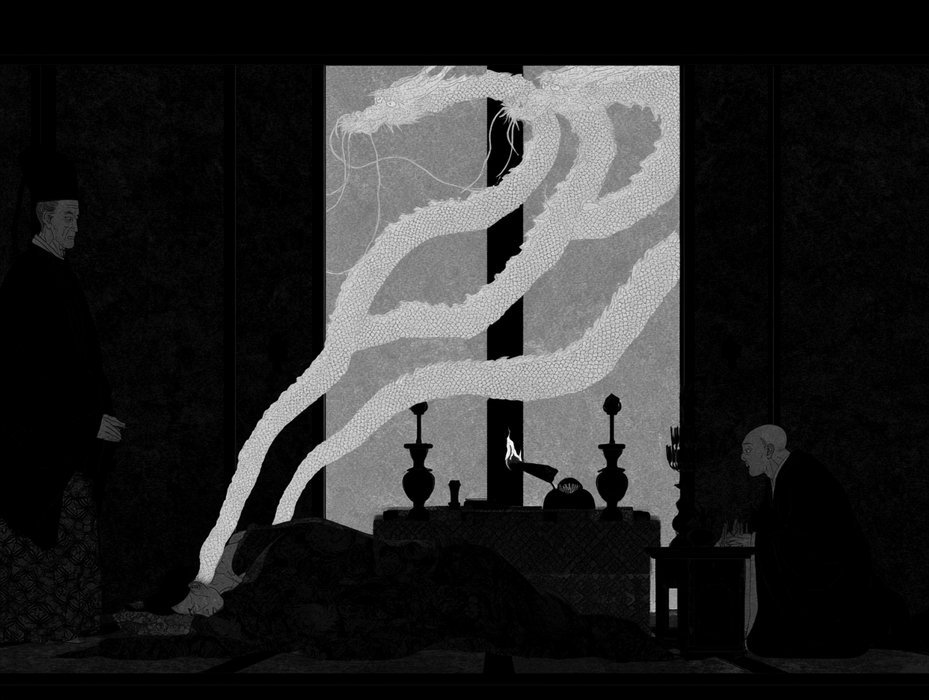
A set of illustrated scrolls made from the early thirteenth century, the Kitano Tenjin engi emaki, tells the whole arc in pictures: the career, the exile, the death, and the storm.[4] The scrolls are about a spirit with a grievance. They are not about a teacher.
And Then Examinations
The reinterpretation that produced the god students pray to now belongs mostly to the Edo period, when scholars, teachers and the writing masters of the town schools took up a deified scholar as their own and the shrines followed. It is a long way from a hall full of dead courtiers to a rack of wooden plaques asking for a pass mark, and the distance was covered slowly, by people with an interest in covering it.
When exactly the modern examination visit became customary I could not establish, and I would rather say so than pick a century.
What can be said is the order. The anger was enshrined first. The learning was added by people who found it useful later, and it is the learning that kept the shrines full after the fear wore off.
What the Two Halves Have in Common
It is tempting to treat the vengeful spirit and the kindly patron of study as two different figures who happen to share a name, and much English writing does exactly that.
They are joined, though, by the thing that actually happened to him. Michizane was a man whose learning was his entire standing, and who was destroyed by an accusation that had nothing to do with learning. The court could not admit the second part without conceding something about itself, so it conceded instead that he had become a god and gave him the offices back.
Read that way, the examination plaques at Kitano are not a sentimental afterthought. They are addressed to someone who is understood to know, from experience, what it is to be judged by an institution and found wanting for reasons that were never about the work.
Sources
- Kanke bunsō 菅家文草, Sugawara no Michizane’s collected Chinese verse and prose, presented to the throne in 900. Wikipedia
- Kanke kōshū 菅家後集, the later collection, assembled at Dazaifu near the end of his life and sent to Ki no Haseo.
- Nihon kiryaku 日本紀略, court chronicle compiled in the Heian period — the deaths of 909, 923 and the lightning of 930. Wikipedia
- Kitano Tenjin engi emaki 北野天神縁起絵巻, illustrated scrolls; the best-known set carries a date corresponding to 1219. Wikipedia
Further Reading
- Robert Borgen, Sugawara no Michizane and the Early Heian Court, 1986
- Ikumi Kaminishi, “The Political Culture of a Scroll: Jien’s Appropriation of Kitano Tenjin,” Ars Orientalis 44, 2014
The reading in “What the Two Halves Have in Common” is KWAIDANOTE’s own.
Found an error? Write to kwaidanote@gmail.com — corrections are made on this page and dated.