Kitsunebi Was One Fire of Twelve
Twelve Kinds of Fire
Kitsunebi, foxfire — the blue light that travels in a line along a ridge at night — is usually presented in English as a single item: a fox lights it, or a fox is it. In the Japanese material it is one entry in a classification.
A lecture course on the study of the uncanny, delivered at a Tokyo academy in the 1890s, opens its treatment of strange fires by quoting an illustrated encyclopaedia of 1712, which is in turn quoting the great Chinese pharmacopoeia. Fire, it says, is one of the five phases; it has vapour but no substance. It divides in two, yin fire and yang fire. It has three headings — the fires of heaven, of earth, and of man. And under those it has twelve kinds.
An Edo collection of village talk sets the twelve out again, six yin and six yang: fire struck from metal or stone, drilled from wood; the sun, a star’s essence, flying fire; fire in water, fire from rock-oil; dragon fire and thunder fire.
And then a category that does the work of this whole article. The fires of the fox, the weasel, the firefly and the spider, it says, resemble fire and are not fire. In linked verse they are called the counterfeit fires. Blue in colour, and without flame.
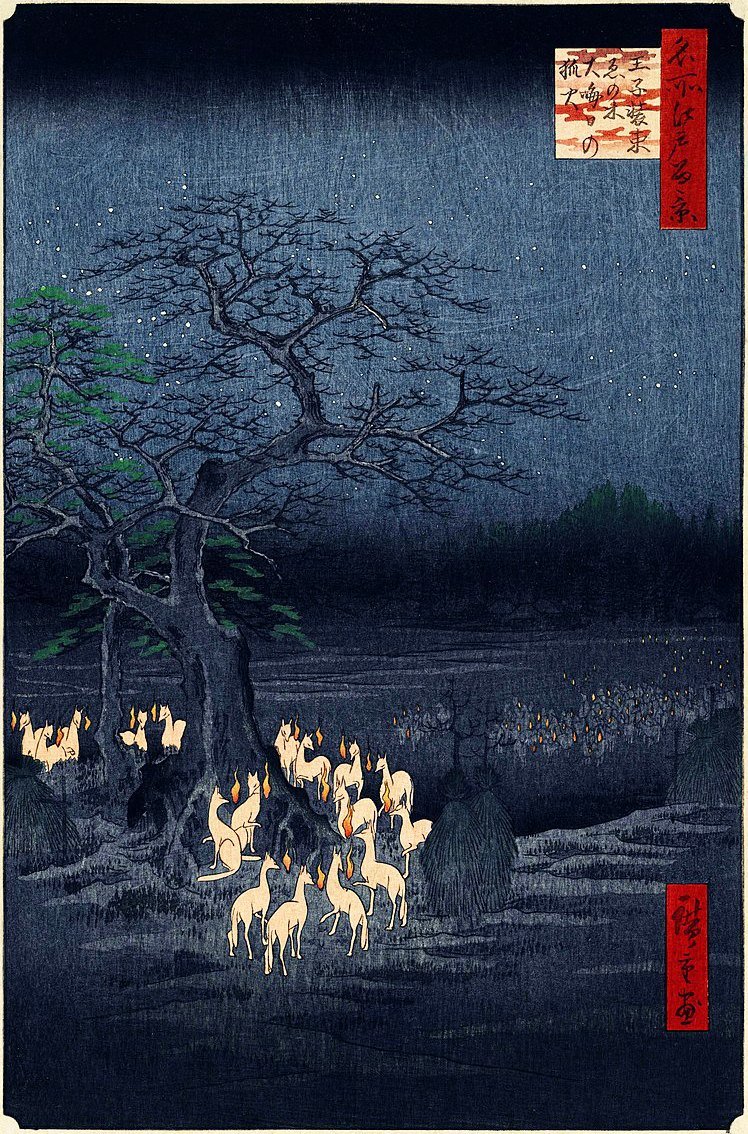
Utagawa Hiroshige, 1857: the foxfires at Ōji on New Year’s Eve. Public domain, via Wikimedia Commons.
The Ones That Had Names
What survives from the older layer is not explanation but a list of fires local enough to be named.
There is the rinka, the corpse-light: the blood of people and of cattle and horses killed in battle, sunk into the ground and changed over years. Blue-green, like a torch. It gathers and scatters, and comes close and takes the breath out of a person — but clash two stirrups together and it goes out at once.
There is the fire on the western foot of Mount Hiei, coming on dark summer nights, many lights flying north and south, which people took for the fires of attachment — and which the text says are birds.
There is the fire of Dōgen at Shichijō Suzaku, and the old woman’s fire at Hiraoka in Kawachi, both of which the text says are in everyone’s mouth and handed down. It gives no story for either.
Those two are the subject in miniature: a fire with a person’s name attached, in a named street, which everybody knows and nobody wrote down.
The Sentence He Should Not Have Written
Then the lecturer does something that is worth stopping on.
Having filled several pages with Chinese citations — a first-century essayist, a fourth-century collection of strange tales, a Yuan-dynasty miscellany, a string of Chinese county gazetteers — he turns to Japan, and writes that examples in this country are scattered through many books and exceedingly numerous, and that reports sent in from all quarters are likewise exceedingly numerous, and that he will omit them and proceed directly to the explanations.
He had built a machine for collecting reports of the uncanny from across Japan, and he had them. At the point where a reader most wants them, he says there are a great many and moves on to the theory.
I think that sentence is the most revealing thing in the section, and everything good in it survives in spite of that sentence rather than because of it. The cases leak in anyway, because he cannot make an argument without them, and they are the only part of the chapter anyone would read today.
The Fire Pillar and the Wet-Nurse
Here is the best of them.
The belief is that when a pillar of fire stands, a fire will certainly follow; the house it stands over is the house that will burn. An Edo book of Shōnai talk gives the rule and then gives a case against it.
One year the house of Haga in Daikanmachi burned down, and word went round that a fire pillar had been seen standing beforehand. Afterwards the district was uneasy, and in an uneasy district people say all sorts of things. So they traced the rumour back to whoever had said it first.
It was the wet-nurse of that household. They took her and questioned her, and it was a lie. She was the arsonist, and she had put the fire pillar into circulation in advance, so that the fire would already have been foretold when it came. She was burned for it.
A portent used as an alibi, planted before the crime, and unpicked by asking who said it first. The book prints it as a caution against believing in fire pillars. It is also a complete account of how one gets made.
The same section attributes the genuine sightings to weasels — the creatures being fire-natured, gathering in the hundreds, and breathing out so that their breath shows as fire in the night sky. This note does not adopt that, and neither, entirely, did the Edo book: it adds that the explanation is itself strange, and not found in any text.
The Fire Only You Can See
The minobi, the straw-cape fire, comes from a correspondent in Echigo named Kimura Gishichi, and it is the strangest entry.
A person’s whole body appears to be burning. There is no heat and nothing is scorched. Bystanders see nothing; only the person it is happening to can see it. Panic and the flames grow fiercer; keep still and it fades. And if you strike a match, it vanishes instantly.
A boatman carrying a passenger toward Niigata at one in the morning was struck by it. He knew what it was and did not lose his head; he calmly asked his passenger for a match, struck it, and the fire went out. The passenger had seen nothing the whole time.
In another case three people were taken at once at dusk, just past a village Inari shrine. Their match would not light. They fell into a roadside stream that had not a drop of water in it, and could not climb the bank. Then one of them got a light, and all three came back to themselves.
A hunter who had been caught by it several times gave a list: commonest in autumn; keep still and it goes; panic and it grows; a flame ends it; no burns; no heat; nobody else can see it.
The Dragon Lamps
The ryūtō are the lights that come in from the sea to a temple on an appointed night.
A snow-country book of the north records an account from Iizuka Tomoyoshi, headman of Shindō village, of a night on Mount Yoneyama. The lights gathered out of nowhere — the large ones the size of a cupped hand, the small the size of a hen’s egg, the colour of fireflies, never still, too many to count. The watchers had shut the hut and kept quiet, so the lights behaved as though nobody were there. Two or three came within fifteen yards, and by their own light the shape looked like a bird, the light coming from below the throat.
They had brought a gun. A young man who was a good shot took aim at one, and an old man stopped him — wait, how impious; these lamps are offered by the dragon god to the Buddha of the mountain; you will be punished. At the scolding, the lights started as if surprised and flew off.
A later report from Manome Tokutarō in Iwaki describes the same thing as something he had checked himself. Around midnight a white, brilliant light appears out at sea, vanishing and returning, now one and now dozens. It comes toward the shore, follows the Natsui river to the foot of the mountain, up the ravine, and moves about in the grove before the hall — and sometimes goes inside. Locals call it the vapour of crystal; others say corpse-light. Neither can be believed yet, he writes; it must wait for later research.
One of Them You Can Still Go and Look At
The most famous sea-fire is the shiranui of Higo, and its record is the oldest thing here.
The chronicle has an emperor sailing at night, unable to find the shore, who sees a distant light and orders the helmsman to steer straight for it. They land. He asks what village the light was in, and is told; he asks whose fire it was, and nobody owns it. Knowing it to be no human fire, he names the country: the Land of Fire.
That is a naming story, and naming stories are usually where this site stops. Not here: the sea is still there, the season is known, and people still go out to look.
Foxfire, corpse-light, the straw-cape fire, the dragon lamps — the lecturer wanted them all reduced to one cause and filed away. What he left behind instead is a gazetteer of lights: which coast, which mountain, which night of which month, and what to do when one comes at you.
Sources
- Yōkaigaku 妖怪学, by Inoue Enryō 井上円了; the sections on strange fires in the natural-science division — kinds of strange fire; corpse-light, yin fire, demon fire and foxfire; the fire pillar and the straw-cape fire; dragon lamps, holy lamps and Buddha lamps; and the explanation of strange fires. All quotations below are as given there.
- Wakan sansai zue 和漢三才図会, 1712, quoting the Chinese Bencao gangmu 本草綱目: fire as one of the five phases, having vapour but no substance; two, three and twelve.
- Shokoku rijin dan 諸国里人談, the section headed 火辨: the six yin and six yang fires, and the fires of fox, weasel, firefly and spider called the counterfeit fires in linked verse.
- Kunmō daichiben 訓蒙大地辨: the fire pillar explained as the breath of weasels, with the writer’s own note that this is strange and not found in any text.
- Shōnai kanaridan 庄内可成談: the burning of the Haga house at Daikanmachi, the rumour of the fire pillar, the tracing of it to the household’s wet-nurse, her confession to arson and her execution.
- The straw-cape fire cases are credited in the source to a report from Kimura Gishichi 木村義七 of Echigo; the account of the dragon lamps at Yoneyama to a snow-country book of the north, reporting Iizuka Tomoyoshi 飯塚知義, headman of Shindō; and the dragon lamp at the mountain in Iwaki to a report from Manome Tokutarō 馬目徳太郎. The source also cites Tōyūki kōhen 東遊記後編 for the lamps at Sakka-san in Etchū.
- Nihon shoki 日本書紀; the naming of the Land of Fire in the reign of Emperor Keikō. Read here in the quotation given in the lecture course, not in the chronicle itself.
- The original works quoted at second hand above were not collated against their own editions for this note.
The readings in “The Sentence He Should Not Have Written” and “One of Them You Can Still Go and Look At” are KWAIDANOTE’s own.
Found an error? Write to kwaidanote@gmail.com — corrections are made on this page and dated.