You Could Walk Up to Hell and Put Your Hand In
Item 407
The compendium of oral tradition published in Tokyo in 1913 files strange occurrences by number, one paragraph each, with the older book it came from in brackets at the end.
Item 407 is headed ikijigoku — the living hell — and its margin keyword names a mountain in Hizen.
What makes it worth an article is not the incident. It is the assumption the entry does not bother to state: that hell is a place on the map, on a named mountain, which people climbed up to look at.
Three Men Went Up
Three companions went on pilgrimage to the mountain. A townsman from Bungo; a monk of Hizen; and a masterless samurai who was lodging at the monk’s temple.
They arrived at the place where the water of the hell wells boiling out of the ground.
And the monk put a finger into it. Only a little way. It is not so hot, he said.
The Finger
Then he drew the finger out, and it was suddenly hot beyond bearing.
So he put it back in — and the heat stopped.
That is the whole mechanism, and the entry lets it run. He thinks that will do and takes the finger out: hotter than before. In, and it stops. Out, and worse. He keeps doing it. Then he has his arm in, and draws it out, and it is burning.
So he got into the water entirely, and said: ah, this is a good feeling.
Then he felt himself being pulled strongly downwards, and became frightened, and grieved.
Why Nobody Stopped Him
It is worth saying plainly what the entry has described, because the phrasing hides it.
A man put part of himself into boiling water. Withdrawing it hurt more than leaving it in. So the relief available to him at every moment was to put more of himself in, and each time he took a part out the pain was worse than the last time — which made the next immersion a larger one.
That is not a monster and it is not a punishment. It is a trap with no moving parts, built entirely out of the difference between two sensations, and it needs no agency at all to work. The entry does not say the hell reached for him. It says he went in by stages, and that the last stage felt good.
What the Other Two Did
His two companions could do nothing at all.
So they left the monk where he was and went down the mountain, weeping.
That sentence is the end of the entry. There is no rescue, no body, no funeral and no moral. Two men walk down a mountain crying, having watched the third one work out, by experiment, that the only way to stop the pain was to go further in.
Two More Doors
The next two items are from the same older book and are the same kind of thing.
Item 408 is a hell at Nasu, a few hundred yards from the hot springs. A man went up the mountain for firewood; his breakfast was late, and, angry at being left behind by the others, he kicked his mother down and went out. Passing the side of the hell, a great hell suddenly opened under him and he went in. A friend ran and got hold of his head, but he could not be stopped, and he died.
Item 409 is a bell-thief. A metal-caster stole a temple bell, and afterwards went on pilgrimage to Hakusan. Around the eighth station his legs gave under him and he could not move, because flames were going up all round his body. His companions looked at him and said: he will not survive, and if he dies here we shall be polluted, so let us get up the mountain quickly. And they left him.
On the way down they came back to the spot. His body was standing there, unharmed, with the flames still blazing all round it, and they went down the mountain appalled.
The following year, pilgrims from another province found him standing exactly as he had been the year before.
The Instructions
Both of those entries end with something the first one does not have, and it is the detail this site exists for.
At Nasu the place is still called by the man’s name, and if you stand there and shout that name, with the insult attached, the ground bubbles up.
At the other mountain the body was gone on the pilgrims’ return journey — but smoke still rises from the spot, and the stone beside it is burnt so that you cannot put your hand on it.
Those are not descriptions. They are instructions for verification, addressed to a reader who might go. Shout this and watch. Touch this and see that you cannot.
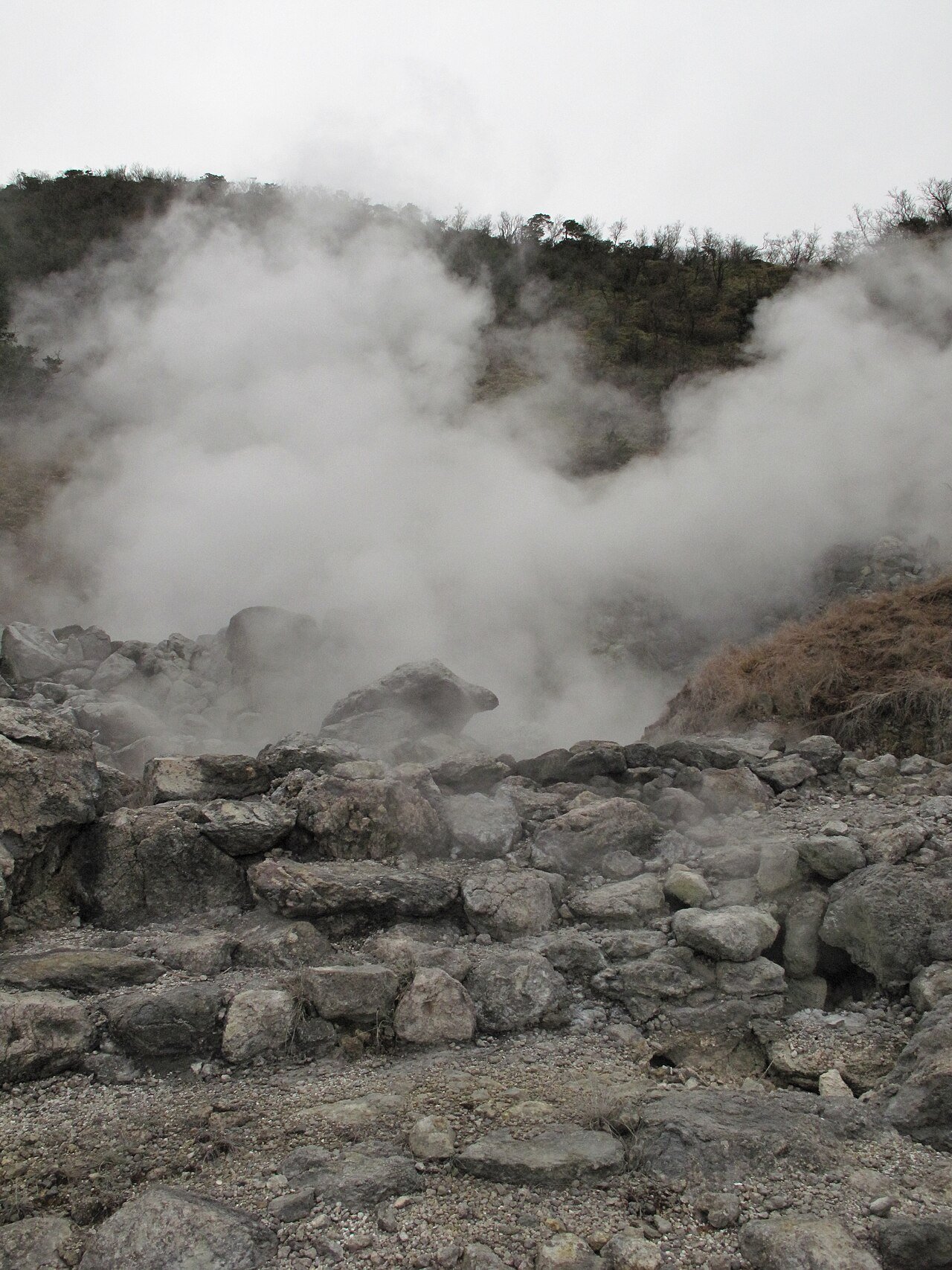
A boiling hell of the kind the entry describes: Unzen, in what was Hizen province. Photograph by Barry Silver, CC BY 2.0, via Wikimedia Commons.
What “Living Hell” Meant
In most of what this site handles, hell is the other place: where you go afterwards, described by people who have not been.
Here it is not. It is a stop on a pilgrimage route, with a townsman and a monk and a rōnin standing at the edge of it, and steam coming out of the ground. Nobody in any of the three entries expresses surprise that hell is available to visit. The surprise is reserved for what happened to the individual.
That word living in the heading does the work. A living hell is not a metaphor for suffering and not a vision of the afterlife. It is the hell that is here, above ground, on a mountain with a name, which anyone with the legs for it can go and look into.
The notes on this site about the giant salamander’s shrine and about the strange fires deal with the same thing from the other end — cases where the record points at something that is still there and can be checked. This is the version where the thing still there is a hole in the ground that boils.
One more thing the compendium’s arrangement makes visible. Items 407, 408 and 409 are consecutive, they come from the same Edo collection, and all three are hells you reach on foot: a mountain in the west, a hot-spring district in the east, and a sacred peak in between. Whoever cut them down to paragraphs put them in a row, and the row is an argument he never makes out loud — that this was a category of place, distributed across the country, and that people knew where they were.
The entries do not say this, but all three men are on pilgrimage. Not one of them is doing anything wrong at the moment the hell takes an interest: the monk is being curious, the woodcutter is walking past, the caster is climbing. The offence, where there is one, is always somewhere behind them — and the ground is where the account is settled.
Sources
- An encyclopaedic compendium of Oriental oral tradition, first volume, Japanese part, chapter nine, on strange occurrences; item 407, the living hell, with the mountain in Hizen as its margin keyword. Read here in the text of the entry. The three companions and their descriptions, the finger, the alternation of heat and relief, the arm, the whole body, the words spoken, the pull downwards and the two companions going down the mountain weeping are all from this entry.
- The same chapter, items 408 and 409, for the hell at Nasu and for the bell-thief at Hakusan, including the shouted name that makes the ground bubble, the abandonment on grounds of pollution, the body still standing a year later, and the smoke and the stone too hot to touch.
- All three entries credit their material to an Edo collection of tales of karmic cause and effect; that collection was not consulted for this note, and its date and compiler were not established. The name of the man in item 408 is damaged in the copy read and is not given here.
The readings in “What ‘Living Hell’ Meant” are KWAIDANOTE’s own.
Found an error? Write to kwaidanote@gmail.com — corrections are made on this page and dated.