The Hundredth Candle
The Rules, and Where They Are Written
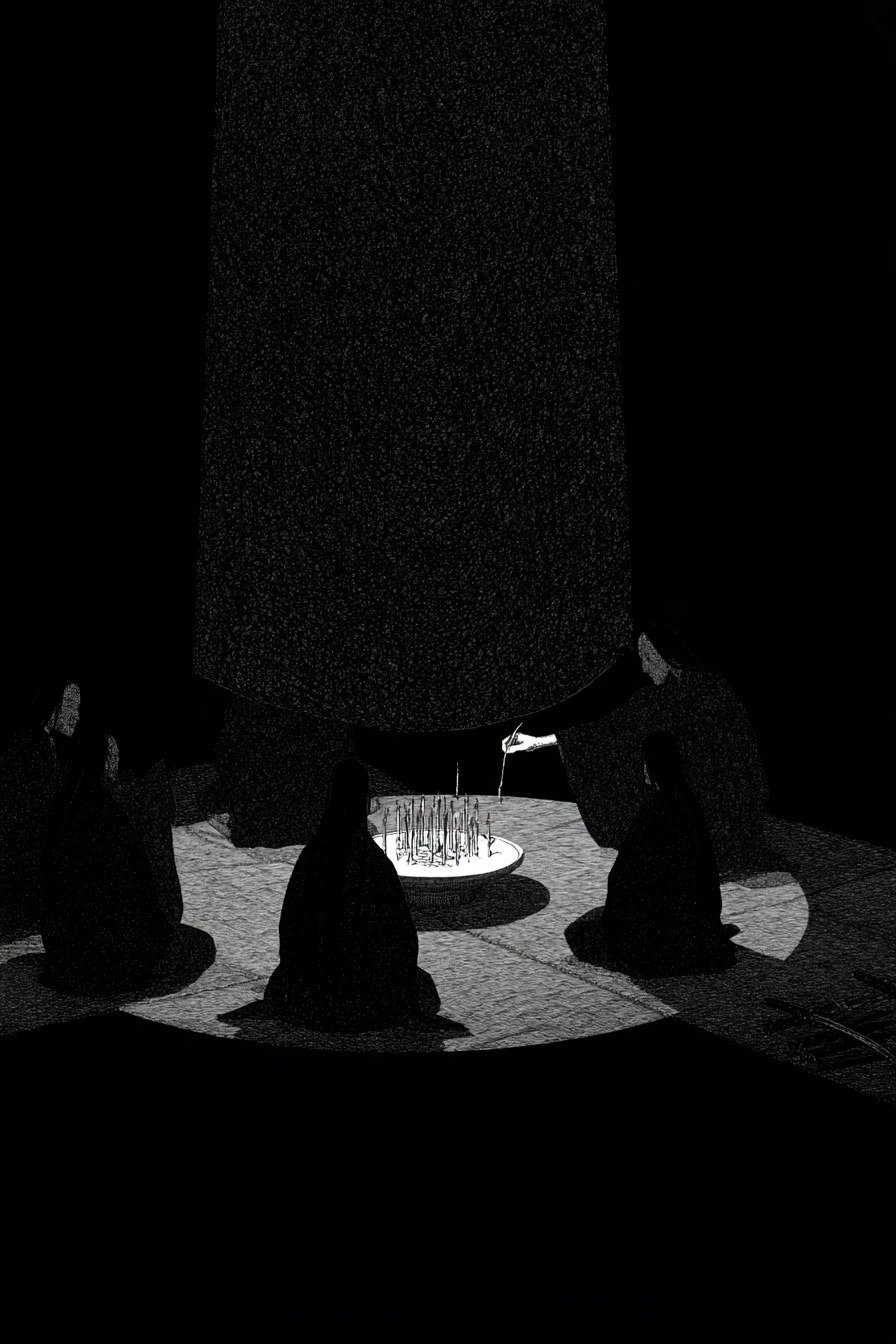
The game is simple enough to describe in a sentence. A company gathers at night, a hundred lights are set burning, and after each strange story one light is put out. When the last goes out, something comes.
The earliest description of the procedure that can be checked is in Otogibōko, a collection of strange tales published by the Kyoto priest and writer Asai Ryōi in 1666. It is usually said to be in the preface. It is not in the preface. The prefaces — there are two, one in Japanese and one in Chinese — say nothing about it. The passage is the last story in the thirteenth volume, and the story is called, roughly, “Speak of the Strange and the Strange Arrives.”
What it specifies is this. There is a proper method for the hundred tales. On a night with no moon, a lamp is lit and papered over in blue. A hundred wicks are set burning in it. With each story told, one wick is drawn out, so that the room grows darker by degrees, the blue of the paper alters, and the whole place becomes, without anyone doing anything, unpleasant.
Read as a piece of stagecraft, that is a remarkably exact specification. The blue paper does the colour, the hundred wicks do the dimmer, and the rate of the fade is set by the length of the stories, which means the room is tuned by the company without the company attending to it. The frightening part of the evening is built into the lighting rather than into the tales. Ryōi says as much: the place becomes unpleasant of itself, with nobody doing anything.
The Oldest Account Is of a Game That Stopped
That would be worth knowing on its own. What makes the passage remarkable is what happens next in it.
The company does not reach a hundred. Lights appear like fireflies, thousands of them, gathering into a round shape like a mirror, breaking apart and gathering again; then a white mass some five feet across strikes the ceiling and drops onto the mats.
And the text ends: the tales did not fill a hundred, and the brush stops here.
The story is itself a Japanese reworking of a Chinese tale about talking of the strange until the strange comes, so even this is not an origin, only the earliest description anyone has been able to produce. But the shape of it is unimprovable. The first surviving account of the hundred-story game is an account of the game being cut short.
The Details That Came Later
Two features everybody now repeats are not from 1666.
The company hiding their swords and long knives, and the flat statement that when all hundred lights are put out a monster will certainly appear, come from a text of 1802. They are a hundred and thirty-six years younger than the rules they are usually attached to.
The modern convention that one always stops at the ninety-ninth story, deliberately, to avoid what would otherwise come, is harder to place. I have not been able to find it stated in an Edo-period source, and it is best treated as a later tidying-up of a practice that the older texts describe as ending on its own terms — or not ending at all.
The often-repeated origin, that the game began as a test of nerve among warriors, rests on modern scholarship rather than on any document of the period. It may well be true. It is not, at present, evidence.
The Count Almost Never Arrives
Once the form had a name, it became a way to sell books, and the books are an education in themselves.
Shokoku hyakumonogatari, of 1677, is the first collection of strange tales to take the title. It has five volumes of twenty stories: a hundred exactly, the only one of these books that actually delivers the number. Its frame — a gathering of young samurai in Shinano, hosted by a masterless man — is now generally regarded as invention, the form borrowed rather than a record of any evening.
Kokon hyakumonogatari hyōban, of 1686, uses a gathering in Kyoto as a frame for arguing with the stories rather than telling them. It is quoted on this site in our note on the snow woman and again in our note on the kappa.
Taihei hyakumonogatari, of 1732, promises a hundred in its title and contains fifty.
Hokusai designed a series of prints called Hyakumonogatari in the early 1830s, intended to run to a hundred images. Five are known.
A hundred, a hundred, fifty, five. The number in the title is a form, not a count, and the gap between the promise and the delivery is the most consistent feature of the genre.
Where the Number Leaked
The bookkeeping had one further effect. When Toriyama Sekien assembled his illustrated catalogue of monsters in 1776 — the book that gave a great many creatures their standard picture — at least three of them came straight out of the 1686 discussion book: the filth-licker, the well-bucket fire, the sickle weasel.
Sekien drew on other sources too, and it would be too neat to say the parlour game produced the bestiary. But a game that required a hundred separate strange things, evening after evening, was a machine for generating names, and some of those names went into the catalogue and have stayed there.
What the Game Was For
One reading is that the hundredth candle is the point: a dare with a threshold at the end of it.
The books suggest the opposite. What the form actually licenses is the ninety-nine. A gathering that has agreed to tell a hundred stories has agreed to sit in the dark all night and keep going, and the terminal monster is the excuse rather than the object. Otogibōko is candid about this. Its company never gets near a hundred, and the thing arrives anyway, which rather gives away that the counting was never what summoned it.
Sources
- Otogibōko 伽婢子, by Asai Ryōi 浅井了意, 1666; volume thirteen, final tale. Wikipedia
- Wakan kaihyōrin 和漢怪評林, 1802, for the hidden swords and the certainty of an apparition.
- Shokoku hyakumonogatari 諸国百物語, 1677; five volumes, one hundred tales, compiler unknown. Commons
- Kokon hyakumonogatari hyōban 古今百物語評判, by Yamaoka Genrin 山岡元隣, printed 1686. Wikipedia
- Taihei hyakumonogatari 太平百物語, by Ban Yūsa 伴祐佐, 1732; fifty tales.
- Hyakumonogatari 百物語, print series by Katsushika Hokusai 葛飾北斎, c. 1831–1832; five designs known.
- Gazu hyakki yagyō 画図百鬼夜行, by Toriyama Sekien 鳥山石燕, 1776. Commons
Further Reading
- Michael Dylan Foster, The Book of Yōkai: Mysterious Creatures of Japanese Folklore, 2015
The reading in “What the Game Was For” is KWAIDANOTE’s own.
Found an error? Write to kwaidanote@gmail.com — corrections are made on this page and dated.