Inoue Enryō Wanted Them Gone
Two Sentences
Two of the notes on this site end with a sentence of his.
One is from his lectures of 1896. A scholar had argued that a particular mountain rite was addressed to a tengu rather than a fox, and had cited a Noh play in support. Enryō’s reply was that a Noh libretto is hard to establish as certain evidence.
The other closes his discussion of the kappa. Having explained the creature as a compound of water snakes, misperception and deliberate invention, he writes that this is only his own conjecture, and that he must wait for the judgement of those who know better. A man who spent his life collecting what Enryō wanted gone used the same formula about himself, three times in one book: Sasaki Kizen Wrote Down the Names.
Those are the habits of a good scholar: name the source, refuse the weak evidence, mark your own reasoning as reasoning. They belong to a man whose declared purpose was to put an end to the beliefs he was describing.
Who He Was
Inoue Enryō was born in 1858 into a temple family in Echigo, on the Japan Sea coast. He read philosophy at Tokyo University, graduating in 1885, and two years later, at twenty-nine, founded a school called the Tetsugakukan — the Philosophy Academy — which became Toyo University.
He spent much of his life on the road, lecturing across Japan and beyond it, and died in 1919 in Dalian, in the middle of one of those tours. People called him the monster doctor.
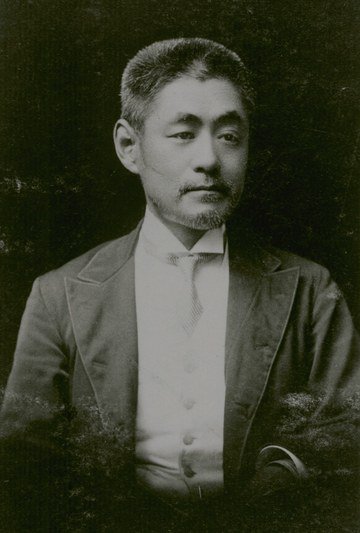
Inoue Enryō, photographed between 1903 and 1905. Public domain, via Wikimedia Commons.
Four Kinds of Monster
His system is a sorting machine, and it is set out in the same terms in a book of 1904 and again in his last book of 1919.
A false wonder is one that people have made deliberately, for some purpose of their own. A mistaken wonder is something that is not a wonder at all, taken by accident for one. Those two together he calls the empty wonders.
A provisional wonder is real, in the sense that something is actually happening, but it happens by the ordinary workings of heaven and earth and can be accounted for by physics or by psychology. And beyond it he places the true wonder: what the order of heaven and earth cannot explain. The provisional and the true together are the real wonders; everything else is empty.
It is a good scheme, and it does the work of demolition quietly. Almost every reported strangeness can be assigned to one of the first three bins on inspection, and the assignment is the explanation.
What He Kept, and Why It Was Safe
The true wonder is the reserved category, and it is usually cited as evidence of his open-mindedness. It is worth reading what he actually says about it.
The true wonder, he writes, is not what ordinary people call a yōkai. It is something that academic inquiry alone reveals to be a wonder at all — which means that the protected category was defined, at the outset, so as to contain nothing that anyone actually believed in. Ghosts, fox possession, curses and the rest go into the empty and provisional bins by definition.
And he never filled the reserved one. His final book is laid out as questions sent in by readers with his answers beneath them, and candidate after candidate — fireballs, spirit photographs — is dismissed with the same formula: still far from the true wonder. The category stayed open and stayed empty.
What He Wanted Gone
The two elegant sentences at the top of this note can make him sound like a disinterested investigator. He was not, and he did not pretend to be.
His book on superstition of 1904 says in its own preface what it is for. It was written to expand on the lessons about superstition in the state’s elementary school morals textbooks — the ones issued by the Ministry of Education, taught to every child in the country. The programme was an arm of a national curriculum, and he said so on the first page.
The targets are specific. He attacks healing by prayer and incantation in place of medicine, which he calls extremely foolish. He attacks the practitioners who handle fox possession, and the mountain ascetics among them. He attacks charms, sacred water and protective slips, and divination and the drawing of lots. He tells the story of a medium in Kyoto who pretended to identify a thief, and explains the trick with the cord.
These were not abstractions. They were trades. They were what a village did when someone was sick and there was no doctor, or when something had been stolen and there was no constable. A man with a national platform and a state curriculum behind him was telling the country that its local practitioners were frauds or fools, and in a good many individual cases he was right, which is not the same as the campaign being harmless.
Whether officials used his arguments in actual enforcement against these practices is a further question, and I have not been able to establish an answer to it. I am not going to assert one.
The Part He Did Not Intend
Our note on inherited familiars makes a point that applies to him more than to anyone: some of the best records of a belief survive because people who wanted it gone wrote it down.
To dismiss a belief, Enryō had to state it exactly. He was a careful man, so he stated it exactly — quoting the older books by name, giving the reported details in full, setting out the local variations before dissolving them. The kappa section quotes a discussion book of 1686 on whether the creature is an aged otter. The tengu passage preserves an argument between scholars that is otherwise easy to miss.
The method has outlived the purpose, and a great deal of what he assembled in order to destroy is now read as evidence for the thing he was destroying.
The Comparison, and Its Limits
He is habitually set against Yanagita Kunio: the one writing to abolish, the other to preserve, with a book devoted to the pair of them.
The contrast is real and it is too tidy. Enryō left a category open, even if he never filled it. Yanagita had a programme of his own, and our note on Tōno shows what his promise of exact transcription was worth. Neither man was simply collecting.
Why He Is Useful Here
He is useful to this site because of how he argued, not because of what he wanted. He would have read these pages as a relapse.
We quote him anyway, and the reason is in the sentence he used to close the kappa. He told his readers that his explanation was a guess and that they should wait for someone who knew more. That is the part of him we have actually inherited, and it is not the part he was trying to leave behind.
Sources
- Inoue Enryō 井上円了 (1858–1919). Commons · Wikipedia
- Yōkaigaku kōgi 妖怪学講義, lectures issued through the Tetsugakukan, 1894–1896; eight parts, including the sections on possession quoted in our note on the tengu.
- Meishinkai 迷信解, 1904; the preface stating its purpose, and the sections on healing by incantation, on fox possession, on charms and sacred water, and on divination.
- Shinkai 真怪, 1919; set out as questions and answers, and the source of the four categories in their final form.
- Yōkaigaku 妖怪学; the section on the kappa.
Further Reading
- Miura Setsuo 三浦節夫, Inoue Enryō to Yanagita Kunio no yōkaigaku, 2019
The readings in “What He Kept, and Why It Was Safe” and “Why He Is Useful Here” are KWAIDANOTE’s own.
Found an error? Write to kwaidanote@gmail.com — corrections are made on this page and dated.