Konjaku, the Unfinished Book
A Book Named After Its Own First Two Words
Every tale in the Konjaku monogatarishū opens the same way: ima wa mukashi, now it is long ago. Every tale closes the same way too, with a formula meaning roughly that this is how it has been told and handed down.
The collection has no other title. It is called Konjaku after the two characters that begin each of its thousand-odd stories, which is to say that the most-quoted narrative source in premodern Japanese literature is named after a throat-clearing.
This site quotes it constantly. It stands behind our notes on foxes, on oni and mountain hags, on the Hannya mask, on Seimei’s rivalry, on what a yōkai is, on the tengu, and it is the single most cited work in our note on ghosts. It seems worth setting down what the book actually is.
The Shape of It
There are thirty-one volumes, arranged in three parts by country: India in the first five, China in the next five, and Japan in the remaining twenty-one. The Japanese part is itself divided, ten volumes of Buddhist material followed by eleven of secular.
Three of the thirty-one volumes do not survive: the eighth, the eighteenth and the twenty-first. Within the rest there are something between about 1,040 and 1,060 tales, depending on how one counts the ones that are not really there.
That last clause is the interesting part.
The Blanks
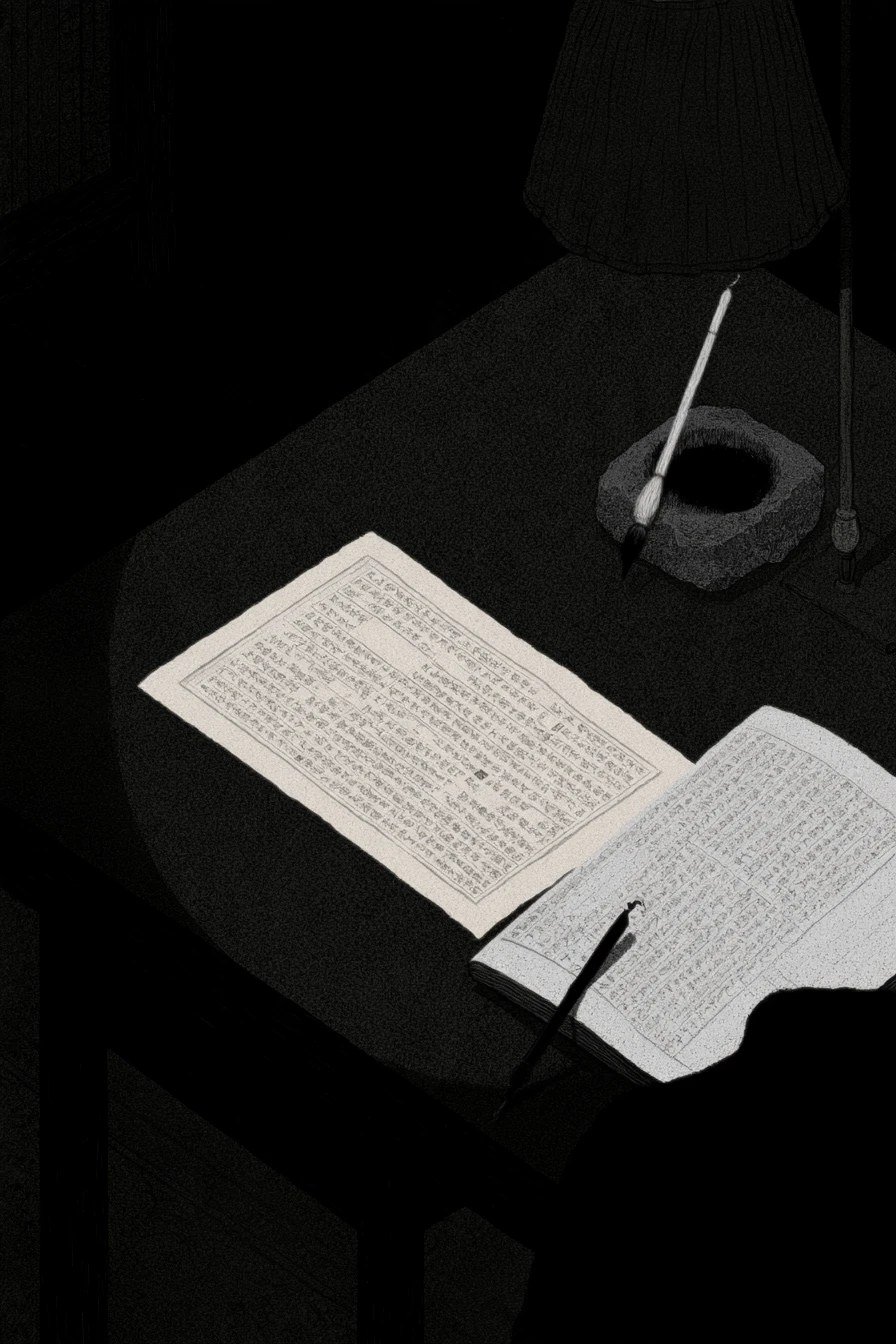
The Konjaku monogatarishū was never finished, and it is unfinished in a way you can see on the page.
Some tales exist only as titles. The heading is written, the number is assigned, and beneath it there is nothing. One of them, in the volume of warrior tales, is the entry for the Later Three Years’ War — the title is there, the story is not, while the entry for the earlier campaign a few tales before it is complete.
Other tales have their text but not their nouns. The compiler left blank squares where names were supposed to go. The tale that Akutagawa Ryūnosuke later rewrote as “Yam Gruel” begins by saying that in the province of Echizen there was a man of such-and-such a family called Arihito — except that the family name is not given, because the space for it is empty. The same thing happens over and over: a district in Hitachi with no name, a governor of Tajima with a gap where his surname belongs, a provincial official identified only by his office.
The book’s own method is visible in those gaps. Whoever was assembling it wrote out the frame of a tale, left holes for the particulars, and intended to go and find them. Then he stopped.
There is even a tale of the numbering going wrong: one volume has no twenty-first story and two stories numbered twenty-nine.
Nobody Knows Who Made It
The compiler is unknown. The name usually offered is Minamoto no Takakuni, on the strength of a remark in the preface to a later collection, but the attribution does not survive contact with the book: it contains events that happened after Takakuni died. There is no consensus, in Japanese or English scholarship, and the honest answer is that we do not know.
The date is firmer at one end than the other. The collection includes material that puts its compilation after the 1120s, and it is generally placed in the first half of the twelfth century.
It is written in a mixture of Chinese characters and katakana, which was then the script of notes, commentaries and working documents rather than of literature. The great prose of the period — the Tale of Genji, the court diaries — is in hiragana. This book is written in the handwriting of administration, and it reads that way: flat, quick, unliterary, the same voice for a miracle and a robbery.
The closing formula does something similar. Every tale ends by saying that this is how it has been told and handed down, which places the whole collection at one remove from its own contents. The compiler is not a witness to any of it. He is the man writing it down, and he says so a thousand times.
What Survives, and Where
The oldest manuscript is the Suzuka copy, held by Kyoto University, written in the middle of the Kamakura period and designated a national treasure in 1996.
It contains nine of the thirty-one volumes. The standard modern editions are therefore built out of several manuscript lines at once, the Suzuka text where it exists and other copies where it does not.
It Is Not a Book of Ghost Stories
Because of what we quote it for, it would be easy to leave the impression that Konjaku is a collection of the supernatural. It is not.
It has thieves and strongmen. It has a volume of comic tales, including a man laid low by mushrooms and a priest with a nose so long it had to be held up at meals. It has love affairs, animal stories, accounts of poverty, and a good deal of straightforward Buddhist instruction. Akutagawa took four of his best-known stories out of it, and only one of them is strange in the way we usually mean.
The supernatural material is there in quantity, but it sits in the same volumes as everything else, told in the same flat voice and closed with the same formula. That is part of why the book is useful to us. It does not mark the uncanny off as a special category.
Why We Cite It by Volume and Number
Every reference on this site of the form Konjaku, book twenty, tale two, points into the structure described above: a text of which three volumes are lost, whose oldest manuscript preserves nine, and whose compiler left gaps for names he meant to fill.
Citing it that precisely is not fussiness. It is the only honest way to use a book that is, in its surviving state, a very large set of notes toward a book that was never made.
Sources
- Konjaku monogatarishū 今昔物語集, anonymous compilation, first half of the 12th century; thirty-one volumes, of which books eight, eighteen and twenty-one are lost. Commons · Wikipedia
- The Suzuka manuscript 鈴鹿本, Kyoto University; mid-Kamakura period, designated a national treasure in 1996. Commons
- Tales referred to: book twenty-six, tale seventeen (the yam gruel); book twenty-nine, tale eighteen (the Rashōmon); book twenty-eight, tale twenty (the nose); book twenty-five, tale fourteen (title only, no text).
Further Reading
- Marian Ury, translator, Tales of Times Now Past: Sixty-Two Stories from a Medieval Japanese Collection, 1979
The reading in “Why We Cite It by Volume and Number” is KWAIDANOTE’s own.
Found an error? Write to kwaidanote@gmail.com — corrections are made on this page and dated.