Tōno, and the Promise Not to Change a Word
Three Hundred and Fifty Copies
Tōno monogatari was published on 14 June 1910. There was no publisher. Yanagita Kunio paid for the printing himself, 350 copies, and had the first sent to the man who had given him the stories and kept the second for himself. He bought two hundred more and gave them away.
It contains 119 numbered items, most of them very short, from the district of Tōno in Iwate: a woman taken by a mountain man, a house where a child-spirit is seen, a man who meets his drowned wife on the shore after the tsunami of 1896. The book is now treated as the beginning of folklore studies in Japan.
Yanagita was thirty-four. He was a career civil servant out of the agriculture ministry, serving that June as a records section chief in the cabinet secretariat, and he was writing in his own time.
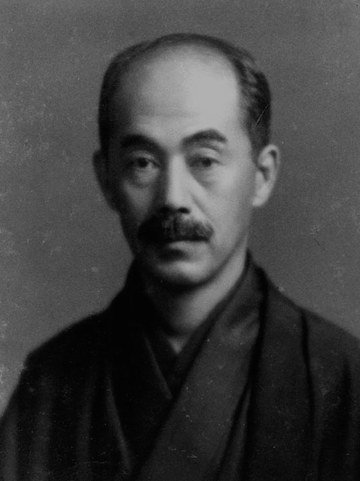
Yanagita Kunio, photographed around 1940. The title page of the book carries his name alone; the man who supplied the contents is in the preface, under a pen name. Public domain, via Wikimedia Commons.
The Sentence
The preface makes a promise that has been quoted ever since, and it is worth reading in full rather than in the usual half.
He writes that he has set the stories down without adding or subtracting a single character or phrase, just as he felt them.
Both claims are in that one sentence. Nothing was altered; and it was written as he felt it. The second clause takes back the first, and nothing in the preface suggests he noticed.
What the Drafts Say
The manuscripts survive, which means the promise can be tested rather than argued about.
An earlier brush-written draft contains 107 items. The fair copy contains 119. And in at least one case the difference is not only a matter of addition: in the second item, on the origin of the three mountains around Tōno, the finished text contains a dream in which each of three daughters is assigned a peak, and that dream is not in the draft. The passage is attributed to Yanagita’s own hand.
That is one documented instance, and I am not going to build a general theory on it. But the claim in the preface is absolute, and one instance is enough to show that it is not true as written.
There is a plainer point as well. The book is written in literary Japanese, in the grammar of formal composition — tari, nari, seshimeyo — and not in anything anyone in Tōno said aloud. Whatever “not one word altered” meant, it cannot have meant the words.
The Man Who Told Them
The preface names him, and does not hide him. It says the stories were told by Sasaki Kyōseki — a pen name — and describes him in a phrase that has followed him ever since: not a skilled talker, but a sincere man. From about February 1909 he came by in the evenings, now and then, and told the stories, and Yanagita wrote them down.
Sasaki Kizen was born in Tōno in 1886 and had come to Tokyo to study at Waseda. He was twenty-three when the evenings began. He went on to become a collector in his own right, publishing several volumes of tales from the northeast, and he described himself in them as a gatherer of material rather than a scholar. What he did with his own books is a note of its own: Sasaki Kizen Wrote Down the Names.
Whether he was given his due is a live argument in Japanese scholarship, with at least one book-length study revisiting the relationship. This note takes no position on it, beyond observing that the preface gives him a pen name and a character reference, and the title page gives Yanagita’s name alone.
The Line After the Famous Line
The most quoted sentence in the preface is a command: tell these stories, and make the people of the flatlands shudder.
The sentence immediately after it is not quoted at all, and it changes the tone completely. A book like this, he writes, is only Chen Sheng and Wu Guang.
Those two were the leaders of the first rising against the Qin — the men who go first, fail, and are remembered for having gone first. Just before, he has said that there must be hundreds more such stories in Tōno alone, and in villages further into the mountains a countless number of traditions of mountain gods and mountain people.
He was not claiming to have done the work. He was claiming to have started something that would leave him behind.
What the Form Did
It did not leave him behind. In 1935, on his sixtieth birthday, the people who had come to his lectures formed a society around him; by 1949 it was the Folklore Society of Japan and he was its first president. The same year, 1935, a supplement added 299 further items to Tōno monogatari, most of them sent in writing rather than told in a room.
Tōno itself now advertises as the home of the folktale, and the book is the reason.
There is a question here that this site has met before. Our note on the snow woman shows a story leaving a book in 1904 and being collected back out of the villages as local tradition in the 1930s. Whether the same traffic ran through Tōno is not something I can document, and I am not going to assume it. What can be documented is that a town’s account of itself is now built on a book, and that the book was made in a room in Tokyo by a man writing down what a visitor said, in a grammar the visitor did not use.
Why We Quote It Anyway
Our notes on possession and on the house that gets named use Yanagita’s later essays rather than this book, and use them as evidence of what people said and did, not as a transcript.
That is the right way to read Tōno monogatari too. It is a real record of a real transmission, made by an honest man who described his own procedure inaccurately in the first three pages. Both halves of that are worth keeping.
Sources
- Tōno monogatari 遠野物語, by Yanagita Kunio 柳田國男, privately printed 14 June 1910; 119 items, with the preface. Commons · Wikipedia
- The supplement of 1935, adding 299 items.
- Sasaki Kizen 佐々木喜善 (1886–1933), named in the preface under the pen name Kyōseki 鏡石. Wikipedia
- On the draft manuscripts and the added passage in the second item, Japanese scholarship on the composition of the text.
Further Reading
- Ronald A. Morse, translator, The Legends of Tono, 1975; centenary edition 2008
- Ronald A. Morse, translator, Folk Legends from Tono: Japan’s Spirits, Deities, and Phantastic Creatures, 2015
The reading in “Why We Quote It Anyway” is KWAIDANOTE’s own.
Found an error? Write to kwaidanote@gmail.com — corrections are made on this page and dated.