Sasaki Kizen Wrote Down the Names
The Man in Somebody Else’s Preface
The preface to Tōno monogatari of 1910 introduces the person who supplied its contents as Sasaki Kyōseki, which was a pen name, and describes him in a phrase that has followed him ever since: not a skilled talker, but a sincere man. Our note on that book, Tōno, and the Promise Not to Change a Word, looks at the promise Yanagita made about how he handled what he was given.
This one is about the man who gave it. He was twenty-three at the time, from Tsuchibuchi in Tōno, in Tokyo to become a writer.
What He Did Afterwards
He did not remain a source. He went home and spent the rest of his life collecting, and the books came out under his own name: tales of Esashi district in 1922, of Shiwa district in 1926, a volume of strange traditions of the northeast in the same year, a volume of an old woman’s night tales in 1927, and in 1931 the large collection that is usually called his major work.
He had not been a rustic informant who happened to know stories. He had gone to Tokyo to write fiction, had failed at it, and turned to collecting afterwards — which makes what he did with his own books a decision rather than a habit.
He Printed Their Names
Open his 1926 volume of strange traditions and the difference from the book he had fed sixteen years earlier is immediate.
His narrators are named. A man of a village in Esashi district. A woman, with the day in October 1925 on which he heard it from her. Another man, with a day in May 1922. Names and, often, dates, set down beside the tales they produced.
A man who had himself been credited under a pen name printed the real names of the people who talked to him. Nothing obliged him to. The convention of the field, then and for a long time afterwards, was the one he had been on the receiving end of.
Except One
There is an exception in the same book, and it is the largest one possible.
The person who gave him the most — something like a hundred and seventy tales, far more than anyone else in the volume — appears throughout as the old woman, and nothing else. He is candid about how he got them. From the winter of two years before, he writes, he came to know an old woman of the village; he went to her through the deep snow, and on nights of blizzard, and what he heard from her came to about a hundred and seventy tales.
Her name is generally supplied now from his next book. In the book where her tales are printed, she does not have one.
I do not think that makes him a hypocrite, and I am not going to turn it into a verdict on him. It shows something harder and more useful: that he had the practice, understood exactly why it mattered, and still did not apply it to the person it mattered most for.
“Merely a Collector”
He also left a description of himself, and he repeats it three times in that one book: he is merely a gatherer of materials and not a scholar, and the serious textual work he would like to hear from those who know.
It is worth putting that beside another sentence this site has quoted. Inoue Enryō, who spent his career explaining yōkai away and would have had nothing in common with a man collecting them in Iwate, closed his account of the kappa by saying that his explanation was only his own conjecture and that he must wait for the judgement of those who knew better.
Two men who could not have agreed about anything, using the same formula about the limits of what they had done. It seems to have been what a careful person said in Japanese in those decades, and it is a better habit than most of what replaced it.
The Argument About Credit
There is a long-running argument in Japanese scholarship about how the work on Tōno monogatari should be divided, reopened by a book of 1983 and still going. This note does not take a side, and the better English scholarship on Sasaki says plainly that its object is not to diminish Yanagita’s achievement.
It is worth keeping the preface of 1910 in view while the argument goes on. It does say where the contents came from, and it says it in the first paragraph. What it does not do is put the name of the man who brought them on the cover, or use the name his family used.
How It Ended
The last years were not good. He served as head of his village and it ended badly; there were debts; he sold up and moved to Sendai, and he died there in September 1933, ill and short of money, at forty-six.
The photograph of him that circulates — the only one most people have seen — was published in a literary album devoted to Miyazawa Kenji. The two knew each other: Sasaki wrote to him in 1928 about one of his stories, and visited him in 1932 when Kenji was ill. Even his portrait survives inside a book about somebody else.
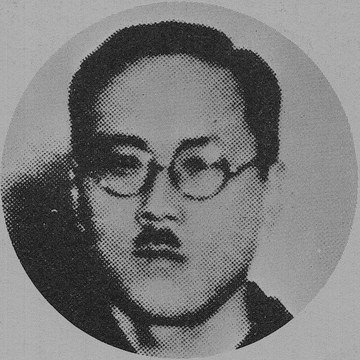
Sasaki Kizen, photographed before 1933. The copy that circulates is the one printed in that album, in 1974. Public domain, via Wikimedia Commons.
What His Career Actually Shows
One reading of Sasaki is that he was robbed, and the argument about that will continue without us.
The more useful reading is that the problem is structural rather than personal. Every record of this kind has a person at each end of it, and only one of them gets the cover. Sasaki knew that from the inside, better than anyone in the field, and when he got the chance to fix it he fixed it — for four or five named people, and not for the woman who came through the snow with a hundred and seventy stories.
That is not a failure of character. It is how hard it is.
Sources
- Tōno monogatari 遠野物語, by Yanagita Kunio 柳田國男, 1910; the preface, naming Sasaki Kyōseki 佐々木鏡石.
- Tōō ibun 東奥異聞, by Sasaki Kizen 佐々木喜善, 1926; the named narrators with their dates, the account of the old woman, and the passages in which he describes himself as a collector and not a scholar.
- Rōō yatan 老媼夜譚, 1927; and Kikimimi zōshi 聴耳草紙, 1931.
- Sasaki Kizen (1886–1933). Wikipedia · Commons
Further Reading
- Christopher A. Robins, “Narrating Tōno: Yanagita Kunio, Sasaki Kizen and Inoue Hisashi,” in Yanagita Kunio and Japanese Folklore Studies in the 21st Century, second revised edition, 2021
- Ronald A. Morse, translator, The Legends of Tono, 1975
The reading in “What His Career Actually Shows” is KWAIDANOTE’s own.
Found an error? Write to kwaidanote@gmail.com — corrections are made on this page and dated.