Its Cry Resembled a Nue
The Thing Over the Roof
In the fourth book of the Heike monogatari the young emperor is taken ill every night at the same hour. A black cloud settles over the roof of the palace, and whatever is in it is the cause.
Minamoto no Yorimasa is sent for. He waits, he shoots into the cloud, and something falls. The text describes it: the head of a monkey, the body of a tanuki, the tail of a snake, the limbs of a tiger.
Every illustration of this story since has drawn that body. What almost no account in English carries is the clause that comes immediately after it.
The Sentence Is a Comparison
The text says that its cry resembled a nue.
That is not a name being given. It is a comparison, made for an audience who would know what was meant, and the thing being compared to is not a monster at all.
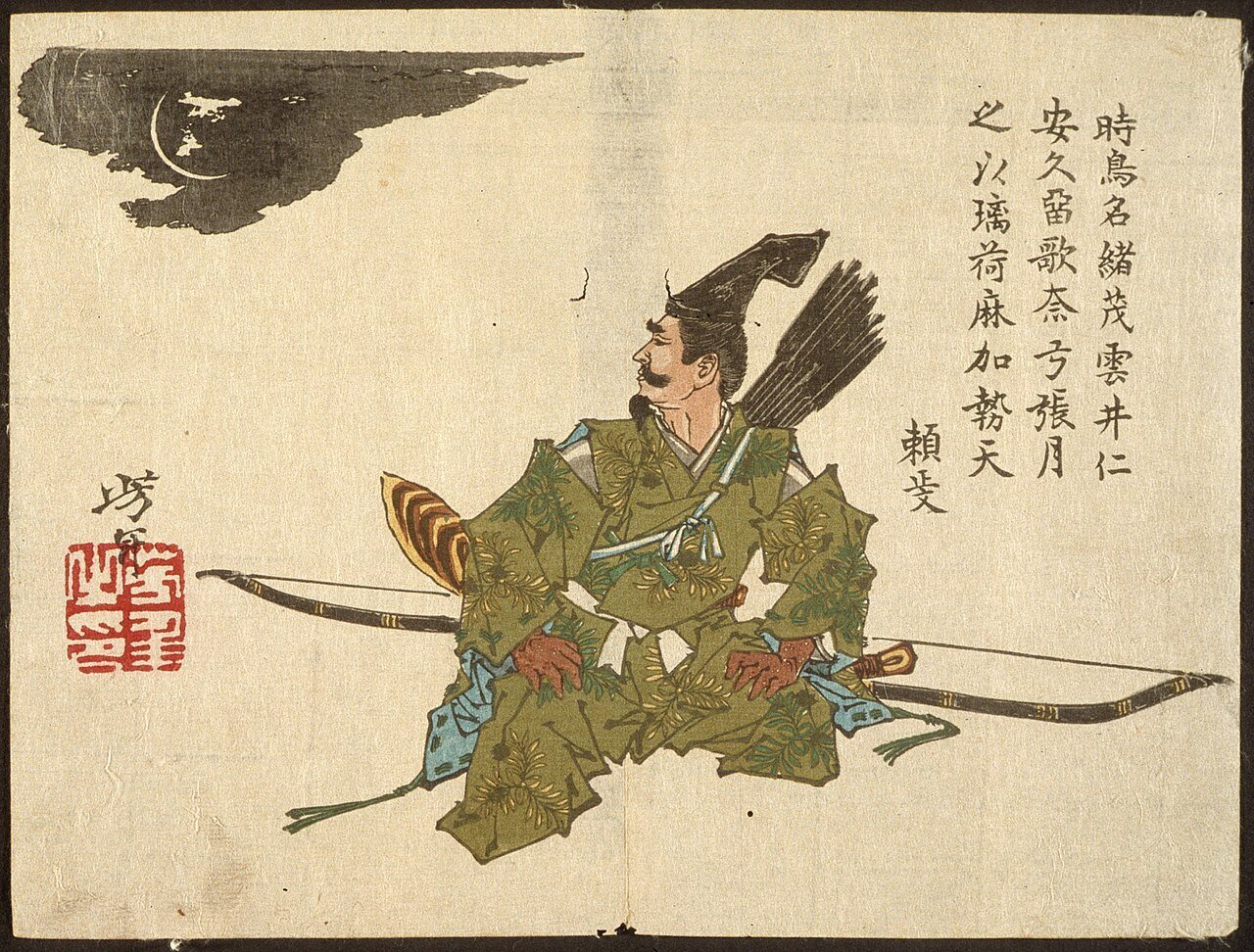
Tsukioka Yoshitoshi, 1882: Yorimasa waiting. Public domain, via Wikimedia Commons.
A Nue Is a Bird
The word belongs to a real and quite common Japanese bird, toratsugumi, White’s thrush. It calls at night — a thin, drawn-out, descending whistle, repeated at intervals, from somewhere in the dark that is difficult to locate.
The word is old. The standard historical dictionary’s earliest citation is not a monster story but the Kojiki of 712, in a song: in the green mountains the nue has cried. The Man’yōshū uses nuedori, the nue-bird, six times, and in every case as a fixed epithet introducing weeping, or longing that is not returned.
For four centuries before anything fell off the palace roof, this word meant a sound, and the sound meant grief.
So the clause in the Heike is doing something quite precise. It is not telling the reader what species the creature was. It is telling the reader that the noise coming out of the cloud was the noise of a bird every listener had heard and already associated with misery.
It is worth being specific about what the poets had done with it, because the association was not vague. In the Man’yōshū the nue-bird is a fixed epithet, one of the set phrases that introduces a particular kind of line, and what it introduces is weeping that is kept inside, or love that is not returned. It does not attach to fear, or to death, or to the supernatural. The bird meant private, unanswered grief — the sound of somebody crying where nobody can hear them, which is what a thin call from somewhere unlocatable in the dark actually sounds like.
A writer reaching for that word over a sick emperor’s roof is not reaching for a monster. He is reaching for the most desolate noise in the available vocabulary.
Then the Text Changes Its Mind
Here the honest account has to double back, because the same book does not stay consistent.
Later in the fourth book, where the story is taken up again, the creature is referred to as the monstrous bird called nue. The comparison has hardened into a name, inside a single work, within a few pages.
That migration is the thing worth having. The usual English telling begins at the second stage — the nue is a chimera with a monkey’s head — and never mentions the first. What the text shows is a name arriving by the shortest possible route: something made a noise, a writer said what the noise was like, and the word for the likeness became the word for the thing.
What Was Actually Shot
It is worth looking again at the body, now that the name is out of the way.
A monkey, a tanuki, a snake, a tiger. Only the last of the four is an animal a Japanese reader of the period would not have seen; the others are the ordinary fauna of a hillside behind a village. The composite is not exotic. It is a heap of familiar animals in the wrong arrangement, which is a different and older kind of wrongness.
And the description comes after the arrow. The reader is not shown a creature; the reader is shown what was lying on the ground when the retainers brought a light. It is a description of a body, given by people looking down at it.
Read it aloud and the form gives it away. Head, body, tail, limbs: four clauses, each naming one part and one animal, in the order you would work through a carcass. It is not a portrait and it does not try to be one. Nobody in the story ever sees this thing move, and the text never attempts the harder job of saying what it looked like alive.
That is the ordinary shape of testimony about something found dead in the dark, and it is a good deal more convincing than a description would have been.
Why the Comparison Was Available
None of this requires the Heike’s author to have invented anything.
A bird that calls in the dark, whose call is easy to hear and hard to place, whose name was already a byword in poetry for crying — that is a ready-made way of saying that something in the night sounded wretched. The author reached for it, as anybody would have.
What he could not have predicted is that the borrowed word would outlive the bird’s claim on it, so thoroughly that today the thrush is the thing that needs explaining.
The Part That Can Still Be Checked
One reading of the nue is that it is Japan’s chimera, a monster assembled from pieces, and that the interesting question is where each piece came from.
The record suggests a plainer and better question. The monster was never given a name. It was given a comparison, and the comparison was to a bird that is still there.
White’s thrush still calls over Japanese hillsides at night. The sound is on record and anybody can hear it. Of everything in this story — the cloud, the illness, the arrow, the body of four animals — the only element that can still be verified by going outside and listening is the one the story is named after.
It is worth doing, because the call explains the rest without any help. It is thin, it comes at long intervals, it does not repeat in a pattern, and it is genuinely difficult to place: a listener cannot tell whether it is near and small or far and large. A sound like that over a roof, on several nights, in a household where somebody is ill, does not need a monster to become one.
If I had to keep one sentence out of the whole episode it would not be the list of four animals. It would be the clause that says only what the thing sounded like, and compares it to something a reader could go and hear — which is the one sentence in the passage written by a man being careful.
Sources
- Heike monogatari 平家物語, book four, the section on the nue; the description of the body and the clause comparing the cry. Commons
- Kojiki 古事記, 712; the song containing the earliest citation of nue given in the standard historical dictionary of Japanese.
- Man’yōshū 万葉集; six occurrences of nuedori as a fixed epithet.
- On nue as the alternative name of toratsugumi, White’s thrush: the standard historical dictionary of Japanese.
Further Reading
- Michael Dylan Foster, The Book of Yōkai: Mysterious Creatures of Japanese Folklore, 2015
The reading in “The Part That Can Still Be Checked” is KWAIDANOTE’s own.
Found an error? Write to kwaidanote@gmail.com — corrections are made on this page and dated.