The Ubume's Child Was Leaves
A Voice at the Water
The ubume is the woman who died in childbirth and comes back holding an infant. She asks a passer-by to take the child. In the version now told everywhere, the child grows heavier and heavier in the arms until the person holding it can no longer stand.
The oldest telling in Japanese is in the Konjaku monogatarishū, in the twenty-seventh book. Our note on that collection sets out its shape; what matters here is that the twenty-seventh book is where it files the strange events of secular life — the things that happen to people who are not monks, told without a moral at the end.
It is the forty-third tale, and it is worth noticing what the title of it is about.
The title is about the man. It names him as Taira no Suetake, one of the retainers of Minamoto no Raikō — the same household our notes on Shuten-dōji and on the severed arm at the Rashōmon deal with. Whoever catalogued this tale filed it under whose man he was.
What the Tale Contains
He is crossing water at night. There is a woman’s voice, and the sound of an infant crying, and she says: hold this, hold this.
He takes it. She comes after him, asking for it back. He keeps going, reaches the house, and opens his sleeve.
There are a few leaves in it.
That is the end. No transformation, no pursuit to a conclusion, no explanation offered by anybody in the story.
What the Tale Does Not Contain
The weight is not there.
Not lightly implied, not present in a different form — absent. The single detail that carries the modern version of this creature, the child that becomes impossible to hold, does not appear in the oldest Japanese telling of it. The tale was searched for it and it is not in the text.
What is there instead is substitution. The horror is not that the burden increases. It is that there was never a child: a man carried something carefully across a river in the dark, and got home, and found he had been holding leaves.
Why Leaves
The detail is not arbitrary, and a Japanese reader of the twelfth century would not have needed it explained.
Leaves are what is left when a fox has paid you. It is the standard closing move of an entire class of Japanese tale: the money is counted, the goods are handed over, the seller gets home and opens his hand, and there is foliage in it. Our notes on the fox and on the tanuki deal with the animals that do this for a living.
So the tale ends on the most familiar token of being taken in that the language has. Not a ghost proving itself, not a warning, not a debt — the ordinary sign that a transaction was never a transaction. Whatever the thing at the ford was, the story files the encounter under fraud rather than under haunting.
That is not the sort of thing that survives translation into a creature entry, which is one reason it has dropped out.
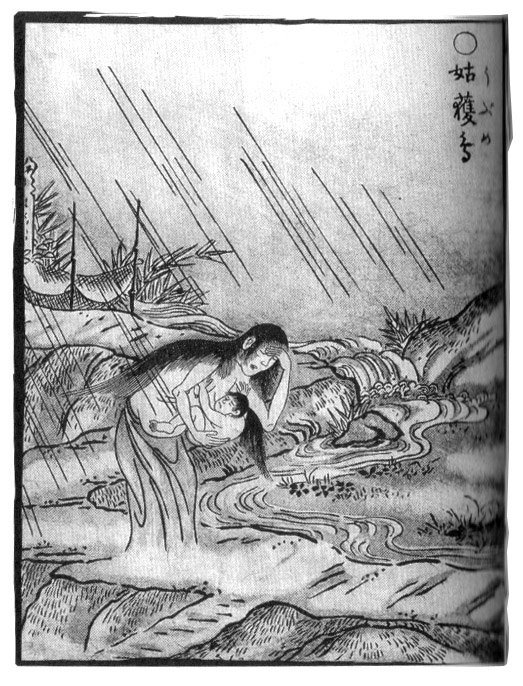
Toriyama Sekien, about 1781, drawing her under the characters borrowed from the Chinese bird. Public domain, via Wikimedia Commons.
The Chinese Bird
The writing now standard for ubume, 姑獲鳥, is not Japanese. Those characters name a bird in Chinese sources — a compendium of the fourth century, and the great sixteenth-century pharmacopoeia — a bird said to take children.
The joining of that Chinese bird to the Japanese ubume happens in the Edo period, and the illustrated encyclopaedia of 1712 shows it happening on the page. Its entry stands in the volume of mountain birds, under the Chinese characters, with the Japanese reading ubume-dori attached and a string of alternative names beside it. The first half of the entry is a block quotation from the great sixteenth-century pharmacopoeia, named as such: a spirit-class creature that collects human souls, wears feathers to be a bird and takes them off to be a woman, and is what a woman becomes after dying in childbirth.
And then the compiler disagrees with it. In his own comment, marked off from the quotation, he writes that the identification with women dead in childbirth is a forced correlation — a thing fitted together after the fact. He suggests instead that the creature may be an actual bird, reported both in China and in the western seas of Japan, and he ends by saying that in his own home provinces he has heard of nothing of the kind apart from the tricks of foxes and badgers.
So the encyclopaedia that is credited with bringing the Chinese bird into Japanese reading carries it across and doubts it in the same entry. The identification is older than the book in any case: a commentary of 1680 already treats it as settled, and one modern historian of Edo strangeness attributes the equation to a Confucian scholar who died in 1657. That last attribution is reported here at second hand and has not been checked against his own writing.
What can be dated is the definition. A Japanese book of 1729 written to refute popular errors states it flatly: a woman who dies having borne a child turns into a kokakuchō — the Chinese bird. The same discussion carries the Chinese description behind it, in which the creature wears its feathers to be a bird and takes them off to be a woman.
The standard modern definition of the ubume does not come from a tale. It comes from sentences in books of reference and refutation. And it is older than 1729: a dialogue book of 1686 already states that the creature is what a woman becomes after dying in childbirth, and the scholarship traces the equation back further still, to a Confucian writer of the mid-seventeenth century. What the 1729 book shows is the definition settled enough to be stated flatly in a work written to correct popular error. By then the Japanese woman at the ford and the Chinese feathered bird are one entry, and the entry carries a cause of death that the twelfth-century tale never mentioned.
The creature acquires a bird’s name, a bird’s plumage and a bird’s habits some six centuries after the tale of the leaves, and from another country. Our note on the nue sets out a different case of a Japanese creature being named after a bird, by a different route.
Where the Weight Came From
The honest answer is that this note does not know.
The usual candidate is a collection of strange tales of 1687, in which a child handed over grows heavier and heavier and then turns into a stone pagoda, or leaves, or a small Jizō figure. That summary is all this note has; the 1687 text was not read, and a motif is not going to be dated here from somebody else’s précis.
What can be added is a negative from 1712, and it is a sharp one. The encyclopaedia’s own comment relays what people in Kyushu said: the creature takes the form of a woman carrying a child, and when it meets someone on the road it asks them to carry it. Refuse and flee, and you may sicken with chills and fever; agree and carry it, and no harm comes. And as the carrier nears a house, the text says, his back becomes light, and there is nothing there.
That is the opposite of the famous detail. In the oldest Japanese encyclopaedia entry on this creature, the burden does not grow — it goes. Twelfth century: leaves in the sleeve. Eighteenth century: the weight lifting off the back near the house. The thing that becomes unbearable is later than both.
One thing in the summary is worth flagging for whoever does the work. The leaves are in both. In the twelfth-century tale the thing in the sleeve is leaves and that is the ending; in the seventeenth-century candidate, leaves are one of the things the weight turns into. If that holds up, the leaf is the older element and the weight was added around it.
What the Story Is Actually About
One reading of the ubume is that she is the archetype of maternal grief in Japanese folklore — a mother who cannot put down her child, asking strangers for the help nobody gave her.
That reading fits the modern version well and the oldest one badly. The oldest one is filed under a warrior’s name, in a household famous for men who went out at night to see whether things were true. Nobody in it pities the woman. Nobody asks who she was. She is the apparatus; the subject is a man who was handed something at a ford and did not drop it, and who came home and opened his sleeve and looked.
Everything that has since made her a figure of sorrow — the weight, the plea, the reward for kindness — arrives later, and some of it arrives from China.
None of which makes the later version false or the earlier one better. A figure that began as an obstacle in a courage story and became a mother asking for help has gained something in the transaction, and the gain is the reason anyone still tells it.
But the two are not the same creature wearing different clothes, and treating them as one flattens the only thing this material is good for. In the twelfth century the question was what a man would do at a ford in the dark. By the modern version the question is what she wants. That is a change in who the story is about, and it happened somewhere between the leaves and the weight, in texts that can in principle be found, by somebody willing to read the seventeenth century rather than summarise it.
Sources
- Konjaku monogatarishū 今昔物語集, 12th century; book twenty-seven, tale forty-three, “How Taira no Suetake, a retainer of Raikō, met an ubume.” Wikipedia
- Imon zokusetsu ben 醫門俗說辨, 1729; the statement that a woman who dies having borne a child becomes a kokakuchō, with the Chinese description of the bird that wears feathers to fly and removes them to be a woman. Read here in the quotation given by a twentieth-century research bulletin, not in the 1729 text itself.
- Wakan sansai zue 和漢三才図会, compiled by Terashima Ryōan 寺島良安, 1712; book forty-four, the mountain birds, the entry 姑獲鳥 read ubume-dori. The block quotation from the sixteenth-century pharmacopoeia, the compiler’s own objection that the childbirth identification is a forced correlation, and the Kyushu account in which the carried child becomes weightless near a house are all in that entry, read here in a transcription of the original. The attribution of the identification to a Confucian scholar who died in 1657 is from modern scholarship and has not been checked against his own writing; a commentary of 1680 already treats the identification as established.
- A collection of strange tales of 1687 is the usual candidate for the earliest appearance of the increasing weight; not read for this note, and not relied on.
Further Reading
- Michael Dylan Foster, The Book of Yōkai: Mysterious Creatures of Japanese Folklore, 2015
The reading in “What the Story Is Actually About” is KWAIDANOTE’s own.
Found an error? Write to kwaidanote@gmail.com — corrections are made on this page and dated.