The Name on the House
A fox, prayed out of a sick person and into a second body hired to receive it, stopped the rite to say that it held no grudge against anyone, that it had only been passing through, and that its children were hungry. It asked for rice cake. The account stands in the Uji shūi monogatari, an early thirteenth-century collection, and it gives no date, no place, and no name for anyone in the room [1]. It is one of thirty records gathered in TSUKIMONO: Tales of Possession and the Things That Cling, and nearly everything in it is the opposite of the other kind of attachment the book is about.
The Japanese word tsukimono means the thing that attaches. The book makes a point of the grammar: the word names the attachment, not the person it is on. Japanese records set the event down for more than a thousand years without agreeing on what it was, and it keeps apart two events that the sources themselves keep apart. In one, a thing enters a body and speaks out of its mouth. In the other, a thing settles on a person, a family, or a house, and stays.
The thing that arrives
The rite in the Uji shūi did not drive the spirit into the air. It moved it sideways, into a medium seated beside the sufferer, the “possession-seat,” where it could be questioned. Whatever came across could be argued with, and in this case it argued back: no grievance, only passing, hungry children, and a request for shitogi, a rice cake. The medium was known to be fond of shitogi herself, and those present suspected the whole performance had been got up by her [1]. The book’s comment is that the tellers of these tales did not always find the mechanism solemn.
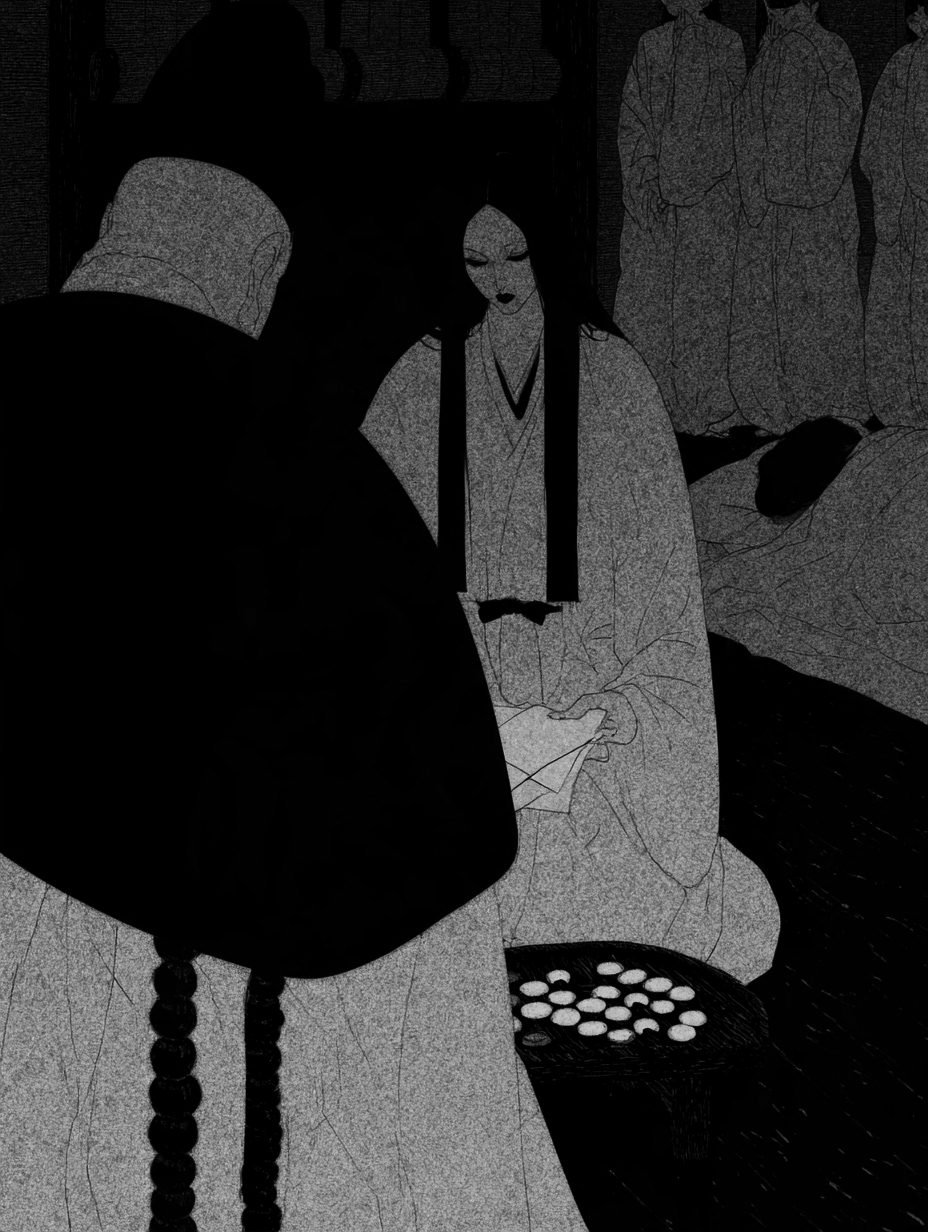
This is the first kind of attachment. The thing that attaches is not always an animal; the dead do it, a hungry ghost does it, a flying thing of the mountains does it. What they share is that they arrive, say what they came to say, and in most of these tales can be dealt with. The answers were as various as the afflictions: a spirit moved into a hired body, physicians who treated the thing as an object under the skin, a monk who set a man to grinding ink for seven days, and one man who brought no rite at all and only argued. Kitsunetsuki, fox possession, is the standard Japanese term for the fox’s kind of visit, and the fox in the Uji shūi is almost reasonable.
The thing that was already there
The second kind does not arrive, because it was said never to have left. In different districts it had different names: the dog-god, inugami; the tōbyō; Osaki; the pipe-fox, kuda-gitsune, small enough to be carried in a length of bamboo; the person-fox, hito-gitsune. It was said to belong to a household and to pass down with it. Once a house was said to have one, the keeper was not thought to need to do anything. Wanting was enough.
That is the sentence I keep returning to. A familiar that acts on its keeper’s wish, without instruction, is a familiar whose keeper can never be shown to be innocent. The book puts the consequence plainly: in the district’s eyes such a house was not accused but known, in the way the boundary of a field is known. What followed was practical. Whom a family might marry. Whose land lay next to whose.
How a house came to be known
Yanagita Kunio asked the question directly in an essay of 1920, in a small series of books of country tradition: how does a household come to be counted a fox-owning house? His answer was that no evidence was required. A sick person’s raving names a house; nobody in the district is willing to be the one who questions it; and a family never spoken of before is added to the list of the excluded and stays there. The essay records that the same could happen by marrying into a named house, or by buying its land, and that people in the marked families often did not learn what they were until they overheard it [2].
The milder end of this is a fish. A reader wrote to the philosopher Inoue Enryō — whose Shinkai of 1919 is laid out as letters and his answers — to report that a fish carried home had spoiled on one side, and that the town blamed a household said to keep the dog-god; in the milder cases the familiar was held to cause not sickness but spoilage. The correspondent was careful about provenance: he had it from a man directly, not from a newspaper. Enryō’s answer was that a fish set down where no air moves spoils faster than one kept where it does, and that a man who expects his supper to be ruined will taste ruin in it. Another correspondent put to him the belief that people sent Osaki to steal silkworms: a sealed room, a watchman through the night, a shortfall at dawn. Enryō replied that he had been asked to look into the outbreak at the time, and that a watchman may carry the worms out himself for the pleasure of being at the center of a wonder, or do it asleep and not know it [3]. Neither answer needed a familiar.
A harder case is the healer. The Setsusō yawa shō, the Snow Window Night Talks, an older miscellany, tells of a household said to keep a tōbyō. During a cattle plague the keeper was asked for a charm; the cures were immediate; he made a great deal of rice and silver; and then it was “discovered” that the sickness had been sent from his house, and he was driven out. The account does not say how the discovery came about. It remarks that in this the tōbyō is no different from the dog-god [4]. The man who cured the cattle was the man who was blamed for the plague, and the record supplies no step between the two.
What was done
Belief of this kind did not stay belief. Teraishi Masamichi, a folklorist writing about his own province in 1928, preserved an account of a sealing in his chapter on the dog-god. The record itself he took from an earlier manuscript; what Teraishi adds is that one of the two witnesses to it had given a firsthand account and that there was no falsehood in it, and he places the events about a hundred years before his book. What the account preserves is not the possession of one person but a treatment of a whole family. A diagnosis was delivered through a medium with a catalpa bow, and then the living members of the house were sealed one after another, in front of invited witnesses, the familiars they were said to hold drawn out of each and shut into a small pot. The source notes that afterward the neighborhood still would not marry them [5]. The rite was performed. The name stayed.
One sentence in the same essay of Yanagita’s records a domain moving against the houses said to own foxes all at once, and burning them. It is placed in the early modern period without a year, and it is given as something told rather than documented; no names and no numbers are recorded. Yanagita, writing from a long way off, added that among those houses there must certainly have been many people who knew nothing of any such thing, and that it was a pitiable business [2]. The truer word is persecution: no one in those houses kept anything, because there was nothing to keep. The book states its position at the front, before any tale begins: where its pages record a village that marked a household, or a domain that burned one, they are recording a persecution. Nothing in it is evidence that anyone was possessed, and nothing in it says that any family, then or now, was dangerous.
Four shelves
The sources behind the thirty tales sit on four shelves separated by as much as a thousand years: the classical tale collections, the Edo miscellanies and books of strange tales, the folklore collections of 1913 to 1928, and the modern books by men who recorded the belief in order to argue against it. There is an irony in that last shelf, and one sentence is enough for it: several of this book’s records of the inherited familiars survive because people who wanted the belief gone wrote it down. Enryō explained the fish in order to be done with it; the folklorists on the shelf beside him wrote down what country people said so that the record would survive.
Keeping the shelves apart matters, because a record says different things depending on who is speaking. The Uji shūi sets down a rite, a conversation, and a suspicion; Teraishi, working from a manuscript, adds a witness. One reading, and it is the book’s own, is that the possessing things, taken one at a time, are nearly reasonable: they state a want, they can be fed or shamed or moved, and in most of these tales they go. What does not go is what a district said about a house.
The fox asked for rice cake and got a hearing. The families on the list were never given a hearing.
Sources
- Uji Shūi Monogatari 宇治拾遺物語, compiled early 13th c., book 4, the tale of how a fox possessed a person and ate rice cake. Wikimedia Commons
- Yanagita Kunio 柳田國男, 「誑す狐と憑く狐」 (the essay on the fox that deceives and the fox that possesses), section 9, 「人狐」 (the person-fox), in Otora-gitsune no hanashi おとら狐の話 (1920).
- Inoue Enryō 井上円了, Shinkai 真怪 (1919): the section on the workings attributed to keepers of the dog-god, and the section following it on Osaki.
- Ueno Tadachika 上野忠親, Setsusō yawa shō 雪窓夜話抄, vol. 2, the chapter on the tōbyō foxes.
- Teraishi Masamichi 寺石正路, Tosa kyōdo minzoku tan 土佐郷土民俗譚 (1928), item 37, the chapter on the dog-god, section on the method of subduing.
Found an error? Write to kwaidanote@gmail.com — corrections are made on this page and dated.