Japan's Toilet God Was a Murdered Woman
The Smallest Room
The privy — setchin — is the one part of a Japanese house that had its own resident supernatural population, and the oldest sustained discussion of it is not a ghost story. It is a Q-and-A.
A dialogue book of the 1680s works through the strange things people talk about, with a pupil raising each one and a teacher answering. When the privy comes up, the pupil states the belief carefully, and the belief has a consequence attached.
There is said to be a monster in the privy, he says, and it is also said to be an arakami — a fierce god. And whoever meets it, if he falls down on his way back, takes an illness like the epidemic fever, and is dead within a few days. What god is this? I do not feel sure.
That is not a fright. It is a named outcome with a timetable, of the kind that gets into a household’s rules for children.
Untie Your Sash
The teacher’s answer is a countermeasure, and it is a strange one.
When you meet that god, he says, you should untie your sash there and then, and go home. It is a charm that has been handed down.
And then, in the same breath, he adds that it is not certain.
I like that clause more than anything else in the passage. The book is not selling the remedy. It gives the rule, attributes it to transmission, and marks it unverified — which is more than most modern retellings of this material manage.
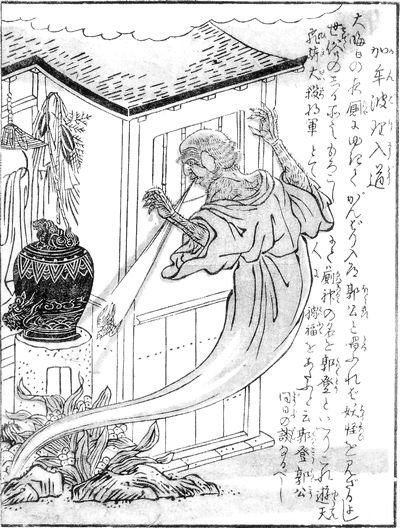
Toriyama Sekien, 1779, gave the privy an occupant of its own. Public domain, via Wikimedia Commons.
The Chinese Occupant
Then the teacher reaches for a comparison, and this is where the section earns its place.
In China, he says, the god of the privy is called Shikoshin — Zigu. And the story he gives with the name is this. A man of Shouyang named Li Jing took a woman of Laiyang, He Liqing, as his mistress. The principal wife was bitterly jealous, and on the fifteenth day of the first month she killed her in the privy. The dead woman made a curse. And after that, every first month, they worshipped her as the god of the privy.
The deity of the smallest room in the house is a murdered mistress, and the date of her festival is the date of her murder.
The teacher does not dwell on it. He says at once that these things cannot be taken for true, and moves on. But he has printed it, and it is the only account in the section that has a place, a month, a day, two names and a motive.
And a Third
One more line, with no explanation at all: in Buddhism, Ususama Myōō is said to be the god of the privy.
Ususama is a wrathful king of the esoteric tradition, associated with fire and with the burning away of impurity. That is the whole entry — no story, no rule, no consequence, just an identification dropped in and left.
It is worth noticing what kind of claim that is. The first two occupants were reported: people say, it is handed down. This one is asserted, from a body of doctrine, in the flat voice of somebody citing a fact. The same paragraph is running two different kinds of authority side by side without marking the join.
So a single small room held three occupants at once — a fierce local god nobody could name, a Chinese woman with a date of death, and an imported Buddhist deity of purifying flame. None of the three cancels the others. They are simply all in there.
The Grime-Licker
The pupil then asks about the akaneburi, the grime-licker, said to live in old bathhouses. He says it could well be so in a derelict house or an abandoned mansion, but that he cannot make sense of the name.
Notice what is being questioned. Not whether the thing exists. Whether the word is well formed.
And the teacher’s answer is a small masterpiece of the period’s natural philosophy. The name is entirely proper, he says. Everything whatever eats the thing it was generated from: a fish is generated from water and feeds on water; a louse is generated from filth and feeds on filth. So the grime-licker, generated by transformation out of accumulated grime-vapour, licks grime to sustain its life. It must necessarily be so.
That is the method of the whole book laid bare in one paragraph. The creature is never tested against evidence. Its name is tested against a theory of how things come to be, and passes.
Two Centuries Later
The same material comes up again in a lecture course of the 1890s, and the lecturer’s interest is not in what haunts the privy but in how any place gets haunted at all.
A house becomes a haunted house, he writes, when one traces it back and finds that a person who lived there was murdered, or that deaths came one after another in the family. Then people say the house has a curse on it and a lingering spirit that works harm — and at last the plot of ground itself is reckoned to be the monster.
The privy ghost is the same, he says. If by chance someone was killed in a privy, or died in one, from that it is handed down as the privy monster, or as a ghost. And he adds the obvious physical point: go out there at night and the air is dark and close, and something in a person expects a shape.
As for the grime-licker, insects do breed in filth, and a delusion grows from that.
What He Walks Past
He has described a mechanism: a real death, then a curse, then a spirit, then the location itself becomes the entity. Our note on what the hyakki yagyō was before it was a picture deals with the same move in the capital, where a haunted building got a proper name and went into a court official’s diary as an address.
What he does not say is that the mechanism is already written into the entry he is explaining. He Liqing was killed in a privy and the privy got a deity with a festival date. That is not an example requiring his theory. That is his theory, in a Chinese source, four hundred years before he set it out.
The Room Stays
There is a modern figure in this territory, in a school lavatory, and this note is not about her; she belongs to a different kind of material and a different kind of evidence.
What the older record shows is something the modern figure inherits without knowing it. The room is the constant. The occupant is not.
A fierce god with no name, a woman with a name and a date, a Buddhist king of fire, and finally a nineteenth-century lecturer’s account of darkness and expectation — four tenants of the same three feet of floor, each of whom arrived believing the room was empty.
Sources
- Kokon hyakumonogatari hyōban 古今百物語評判, a dialogue in which a pupil raises each reported wonder and a teacher answers: the privy monster called also a fierce god; the illness and death of one who falls on the way back; the charm of untying the sash, given as transmitted and marked uncertain; the Chinese privy god Zigu 紫姑神 with the killing of He Liqing 何麗卿 of Laiyang by the principal wife of Li Jing 李景 of Shouyang, in the privy on the fifteenth of the first month, and her subsequent worship; the line naming Ususama Myōō 烏瑟沙磨明王 as god of the privy; and the exchange on the grime-licker akaneburi 垢ねぶり with the argument from what a thing is generated out of.
- Yōkaigaku 妖怪学, by Inoue Enryō 井上円了; the section of the miscellaneous division on the privy monster, for the account of how a house or a plot of ground comes to be counted as the monster itself, and for the explanation of the privy ghost and the grime-licker.
- The dialogue book is Kokon hyakumonogatari hyōban 古今百物語評判, compiled from the papers of Yamaoka Genrin 山岡元隣 (1631–1672) and printed in 1686 — the same book our note on the snow woman takes its 1686 discussion from. Its passages are read here in the quotation given in the lecture course, not in an edition of the book itself.
The readings in “What He Walks Past” and “The Room Stays” are KWAIDANOTE’s own.
Found an error? Write to kwaidanote@gmail.com — corrections are made on this page and dated.